Happy New Year!

Alfred Hitchcock’s Mystery Magazine passes a milestone this year as we celebrate our sixtieth anniversary. You’ll see to the right the special cover we commissioned from Joel Spector for our January/February issue.

The magazine debuted in 1956, capitalizing on the fame of director Alfred Hitchcock and his association in the popular mind with the mysterious and macabre. The television show Alfred Hitchcock Presents had reinforced this association when it began in 1955, but we have now out-lived the TV show by decades thanks to the creative fecundity of our authors and to the loyalty of our readers: your appetite for murder and mayhem appears to be endless.

Though now eligible for AARP membership, AHMM still strives to keep up with the times. We maintain a lively Facebook presence, where we have lately been posting classic covers from past issues, and if you haven’t yet checked out our podcast series on iTunes and Podomatic featuring authors reading their stories, I encourage you to do so.

And even after threescore years, we’re still looking to try new things. Our January/February issue also features our first-ever graphic short story, “Not a Creature Was Stirring . . .” by Dale Berry.

Over the course of the year, we’ll be looking for other ways to celebrate our sixtieth anniversary. But most importantly we will continue to do what has gotten us this far: Bring you, month in and month out, the best mystery and crime short stories from both new and established authors.

Thank you for sixty years of support, and here’s to a delightfully criminous 2016!

Leave a comment

Filed under Administrivia

The Joys of the Dark Side by Elaine Viets

Every sub-genre has its peculiar satisfactions—a reality recently borne in on Elaine Viets, who launched a new and darker series in our November issue. Here she reflects on some of the opportunities it offered.

Alfred Hitchcock’s Mystery Magazine heralded my return to the dark side in November with a hardboiled short story. “Gotta Go” introduced Angela Richman, a death investigator in mythical Chouteau Country, Missouri, stronghold of the over-privileged and the people who serve them.

Death investigators work for the medical examiner’s office. At a suspicious death, DIs are in charge of the body. The police handle the rest of the crime scene.

AHMM brought good luck. As “Gotta Go” was published, I signed a two-book deal with Thomas & Mercer for the Angela Richman mysteries. Brain Storm, the first mystery in the new death investigator series, will debut at Thriller Fest this July.

After a decade and a half of writing traditional Dead-End Job mysteries and cozy Josie Marcus, Mystery Shopper novels, I was back writing bloody, forensic-heavy mysteries. The death investigator mysteries aren’t too gory—not like Patricia Cornwell “I boiled my dead boyfriend’s head.” This death investigator series is more like the TV show Forensic Files, without the commercials.

I was back home again.

My first series, the Francesca Vierling newspaper mysteries, were hardboiled. When Random House bought Dell and wiped out that division, I switched to the traditional Dead-End Job mysteries, featuring Helen Hawthorne. The Art of Murder, the fifteenth novel in the series, will be published in May 2016. I also wrote ten cozy Josie Marcus, Mystery Shopper mysteries.

I love both series, but wanted to write dark mysteries again. But I didn’t want to do another police procedural, or a private eye with a dead wife or a drinking problem. Other writers had done those and done them well.

But death investigators were a profession many readers didn’t know about. Janet Rudolph, founder of Mystery Readers International agreed. She believes Angela Richman is the only death investigator series.

Last January, I passed the MedicoLegal Death Investigators Training Course for forensic professionals at St. Louis University. I wanted the training—and the contacts—to make the new series accurate.

I’ll still keep the Dead-End Job mysteries. In fact, I’ll need them. Their light-hearted look at Florida will keep everything from becoming too grim. The sun-splashed craziness of South Florida should counteract the intensity of the death investigator series.

Now I that I’m writing dark again, my writing has changed.

My characters can cuss. Angela Richman’s best friend and colleague is Katie, Chouteau County assistant medical examiner Dr. Katherine Kelly Stern. Pathologists tend to be eccentric, and Katie is based on a real pathologist who’d perfected the art of swearing. Her profanity was a mood indicator. I could tell how angry she was by whether she used “fricking,” “freaking,” or the ultimate F-bomb and how often she employed these and other cuss words. Oddly enough, when she swore, the words didn’t sound offensive. Katie cusses with style and grace in Brain Storm.

Body counts. In cozy and traditional mysteries, the murders take place off-stage. Readers aren’t forced to take a blood bath when they read the death investigator mysteries, but they will see crime scenes and forensic procedures. They’ll get a firsthand look at the sights, sounds, even the smells of death.

Real weapons. In cozy mysteries, when Josie Marcus battles killers, she resorts to “domestic violence,” using kitchen tools, gardening equipment, and whatever she can grab for weapons.

Helen Hawthorne in the Dead-End Job mysteries is a little bolder. She’s armed with pepper spray to take down killers, though in Checked Out she did get sprayed with her own weapon.

In Brain Storm, when Angela confronted the killer, she was in an office, surrounded by the standard supplies: waste baskets, chairs, coffee mugs, letter openers. I was prepared to have Angela grab one, when it dawned on me: Wait! This isn’t a cozy.

I can use firepower.

So Angela shot the killer in the head. It felt so good.

3 Comments

Filed under How'd That Happen

“The Finlay Millions” and the Carr Detective Series by S. L. Franklin

S. L. Franklin, author of the Carr detective series, first appeared in AHMM in the July/August 1999 issue with “Capriccio with Unaccompanied Violin.” Since then he and R. J. Carr have appeared in our pages thirteen more times, most recently in the current issue with “The Finlay Millions,” which he talks about here.

The basic situation for “The Finlay Millions” came to me several years ago—the old house, the death of the reclusive owner, some heirs in the wings including an estranged wife—but converting the situation into an R. J. and Ginny Carr mystery wasn’t as simple as turning open a tap and letting a story run out.

I once heard the jazz musician Patricia Barber explain in an interview that to recast a classic standard song by, say, Rogers and Hart, into an effective jazz performance, she first had to find a way to “break into” the piece. That was my original difficulty in writing “TFM”—discovering a means of cracking this particularly hard nut of an undeveloped set of characters and situations. Those familiar with Carr mysteries will realize that my difficulty was compounded by the fact that the series stories are always told via multiple voices, those of R. J. and Ginny, but often those of other characters as well, so it’s a rare Carr mystery that follows a straight narrative line.

Another problem was—as it always is for me—bringing new characters to life. R. J. and Ginny seem, I hope, well-defined in every story, both in what they do and in how they think and express themselves. Other characters, especially those who narrate, need to be just as well-defined, and when the sometimes kindly but often dilatory muse of detective fiction finally fired my feeble brain cells with images of Bill Finlay—bulky, limping, seventy-three years old, a retired engineer from Syracuse—I had at last both a means to break into the plot outline and a narrative voice and perspective that actually drew me, the author, into the story even as I put Bill’s words down on paper. (Yep—Carr stories: still made by hand.)

Some mystery plots are schematic, others formulaic; some psychological, others ratiocinative. Mine tend instead to be intuitive and organic.

To illustrate what I mean with a rather trite and overblown metaphor: From the kernel of an original, dormant idea grows a story—living, if it succeeds—that is shaped and nurtured by its characters as they come to life and respond to the fictional situations they face. In the case of “The Finlay Millions,” the tale’s outcome is in many ways the product of R.J. and Ginny, the Finlays and Penny Wright, at least as much as it is a result of the tentative original design of the author.

Put in another way, “TFM” is not plot driven but character driven, as—within reason—is every Carr story. The basic premise of the Carr Detective Series, in fact, has always been a what if: What if real people with real human weaknesses and strengths, thoughts and feelings, were suddenly to find themselves in the artificially melodramatic strictures of a mystery plot? How would they behave? How would the action advance?

Ambrose Bierce defined literary realism as the “art of depicting nature as it is seen by toads.” He, of course, was a fantasist with a grudge, who had only the works of contemporaries like Theodore Dreiser to gauge by. The Dreiser version of realism, however, largely consisting of a mix of human failing, squalid situations, and cynical fatalism (which mix, incidentally, underpins many a noir mystery story) is not the only realism the mind can conjure. There exists a far different realism of everyday concerns and problems—e.g., Bill Finlay’s physical frailties and objections to his younger brother’s attitude; Penny Wright’s struggles to relocate her aged and ailing father—and this realism is what I have attempted to establish as the hidden though underlying scenario of all the Carr stories.

A final note. Anyone who has made it through to the end of this ramble and still wants to know more about the Carr Detective Series, especially about R.J. and Ginny, can satisfy his or her arcane tastes at www.carrdetective.com. No charge and worth every cent.

Leave a comment

Filed under How'd That Happen

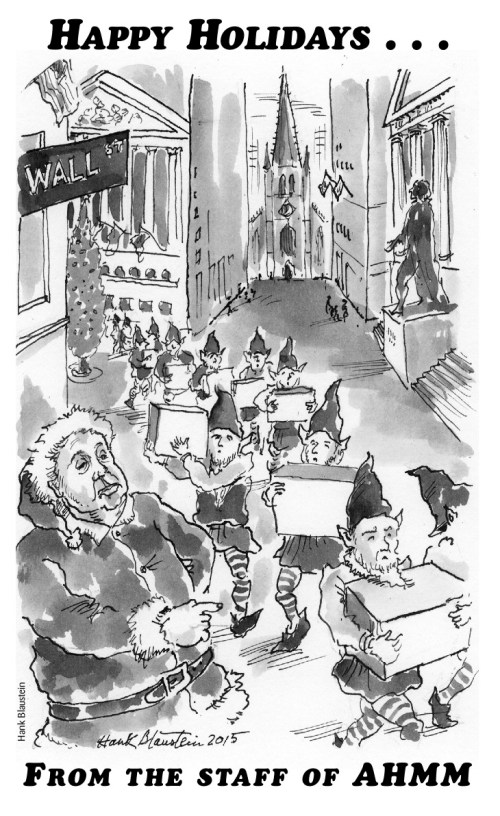
Season’s Greetings

AHM_card

1 Comment

December 11, 2015 · 11:59 pm

The Ninth Annual Black Orchid Novella Award Given

Congratulations to Mark Thielman, whose novella “A Meter of Murder” won the 9th Annual Black Orchid Novella Award! The author was celebrated at the December 5th Black Orchid Banquet as part of The Wolfe Pack’s weekend of festivities. Mr. Thielman, who currently hails from Texas, is a former prosecutor. You can look forward to reading the novella—his first published piece of fiction!—in the July/August 2016 issue of AHMM.

1 Comment

Filed under Awards

Past, Present, Future Crime: December 2015 issue

Reviewing our annual index (on pages 108–109 of the current issue) puts 2015 in perspective. We published 79 short stories that represented all subgenres of mystery fiction and ranged in tone from humorous to ironic to tragic. Our authors came from the four corners of the earth with stories just as far-ranging in their settings. Which is not surprising: Crime is part of the human condition, and crime fiction captures the universal struggle of human beings under extraordinary conditions.

Many of the stories in our December issue also take a retrospective turn. Long submerged memories surface for a retiree in Theresa E. Lehr’s cover story “Lake People.” Turn-of-the-century bounty hunter Placido Geist discovers the last surviving participant in a botched bank robbery ten years on in “The Sleep of Death” by David Edgerley Gates. Suspicious coincidences put a teen in the CIA’s scope for fifty years in “Larry’s Story” by David Braly. And Marianne Wilski Strong sets her tale “Warsaw” in the heady days before the fall of the Soviet Union. More contemporary issues surface in Catherine Dilts’s “Industrial Gray” and Neil Schofield’s “The Purslow Particle,” both of which touch upon work-a-day maladies.

In this issue we offer up great stories now, just as we’ve been doing since AHMM first came on the scene in 1956—and there’s plenty more great fiction to come in the future!

1 Comment

Filed under Uncategorized

Ken Wishnia: Putting on The Editor’s Hat

Or, damn, you people are making me work!

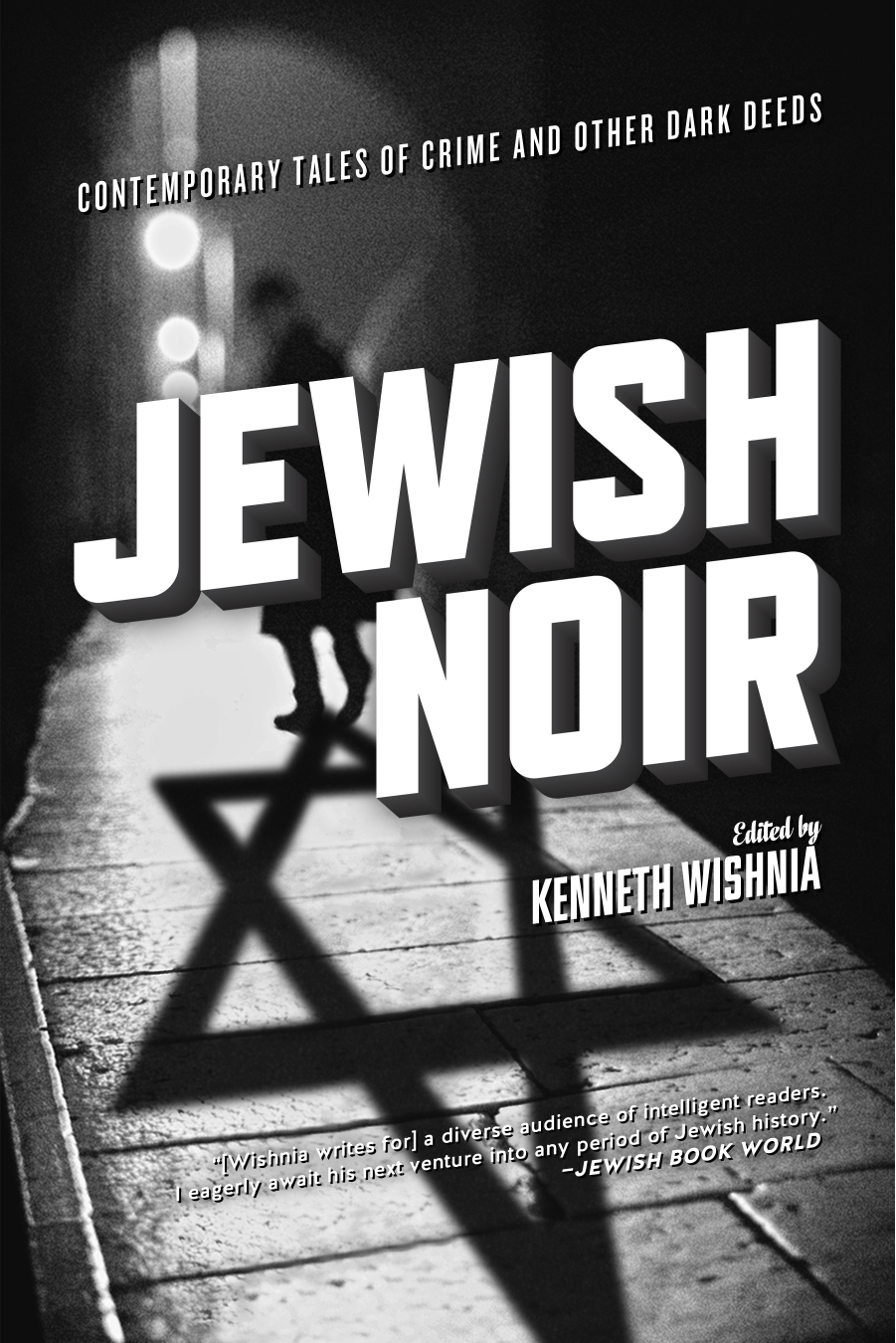
I’m supposed to be a writer, not an editor. I’ve published six novels and a bunch of short stories in various anthologies, but Jewish Noir (PM Press) is the first time I’ve ever proposed, assembled and edited an anthology by myself. I had been warned, by none other than Reed Farrel Coleman, that editing an anthology is a lot of work, but I had no idea that it would be quite so much work. Also, the publisher’s contract should have come with a label saying, Warning: You Will Lose Friends—if you do the job right.

Jewish noir jpegBut first, the fun stuff. It was a real treat to be able to work closely with such luminaries as Marge Piercy, Harlan Ellison, S.J. Rozan, David Liss, Wendy Hornsby, Jason Starr and Eddie Muller, among others. I had to do a lot of back-and-forth emailing with the contributors, including some face-to-face discussions and sitdowns with authors to go through their manuscripts page by page.

And thanks to our generous “You don’t have to be Jewish to write Jewish Noir” policy, I also got to collaborate with writers like Canadian author Melissa Yi, who was a joy to work with. She sent me two stories for consideration, and I ended up replying with a carefully worded email explaining that I liked the first half of the first story and the second half of the second story, and asked if she would be willing to combine the two stories along these lines to create a totally new story. That’s asking a lot, but not only was she willing to do it, after revising the two stories into one, she ended up adding a new section that gave her story “Blood Diamonds” a crack-of-the-whip sting of an ending that will linger in your mind for long after you’ve read it.

All this from a definite non-Jew, you should know.

But I have to say that some of the non-Jewish authors’ attempts at capturing Jewish culture made me laugh out loud. One author had a family dinner featuring matzoh ball soup, latkes and potato kugel. This may not seem like much to some readers, but I don’t know any Jewish cooks who would ever make all three of these dishes at the same time, especially the last two, which are both labor intensive high-calorie potato-based dishes that are variously fried in oil and served with sour cream, or baked and sizzled in rendered chicken fat (using traditional recipes, anyway). I told the author that’s like having a “typical” Irish dinner of corned beef and cabbage and an Irish stew and a shepherd’s pie and a steak and Guinness pie and boiled potatoes and some Irish soda bread. A bit much, I would say.

Then came the brisket. Vey iz mir. At one point, it seemed like every other story had someone getting ready to chow down on some brisket, which my family only has once a year on Passover, for God’s sake. I emailed the authors, asking, “Are you guys just Googling ‘Jewish food’ and picking the first thing that comes up? You never heard of chopped liver? Or some nice flanken for a change? Maybe a piece of herring?”

They pleaded guilty.

But the Jews know from guilt, too. Even some of the Jewish authors messed up the Yiddish words and phrases in their stories. Part of my job was to establish a style to standardize the transliteration of common Yiddish expressions. What fun.

For the uninitiated, Yiddish was the primary language of the majority of Central and Eastern European Jews for many centuries (German Jews typically spoke German). Descended from Middle High German, with a vocabulary that is roughly 30-40% Slavic and Hebrew, depending on whom you ask, it is written using the Hebrew alphabet. So if it looks like Hebrew and sounds like German, it’s Yiddish.

The problem is that very few contemporary American Jews have had significant contact with genuine literary or conversational Yiddish. Many of them merely remember a few phrases and expressions that bubbe (that’s grandma to you) used to say. But since they’re remembering from way back, they often get it wrong. Think of the classic Mike Meyers Saturday Night Live sketch, “Cawfee Tawk,” whose host was always saying, “I’m getting vaklempt,” meaning emotionally choked up.

The correct Yiddish is farklempt.

The tricky part about getting it right is that if your character is a third or fourth generation descendant of Yiddish-speaking immigrants, then it would be acceptable, even “correct,” to have that character make a mistake in his or her Yiddish. For example, in Eddie Muller’s story, “Doc’s Oscar,” the narrator complains about his “khazerai  wheelchair.” This is ungrammatical. Khazerai is a noun, meaning “filth, mess, piggishness,” and is not used in Yiddish as an adjective. But after checking with an expert native speaker (my father Arnold Wishnia), who confirmed that Eddie’s character, a boorish Hollywood type of a certain generation, would have said it that way, we decided to leave it in with an explanatory footnote to that effect in the introduction.

We’ve already received an email commenting that “khazerai wheelchair” is wrong and ungrammatical and that we’d better fix it or else. I directed the commenter to the explanatory note. Hope that works.

But the hardest part of being an editor is when you have to reject a story, or deal with authors who—ahem—won’t change a word of their not-quite-flawless stories. This was a situation in which it might have been better to be a paid editor working for the house. Then you can hide behind the generic “this isn’t right for us” response, or the fact that your job is on the line if you accept sub-standard work.

Then there were the people who wanted to be part of the anthology but found out about it too late to be considered. (The slots filled up in about a minute and the anthology ballooned to nearly twice its proposed size, to 32 contributors, and has gone way over budget.) I have already apologized to several authors who were not invited and have promised them an invitation to submit to Jewish Noir 2, should that ever come to pass. (Note: My agent will kill me if I distract myself from my current novel-in-progress with something as insane as doing Jewish Noir 2 at this point.)

Doug Levin! Why didn’t I think of inviting him? Oops.

And Alfred Hitchcock and Ellery Queen favorite, Doug Allyn, who turns out to be Jewish. Who knew?

Even Eddie “The Czar of Noir” Muller said that he recently learned of some Jewish ancestry in his lineage, which raises some serious issues regarding the suppression of Jewish ethnicity during less enlightened times. I mean, how many Americans “discover” that they have Christian ancestors? But that’s a whole other subject for a separate blog.

Now go check out Jewish Noir. Or I’ll sic the global Jewish conspiracy to control world finances and media on you.
5 Comments

Filed under How'd That Happen

Reasons to Cheer: November 2015 issue

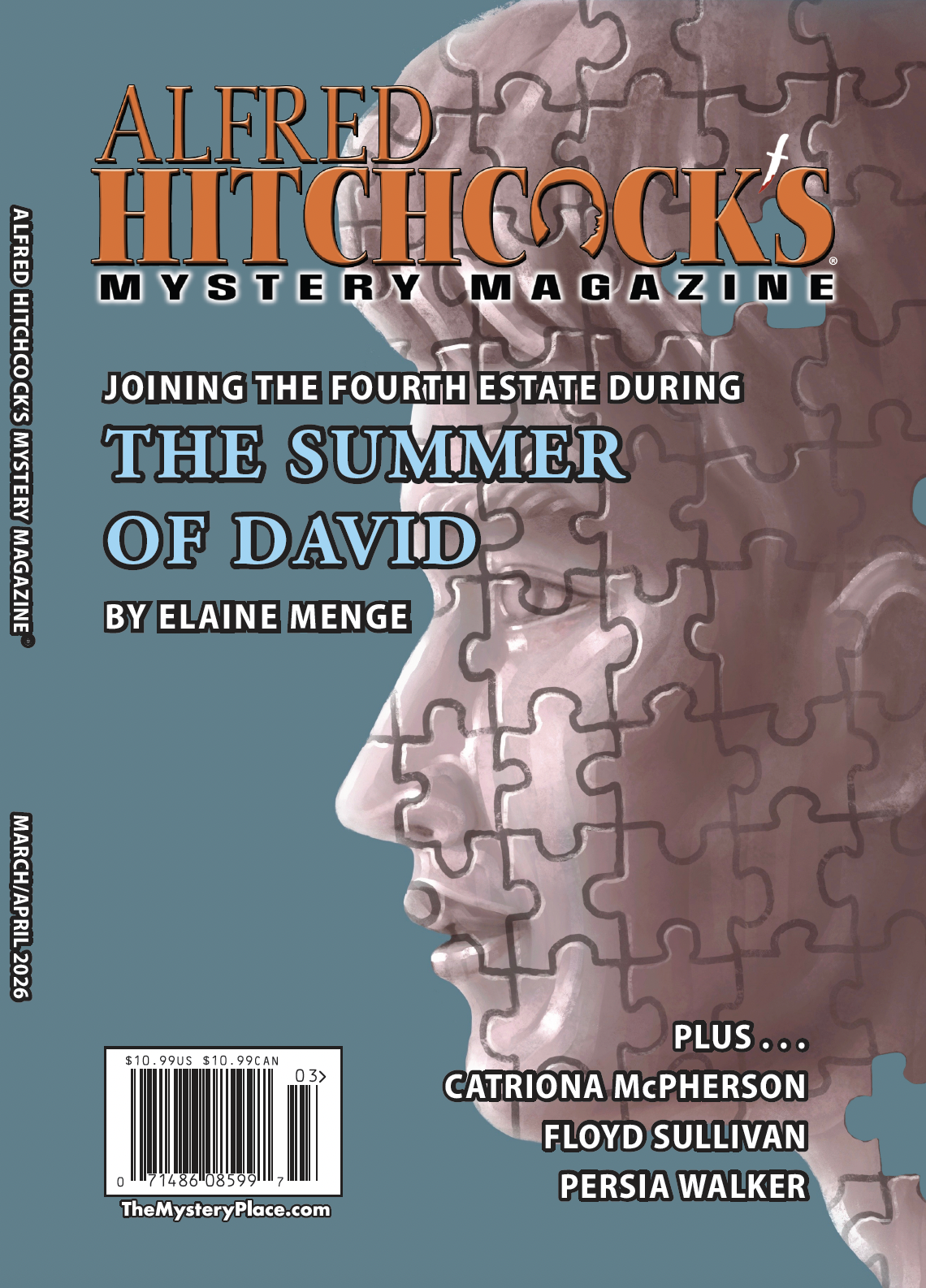
November is our Bouchercon issue. As we prepare to travel to Raleigh, North Carolina, for the conference, the AHMM staff is in a celebratory mood. For one thing, this issue introduces a brand new series from Elaine Viets: death investigator Angela Richman makes her debut in “Gotta Go.” We also celebrate the return to these pages of some reader favorites: John F. Dobbyn with “The Golden Skull”; William Burton McCormick with “Hagiophobia”; Russel D. McLean with “The Water’s Edge”; Chris Muessig with “A Boy’s Will”; Janice Law with “The Dressmaker”; and Joseph D’Agnese with “The Truth of What You’ve Become.” And in the spirit of Bouchercon, we celebrate the genre with an essay by Ken Wishnia on the shifting boundaries of Noir.

Contributing to the celebratory mood, we note the publication of books with AHMM roots. We are proud to publish Loren D. Estleman’s Four Horseman stories set in WWII–era Detroit; he has now collected them in Detroit Is Our Beat (Tyrus Books). John C. Boland has a new collection of stories featuring his “unromantic” spy Charles Marley in The Spy Who Knew Nothing (Perfect Crime Books), all but one of which first appeared here. And B. K. Stevens’s American Sign Language interpreter Jane Ciardi, who first appeared in these pages, is now featured in a new novel, Interpretation of Murder (Black Opal Books).

2 Comments

Filed under Uncategorized

All in the Family

Disfunctional family dynamics provide rich ground for crime stories, as three of September’s stories demonstrate. A well-off London woman hears unsettling news about her fourth husband in Neil Schofield’s “Middleman.” Two vacationing sisters skirt dangerous emotional territory in “Ross Macdonald’s Grave” by Terence Faherty. And a would-be burglar provokes unsettling memories in Bob Tippee’s “A Pushover Kind of Place.”

We’re delighted to make two introductions this month. Kathy Lynn Emerson’s new series character Mother Malyn makes her AHMM debut in “The Cunning Woman.” And we welcome Christopher Latragna, whose AHMM debut “Well-Heeled Shooters” is set on a St. Louis riverboat casino.

Also this month, R. T. Lawton continues his series featuring a Chinese youth thrust into his father’s drug trade and surviving by his wits in the jungle in “On the Edge.” C. B. Forrest returns with “The Runaway Girl from Portland, Oregon,” set in a San Francisco alley during the “Summer of Love.” And Lieutenant Cyrus Auburn and Sergeant Dollinger look into the murder of a traveling salesman in “Solo for Shoehorn” by John H. Dirckx.

Finally, we are saddened to note the passing of Maynard Allington, who died before we could publish his espionage story this month, “The Rostov Error.”

Leave a comment

Filed under Uncategorized

By Hook or by Crook . . .

On her blog The First Two Pages, B. K. Stevens is engaging other writers on the perennial challenge of “capturing the reader’s attention.” It’s a topic of particular concern for the short story writer, who in the briefest of spans must convince the reader that what follows is new and fresh. AHMM readers will see some familiar contributors there, including Robert Mangeot, who analyzes the opening of his story “Two Bad Hamiltons and a Hirsuit Jackson” which was published in our May 2015 issue.

1 Comment

Filed under Uncategorized