
P.I.’s and fixers, burglars and soldiers all join together in our HOLIDAY DOUBLE ISSUE to send you the best wishes of the season! We visit winter locales past and present, chilly and tropical. Michael Nethercott takes readers back to the Fifties with a new tale featuring his Connecticut sleuths Lee Plunket and Mr. O’Nelligan, while S. J. Rozan sets her new series in Manhattan’s Chinatown with matriarch Yong-Yun. Brendan DuBois revisits a facet of rural New England life—kvetching at the town dump. Jay Carey’s Police Chief Eureka Kilburn deals with crime in a time of post global warming Sarasota, and Terence Faherty has an amusing take on Philo Vance that is set in Hawaii. In addition with we have a Mystery Classic treat: a suspenseful puzzler by Hugh Pentecost featuring hotel manager Pierre Chambrun—and you won’t want to miss Marvin Lachman’s insightful introduction for modern-day readers. Happy holidays from AHMM!
Tag Archives: mystery
Bruce Arthurs on “Beks and the Second Note”
Bruce Arthurs is a writer in the mystery, science-fiction, and fantasy genres across several different mediums, including television and, occasionally, poetry. Here he talks about his story “Beks and the Second Note” from the December issue—his first to appear in a mystery-specific publication.
In “Beks and the Second Note” the takeaway quote is this:
“I thought about why I was a detective, about wanting to understand the why of people’s stories, not just the what.”
I’m not a detective, but that question—Why do people do the things they do?—has been a puzzle my entire life. It’s a common question, one almost everyone asks at some point, or at lots of points, in their lives. Why do good people make bad choices? Why do bad people sometimes make good choices?
In the universe inside my head, I’m writing this wonderful script where everyone in the world behaves rationally and understandably; everyone makes sense. In the real world outside my head, everyone keeps ad-libbing. It’s terribly frustrating.
Writing fiction is one way I deal with that frustration. In a story, the writer is in control of characters and events and motivations. It can help to make sense of, and deal with, real life.
“Beks and the Second Note” arose from a stew of news items from recent years: police shootings of black men; economic hardship and homelessness; the increasing presence of surveillance technology; the legalization of concealed carry in many states and the myth of the Good Guy With A Gun. All this simmered in the back of my mind for months until that “Ah-ha!” moment when the potential for a story fell into place.
And the oddly-named Bok Beks seemed the right character to tell that story. It’s not his first appearance; Bok first appeared over a decade ago in a very-small-press chapbook-sized anthology of stories about radioactive monkeys. (Yes, really. Small press can get very weird.) He has a pretty extensive backstory in my head, and I’m hoping future work will occasionally return to reveal more of Bok’s own story and the choices he’s made. But that probably involves a lot more simmering on my brain’s back burner.
My scattershot bibliography has mostly been in the science fiction and fantasy genres, a reflection of my primary reading over the years. The first book I remember reading, at age six, was Todd Ruthven’s Space Cat. But mystery and detective fiction has always been a close second (the Encyclopedia Brown stories are another memory of early reading), and almost every story I’ve written has fallen into one genre or the other. And occasionally, as with “Clues,” the episode I wrote for Star Trek: The Next Generation, something falls solidly into both genres.
But I’m pleased as Punch to break into Alfred Hitchcock’s with “Beks and the Second Note.” It’s my first sale to a specifically-mystery market, and it’s especially satisfying to make it to one of the most important markets for short mystery fiction.
Filed under How'd That Happen
The Story Behind “Lady Appleton and the Creature of the Night” by Kathy Lynn Emerson
Kathy Lynn Emerson/Kaitlyn Dunnett is the author of over fifty books written under several names. She won the Agatha Award for best mystery nonfiction of 2008 and was an Agatha Award finalist in 2015. Currently she writes the contemporary Liss MacCrimmon Mysteries (Kilt at the Highland Games) as Kaitlyn and the historical Mistress Jaffrey Mysteries (Murder in the Merchant’s Hall) as Kathy. Here, she talks about the newest tale in her Lady Appleton series, “Lady Appleton and the Creature of the Night,” in the current issue of AHMM.
I’ve been writing about Lady Appleton and her friends, on and off, for twenty years, ever since she first appeared in Face Down in the Marrow-Bone Pie, published in 1997. In all those novels and short stories, I’ve tried my best to be accurate in my presentation of life in sixteenth-century England. As much as I enjoy reading a good paranormal tale, I’ve been meticulous about sticking to reality when I write historical mysteries.
Until now.
What can I say? The sixteenth century was a superstitious time. Even a rational woman like Lady Appleton would have been unable to explain everything in the world around her. In Face Down Under the Wych Elm, she helped clear a woman of an accusation of witchcraft, knowing full well that some plants are poisonous and require no supernatural assistance to kill. But witches weren’t the only unnatural beings that were real to people of that time. They also believed in pixies, fairies, and ghosts. In Cornwall, it was thought that tommy-knockers lived in mines and gave warning of cave-ins. To prevent the restless dead from walking, suicides (who had committed the crime of self-murder) were supposed to be buried in a public highway between nine and midnight . . . after a stake had been driven into the body. At least in legend, there were creatures who were only half human, or who could change from human to animal.
Back in 2004, I first had the idea to write about a fictional sixteenth-century English family with a dark secret—they were weres. Not werewolves. There were already too many werewolf stories out there. I was thinking of something in the cat family, maybe a lynx or a Scottish wildcat. Unfortunately, I couldn’t come up with a angle that worked. I couldn’t even decide on the decade in which to set the story. One false start (“The King’s Weres”) had members of the Catsby family at the court of Henry VIII early in his reign. Another (“On Little Cat Feet”) let Princess (later Queen) Elizabeth discover their secret and vow to keep it, so long as they would serve her loyally. A separate problem was whether to go all-out paranormal or provide an alternate, rational explanation for everything that happened in my story.
Eventually, “Lady Appleton and the Creature of the Night” began to take shape in my mind. It still took me more than six months to write and when I finished it, I wasn’t sure that anyone would want such an odd little tale. Fortunately, it did find a home. Now I just have to hope that sticklers for historical accuracy will forgive me this little side-trip into the supernatural world, one the Elizabethans believed could exist side by side with their own.
Filed under How'd That Happen
Josh Pachter on “Pisan Zapra”
Writer, editor, and translator Josh Pachter’s Mahboob Chaudri stories can be found collected in The Tree of Life. He is a regular contributor to EQMM’s Passport to Crime department as a translator, and he has been publishing fiction since 1968. Here he writes about how he came to write his story “Pisan Zapra,” which is featured in the November 2016 issue of AHMM.
For Christmas of 2014, my in-laws gave me a fascinating little book called Lost in Translation: An Illustrated Compendium of Untranslatable Words from Around the World by Ella Frances Sanders (10 Speed Press, 2014). As I leafed through it the next morning, I chuckled to find gezellig, which is my favorite untranslatable Dutch word, and came to a dead stop four pages later at pisan zapra, which is listed as a Malay noun meaning “the time needed to eat a banana.”
Now that’s a title for a short story, I thought, and it seemed obvious that the story it was a title for would be set in Malaysia, and would unfold over a period of no more than a couple of minutes—the amount of time needed to eat a banana.
I did some basic research and discovered that there is disagreement as to whether or not the expression is legitimate Malay. Some sources say yes, while others—including numerous native speakers of Malay—say they’ve never heard it.
As I continued poking around the Internet, I stumbled across some fascinating information about a vengeful vampiric spirit known as the pontianak. In Malay folklore, the pontianak are said to be the ghosts of women who died in pregnancy, generally depicted as pale-skinned beauties with long hair, dressed all in white. A pontianak usually announces its presence through the cries of a baby; if the cry is soft, it means that the spirit is close. Although it lives in the trunk of the pokok pisang—the banana tree—its presence is sometimes accompanied by the fragrance of the plumeria flower, followed afterward by a terrible stench. The pontianak identify their prey, I learned, by sniffing out clothes left outdoors to dry. (For this reason, some Malays refuse to leave any article of clothing outside their residences overnight.) A pontianak kills its victims by digging into their stomachs with its sharp fingernails and devouring their organs. If you have your eyes open when a pontianak is near, it will suck them out of your head, and, when the pontianak goes after a man, it may rip out the poor slob’s sex organs with its hands.
So, pisan zapra and the pontianak. Who could ask for anything more? This turned out to be one of those stories that pretty much writes itself—or perhaps it was a vengeful Malay spirit that guided my fingers on the keyboard. . . .
In any case, I wrote the story and submitted it to Linda Landrigan, and I am absolutely delighted that she selected it for inclusion in AHMM in this 60th-anniversary year. Although I’ve been publishing in EQMM pretty regularly since my first appearance in its pages in 1968, this is my first appearance in Hitchcock’s since 1986—half the magazine’s life (and almost half my life) ago. It’s great to be back!
Now I hope you’ll excuse me while I go eat a banana and make sure I get the laundry off the line before nightfall. . . .
Filed under How'd That Happen
Susan Oleksiw on “Variable Winds”
Susan Oleksiw is an author, photographer, and publisher. Here she writes about her story “Variable Winds,” AHMM‘s October cover story. She also writes about sailing in Come About for Murder: A Mellingham Mystery (2016). Her most recent book is When Krishna Calls: An Anita Ray Mystery (Five Star/Gale, Cengage, 2016).
I’m used to strangers asking me where I get my ideas, and most of the time I have no clue where they come from. But not so for “Variable Winds,” in the October issue of AHMM.
A few years ago I came across a book about the Vendee Globe. Since I live on the ocean and grew up sailing with my family, I was curious about an event I’d never heard of. I had full sympathy for the person who came up with the title, Godforsaken Sea, and looked forward to an exciting read. Derek Lundy, the author, recreates the passage of the boats in the Vendee Globe, 1996-97, an international endurance sailing race.
I learned to sail in a Penguin, a class of boat less used in teaching kids today than the Turnabout, a more stable boat for learning to maneuver on the water. I found them both dangerously prone to threatening to keel over, but perhaps that was more my skill as a skipper than a design flaw. I met the original designer of the Turnabout, Mr. Turner, when he owned a summer resort hotel in our area, and he was determined to improve on everything that floated. I went on to sail in other small boats, and then mostly as crew in the family 210, a twenty-nine-foot boat meant mostly for racing. This class has also fallen out of favor on the East Coast, but I have fond memories of sailing along and seeing a whale surface to starboard or dropping anchor in a cove to enjoy a swim or eat lunch. But I also remember a tug pulling a garbage scow that seemed to think we were merely a bit of flotsam to be run over. I remember the challenges of sailing before instant weather reports, but all my experiences paled in comparison to those faced by the skippers in the Vendee Globe.
In this race, sailors set out from northwest France, sail to the South Atlantic Ocean, and circle the Antarctic in single-person sailboats. Yes, they are sailing solo. Sixteen vessels set out in the given year (not all returned), to sail through the worst oceans and weather on the planet. They are tracked, thanks to modern technology, but are truly on their own. The stories of seamanship and survival and personal courage are more than stunning; they are jaw-droppingly unbelievable at times.
As I read I recalled, now with some embarrassment, the times we went sailing and were caught in squalls and prayed lightning didn’t find us, got separated from other boats on a daylong sail, watched a wind burst tear a sail or split a mast. My moments of fleeting terror were less than nothing compared to the stories in Lindy’s book. But as I finished his tale I could see a young woman, an accomplished and confident sailor, setting out for a day on the water, only to discover two sorts of danger, one that nature throws at us, and another that comes from the treachery of human beings. Everything that happens to the Lady Mistral in my story happened to us in our 210, but, thankfully, not all at once.
Filed under How'd That Happen
Welcome to Glasgow by Russel D. McLean
Novelist, short-story writer, editor, reviewer, and author of the J McNee series Russel D. McLean’s upcoming novel is And When I Die, to be released this year from Contraband Books. Here he discusses setting and his story “Tout” from the September issue of AHMM.
My first story for AHMM, back in 2004 (I was twenty-four at the time!) was set in Dundee and featured a detective by the name of Sam Bryson. I liked Sam then, and I still like him now. He was a hardboiled kinda guy, with a few problems, a supportive partner and a best friend who had more than a few of his own demons. His stomping ground was the city of Dundee, on the east coast of Scotland. I’d been living there since I went to uni, and was getting to know the place well.
One Sam story led to another. And another. A few more. Sam was meant to get his own book, too, but I was persuaded to “reboot” the character by my then agent. I handed Sam’s offices to an even more tragic and dour PI by the name of J McNee (we never did find out what the J stood for), although Sam himself has made a few more appearances in the pages of AHMM since then (notably last year’s “The Water’s Edge”).
But you can’t keep doing the same thing forever.
In 2014 I moved to Glasgow for personal reasons (my girlfriend and our cats were there, so it made sense) and began writing full time soon after. The more I explored the city, the more I realised there was something here that made it very different to Dundee, and a place I wanted to explore through my writing. I began work on a novel—And When I Die—set in the city. But I wanted to flex my literary muscles a little first. A short story seemed the ideal way to try and feel my way around this new city, to get a hint of the ways it operated that were distinct from what I knew so well in Dundee.
I also wanted to create some new characters, too. Another PI would have been lazy. And since I like a challenge, I figured that, for this particular short, I’d have a stab at something I’d always been scared of: a procedural.
The story itself—concerning the death of a man who was selling fake tickets for the Commonwealth Games—seemed an obvious choice. At the time of writing the story, we were in the midst of preparation for this major event (that went off without a hitch in 2014), and it seemed to me like an obvious hook.
Any time you have a major event, someone, somewhere will want to try and take advantage. A ticket tout seemed an obvious place to start. I already had a fictional gangland in mind to explore in And When I Die, and so I connected the tout tangentially to one of a pair of warring gang bosses. The two cops—Stringer and White—never made it into the book, but I have a feeling that this isn’t the last time that we’ll see them in action. I enjoyed writing them too much; these sparring coppers whose mutual respect is unstated and yet obvious.
I’m proud of “Tout” for a lot of reasons, and I’m glad Linda and the team at AHMM like it, too. I hope the readers of the magazine get a kick out of it—the new detectives and location, especially.
But even though I write about crime and the darker side of the Scottish urban experience, the one thing I’ve found with the real life Glasgow is that it’s an incredibly welcoming city. I’ve been here for three years now, I’m very proud to call it my new home. I hope that as my fictional exploration of it continues, I’ll continue to find new surprises, unexpected nuances and hidden secrets around every corner. The deeper I delved into the city after writing Tout, the more fascinating things I discovered to explore in my new novel. But this isn’t the end. No, I have a feeling there’s plenty of intrigue left in this place. And I hope that readers will enjoy discovering it alongside me.
Filed under How'd That Happen
On “Louisa and the Silver Buckle” by Marianne Wilski Strong
Lecturer and writer Marianne Wilski Strong is the author of over forty published short stories. Here she talks about “Louisa and the Silver Buckle,” from the September 2016 issue of AHMM, the first in a new series.
My inspiration for “Louisa and the Silver Buckle” began in a small bookstore in Massachusetts where I found a treasure. I was scanning the bookshelves in the back of the store when my eye caught a title that arrested my attention: The Lost Stories of Louisa May Alcott. Within a minute, I had marched up to the register, paid, and left with my treasure. I delayed my visit to Thoreau’s Walden Pond, took the shortcut back to my hotel and settled in to read.
I had, of course, read Little Women years ago, loved it, and like most young girls read it several times, always imagining myself to be Jo. But I had never read Alcott’s short stories. Now I began reading. Within a few days I finished the last of the stories and began hungering for more. Not able to find another edition, I reread my favorites: “Betrayed by a Buckle;” “Ariel: A Legend of the Lighthouse;” “Lost in a Pyramid.” The inspiration for my stories began to take hold in my brain. I would write stories in which the key character would solve mysteries by referring to Alcott’s gothic tales. But I wasn’t sure yet how to handle what I wanted to write. What setting should I use: Concord, where Alcott had lived for many years? I had visited Concord several times, touring the homes of Alcott and her fellow writers: Emerson and Hawthorne. But I knew Concord only as a tourist, not as a resident. In what time period should I set my stories: in the early or mid nineteenth century when Alcott had lived? That wouldn’t work because I wanted my main character to be an avid reader of Alcott’s stories and to have all of them on hand when she needed them.
So the inspiration floated around in my mind, only half formed, until I spent a week in Cape May, New Jersey at the house of my stepdaughter and her friend. Cape May, I realized would be the perfect setting for my stories. Cape May had all the ingredients I wanted. First, Louisa May Alcott herself had vacationed in this Victorian seaside resort. The city abounded in Victorian homes if I wanted such a home in my stories. Cape May had a lighthouse, a lovely beach, a bird sanctuary. It was steeped in history. My inspiration now became a full-blown idea and I began the first of my Louisa stories.
My narrator Amanda owns a condo in Cape May as well as several editions of Alcott’s stories. As with my stepdaughter’s house, the narrator’s condo lies not far from the beach, very near the pedestrian shopping street. Most important of all, the condos, Amanda’s and my stepdaughter’s, are surrounded by homes under renovation. One day, walking along a Cape May Street, I watched workers renovating: knocking down walls, ripping out sagging windows, tearing up old floorboards. Who knew what the workers might find as they demolished parts of the house. Since Alcott had vacationed in Cape May, she could well have visited friends and could well have stayed with them overnight in one of the houses now being renovated. The story took off from there. Louisa wrote a short story for a friend and gave it to her. The manuscript had remained hidden for over a hundred years. Now, it is, of course, valuable and a number of people who suspect the existence of such a manuscript and want it at any cost: even murder.
Filed under How'd That Happen
Out of History Comes a Story, “The Great Aul” by R. T. Lawton
R. T. Lawton is the author of several different series appearing regularly in AHMM. He is a former federal law-enforcement officer and he blogs for SleuthSayers.org. Here he writes about the background of his tale “The Great Aul” from the July/August 2016 issue.
The tomes of history are rich with strong characters whose actions influenced the future of nations, entire civilizations and even the course of world events. Much of known history is written by the winners, some accounts are retold by survivors of that same happening and some events are documented by independent observers who have no axe to grind concerning the facts or truth of those events. Often the perspective or alleged truth depends upon the teller of that history and many times there are gaps in what gets told. These gaps are fertile grounds for an author of fiction to create his own version of the story.
The Known History:
For centuries, the Tsars of Russia had pushed their country’s border southward into the Turkic lands. Their invasion vanguard usually consisted of freebooting Cossacks who lived in stockade villages along the frontier and raided their Muslim neighbors by horseback or by sea. Eventually, after many rebellions by the freedom loving Cossacks against their own Tsars, the Russian army quartered soldiers in each frontier village, made these Cossacks into subordinate military units and launched their own massive spring campaigns into Chechnya to subjugate the various hill tribes.

Imam Shamyl
One of the opposition leaders was an Imam named Shamyl, who led a group of religious Chechens and Daghestans known as Murids in the northern Caucasus. At one point, the Russians offered to broker a peace treaty with the Murids. In order to guarantee the safety of the Russian negotiators, Shamyl was forced to give up one of his sons as a temporary hostage. The Russians, acting in bad faith, promptly whisked the young boy off to Moscow, Russianized him over the years and made him a cavalry officer in one of their units.
During the summer of 1854, Shamyl put a plan in motion to recover his now grown son. On the morning of July 4th, a detachment of Murid horsemen clattered into the Tsinandali palace courtyard of King George XII, the last king of Georgia and an ally of the Tsar. They seized the two princesses, their children and their governesses. The women were tied to the horsemen’s saddle frames and the small children were stuffed into large saddlebags. In short time, the entire group rode off into the mountains headed for the Great Aul, a mountain fortress in the heart of Daghestan. Imam Shamyl had plans to trade the hostages for his son Jamal al-Din (various spellings depending upon the source). As a matter of history, the trade did take place, but there is a gap in the details.
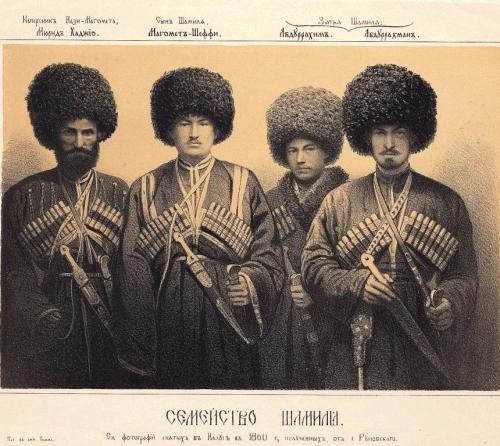
Members of Shamyl’s band.
Filling the Gap:
Constantly researching for more Russian history on their invasion into the Caucasus to use as story background, this event is a great find for me. I already have two story characters, the Armenian and his helper the Little Nogai Boy, trading goods with the Cossacks on the Terek River and with the Chechens south into the Wild Country. Since the Armenian is already trusted by people on both sides of the river (as shown in previous stories), who better to act as intermediary for the exchange of hostages? These two fictional characters can fill the existing gap and write their own story as to their part in what happened.
It’s now time to invoke the writer’s famous What If . . . clause. What if the Armenian and the Little Nogai Boy are crossing a shallow river deep in the Wild Country when the raiders fleeing with their prisoners happen upon them?
The Story is Born:
The young orphan boy, from the Nogai split out of the Great Mongol Horde after the death of Genghis Khan, tells “The Great Aul” story as he sees these hostage events through his own eyes. Using the young boy as the Point of View also allows for a more emotional impact upon the reader at the end. So, let’s get down to the bare bones.
Our two protagonists, all their trade goods, plus their string of pack animals are taken by the Murids and are forced to travel along with the hostages to The Great Aul high up on a mountain top. Here, the Armenian is offered freedom for himself and his helper if the Armenian takes a letter from the Imam to the Tsar, offering the Georgian hostages in exchange for his son Jamal. However, the Nogai boy must stay behind to ensure the Armenian’s return.
It’s a long trip to Moscow and back. Many things could happen to the Armenian along the route, and the boy doesn’t know if his master will even return to get him out of the aul. To pass time, the boy starts selling their trade goods in the local market place and making his own plans for escape just in case things don’t work out according to the plan of others. But, he has to be careful in his actions because he is closely watched by one of the Murids assigned to guard him, a Murid who has lost his entire family to earlier Russian incursions. Plus, it seems not all Murids are happy to have outsiders on the inside of their fortress.
Sorry, but that’s all you get here. To find out what becomes of our young orphan after the Imam’s son is returned, you’ll have to read the story for yourself. If you are female, you might want to have a tissue handy. If you’re a guy, well, you’re on your own.
In any case, be sure to leave a comment after you read the story.
Filed under How'd That Happen
A Legacy of Crime (July/August 2016)
Over the past sixty years, it has regularly been our pleasure to welcome new voices, writers either new to our pages or making their publishing debut. This double issue continues that legacy. Congratulations, then, to two authors appearing in print for the first time: Jason Half with “The Widow Cleans House,” and Mark Thielman with his Black Orchid Novella Award–winning “A Meter of Murder.” And welcome to three authors new to AHMM: Alan Orloff, author of “The Last Loose End;” Andrea Smith, who introduces to our readers her intrepid beauty salon proprietor Vera Ames in “Beauty Shop of Horror;” and James Nolan, who brings us a tale set in Mexico in “Shortcut to Gringo Hill.”
As it happens, the notion of legacy plays an important role in several of this issue’s tales. Our cover story, Eve Fisher’s “Great Expectations,” examines a family’s handling of a small inheritance. Attorney David Crockett, in Evan Lewis’s “Mr. Crockett and the Indians,” carries with him a rather uncomfortable legacy—the crotchety voice of his ancestor Davy. Kevin Egan’s “The Heist,” set in the New York State Supreme Court building in Manhattan, involves the cultural legacy of a Hungarian émigré. And a legacy of Mob violence drives the latest installment of Janice Law’s series featuring Madame Selina and her young helper Nip.
Regular appearances by favorite writers and characters are another aspect of the AHMM legacy, and this issue features other strong installments in familiar series. John H. Dirckx, a recidivist for nearly forty years, teams Lieutenant Cyrus Auburn and Detective Sergeant Fritz Dollinger in “Can’t Undo.” R. T. Lawton, whose four different series display an impressive range of tone, setting, and eras, this time brings us “The Great Aul,” a new tale of the Armenian and his young Nogai helper. And Terence Faherty, who first appeared in our pages in 2007, offers “Margo and the Milk Trap,” his latest entry in a WWII–era series featuring radio producer Margo Banning.
Great crime fiction is a legacy our readers need not feud over.
Filed under Uncategorized
 Trace Evidence