One of the initial decisions that every author must make is whether to write in the first-person (I) or the third-person (he/she/they). To the reader this may seem like a technical matter with limited effect on the end product, but in the mystery story, the stakes are amplified; there is a crime to be solved, and having—or not having—access to the inner workings of the mind is of paramount importance to how the solution to the mystery is revealed.
The first-person narrator seems less popular in contemporary crime fiction as writers appear to prefer the freedom to move through time and space, from scene to scene, from character to character, and from mind to mind. But it wasn’t always this way: the Sherlock Holmes stories, the early Agatha Christie, and the Nero Wolfe novels all employ a first-person narrator. And in each case, it’s the plodding sidekick—Doctor Watson, Captain Hastings, and Archie Goodwin—who tells the story from the perspective of “I”. There is good reason for this: the reader needs to be kept a distance from the machinations of the mastermind detective’s inner thoughts. Imagine if the reader is permitted to know all that Holmes, Poirot, or Wolfe are thinking. The mystery would be solved quickly; the story would be over almost before it began. Justice would be served, but the reading experience would be short. How often is Watson forced to admit, “I confess that I was filled with curiosity, but I was aware that Holmes liked to make his disclosures at his own time and in his own way”? The good doctor is the filter between the reader and the detective, denying us access to Holmes’ omniscience.
Most of the earliest authors of the hardboiled school, who, in inventing their own style, wrote in reaction to the intellectual puzzles of the earlier mysteries, continued to write in the first-person: Hammett, with his nameless Continental Op, Chandler with Phillip Marlowe, and later, Ross MacDonald with Lew Archer. The new hardboiled detective wasn’t a genius, he was a man of action, tough and immediate. He wasn’t sitting in his armchair, smoking his pipe, thinking about whodunnit; he was knocking down doors not knocking on doors—and getting knocked down himself, if not knocked out. The detective in these early noir novels parallels the reader: the two locked together, united in purpose, chasing down the killer page by page; the detective’s discoveries are simultaneously made by the reader. There is no space between when the detective has a flash of understanding and the reader learns of it.
And it’s not just the immediacy: writing in the first-person is the most realistic of all narrative techniques. It is how we experience our world everyday: locked inside our heads, looking out at the mystery of life around us, unable to see into the black boxes of others’ psyches. In truth, the novel is the one artistic form that fully allows us into the mind of another, to know—if only on a fictional level—the voice, the thoughts and emotions, the dreams and loathings of another. (Film occasionally tries voice-over to get at this intimacy and fails miserably.) James M. Cain took it a step further and had some of his first-person narrators explain the very act of writing their stories. Frank Chambers in The Postman Always Rings Twice: “So I’m in the death house now, writing the last of this so Father McConnell can look it over and show me the places where maybe it out to be fixed up a little, for punctuation and all that.” Even the copy-editing is made transparent!
And so when I write, I’m reaching for that same feeling—to be immediate and realistic, to show the world as we experience it, to propel the reader through the pages alongside the detective, to have them in his head sharing his discoveries, failures, and doubts in real time as if they were their very own.
Alexis Stefanovich-Thomson is a writer living in Toronto. He is a past winner of the Black Orchid Novella Award, the Crime Writers of Canada Best Novella Award and the Toronto Star Short Story Contest. His first novel, The Road to Heaven, was published by Dundurn Press in 2024. Visit his website at https://www.alexisstefanovichthomson.com/
When most readers and writers think of a crime fiction series, they envision following a single protagonist and his or her sidekicks through several stories. Consider, for example, Dashiell Hammett’s Continental Op, Robert B. Parker’s Spenser, Sue Grafton’s Kinsey Millhone, and any of hundreds of other amateur and professional sleuths who come immediately to mind.
Not me. I stumbled backward into writing a series in which the setting—a fictional version of West Texas—is the reoccurring element that ties the stories together. This began with “Quarryville, Texas,” a story I wrote for The Private Eye Writers of America Presents: Fifty Shades of Grey Fedora (Riverdale Avenue Books, 2015). In the story, a private eye from Waco travels to Quarryville to solve a decades-old crime.
The quarry at the heart of Quarryville’s economic existence had closed in the early 1950s, leading to the town’s “long, slow slide into oblivion,” and the “dried-out scab of a town” is barely clinging to life at the beginning of that story. I returned to Quarryville for “Smoked,” written for Noir at the Salad Bar (Level Best Books, 2017), a story later included in The Best American Mystery Stories (2018). In “Smoked,” a former biker in the Witness Protection Program opens Quarryville Smokehouse, a barbecue joint that is soon named one of the state’s best. This unexpected publicity leads to all kinds of trouble.
The notoriety of the Quarryville Smokehouse brings visitors to Quarryville, and that sparks a “rebirth on Main Street” in “Mr. Sugarman Visits the Bookmobile,” written for Shhhh…Murder! (Darkhouse Books, 2018). As the story begins, an antiques shop and an art gallery are scheduled to open within the month.
In “Sonny’s Encore” (Black Cat Mystery Magazine #9, 2021), we visit Quarryville’s past when we experience the 1935 robbery of the quarry’s payroll office.
In subsequent stories, the town plays a minor role. Instead of featuring Quarryville, I developed the region, adding towns such as Chicken Junction and Mertz. Even so, characters visit Quarryville, spend the night in the six-room motel, dine at the Quarryville Smokehouse, or travel through on the way to somewhere else. I even set stories outside of West Texas in which characters from Quarryville play prominent or minor roles.
But I didn’t return to modern-day Quarryville as the central setting until “Barbed Wire Bison” (Alfred Hitchcock’s Mystery Magazine, November/December 2024). The smokehouse is still popular, the antiques shop and the art gallery are now open, and the town is no longer a dried-out scab.
In “Barbed Wire Bison,” a woman moving to Quarryville hires two retired barflies to help her unload her rented moving van. There aren’t many secrets in a small town, and before long they wonder what she’s hiding or who she’s hiding from. When violence comes to town, they learn the reason behind her relocation.
This is far from my last West Texas story. There’s one coming up in a future issue of AHMM about a young woman from Quarryville who travels to Hollywood to seek her fame and fortune, and there are others in the pipeline.
While every West Texas story can be read and enjoyed without reading any of the others, seeing how they all tie together provides readers with a richer experience.
And, as I discovered by accident, a series doesn’t need to feature a reoccurring protagonist. Sometimes the right location can tie everything together.
Michael Bracken (www.CrimeFictionWriter.com) is an Edgar Award and Shamus Award nominee whose crime fiction has appeared in The Best American Mystery Stories, The Best Mystery Stories of the Year, and many other publications. Additionally, Bracken is the editor of Black Cat Mystery Magazine and several anthologies, including the Anthony Award-nominated The Eyes of Texas. In 2024, he was inducted into the Texas Institute of Letters for his contributions to Texas literature. He lives, writes, and edits in Texas.
If you’re a reader of Alfred Hitchcock’s Mystery Magazine, it’s a dead certainty you enjoy reading mysteries. It may reasonably follow that you delight in thrillers and suspense fiction, as well. All three types of stories can present the reader with the kind of scintillating and satisfying experience found in no other genres.
But are there distinctions between the three—mystery, thriller, and suspense? Does it matter if there are?
If, like me, you are fascinated by what captivates us as lovers of the mysterious and suspenseful, please join me for a closer look into what sets these story types apart and what drives us to devour them with such pleasure.
Most merchants of mystery, AHMM included, define a mystery story as one that features a crime or the threat or fear of a crime. So, let us start with the crime as we examine the differences between our three chosen genres.
Naturally, there will be exceptions to the observations I’m making throughout this exploration, but most mysteries open with the crime—the grisly discovery of a corpse or an empty safe, bereft of jewels and bearer bonds. If the crime hasn’t occurred by page one, count on it to happen soon.
That’s because the remainder of the story revolves around discovering whodunit, why they did it, and how it was carried out. The answers to those questions are what keep us turning the pages, piecing the clues together, pitting our own gray matter against the sleuth at the wheel.
We want to solve puzzles and anticipate a resolution at the end, but our expectations go far beyond that. We also want to identify with the hero, experience the thrill of the hunt, and revel in the satisfaction of seeing the perpetrator punished.
Thrillers also involve a crime. Usually, there is the threat of some horrific catastrophe looming ahead and the bulk of the story consists of spine-tingling, nerve-wracking attempts to stop that crime from happening.
If the action kicks off with a crime, that early crime is just a sample of what’s to come. If there’s not a crime at the start of the book, there must be the credible threat of a crime waiting in the wings. The story centers on the hero’s efforts to prevent such a calamitous crime from occurring.
Crime lurks beneath the surface of a suspense story, too. Tales of suspense are about danger, or the provocative threat of danger. The peril can be clear and present or a low-level hum but it must persist throughout the story as a pervasive element.
While a crime must take place in a mystery so that there’s something to solve, and the threat of a disastrous crime serves as the driving force of a thriller, it’s possible to have a complete and satisfying suspense story where the crime never occurs. The fear of it, the underlying menace, is enough to produce a full-fledged, emotionally fulfilling reading experience.
In all well-told stories, there must be something at stake. In a mystery, the risk may not rise to the level of life and death, at least not in the physical sense. The stakes may involve the detective’s reputation or relationship with a loved one. But there has to be something the protagonist yearns to gain or fears to lose.
In a thriller, the stakes are large, usually (but not always) expanding well beyond the personal realm. Life, liberty, and justice—these are the values on the chopping block of a thriller. We want to share the hero’s experience of riding the razor edge, nearly losing the desperate gamble, and then pulling back from the gaping jaws just as they snap shut!
We want to free the captives and defeat the enslavers, conquer the villain and see him get what’s coming to him. Give us anything less than life, liberty, and justice at stake in a thriller and we’ll walk away disappointed.
Beyond the intangibles at risk, we thrill over having something concrete in the mix—the formula for a dastardly bioweapon or a time machine programmed to bring Hitler into the twenty-first century. If you’ve ever heard anyone refer to the MacGuffin, this is what they were talking about.
It’s the back and forth of the game that keeps us enthralled and turning pages, keeping score and placing bets as we anticipate what will happen next and how it will all turn out.
While the scope of a suspense story doesn’t usually rival that of a thriller—entailing danger to a single person or small group rather than a widespread population—the measure of risk to the individuals involved should still be life and death, or something comparable.
The focus of the story differs as well across these three genres. In a mystery, the focus is on the crime and follows the protagonist in their pursuit of the perpetrator.
In a suspense story, that focus is flipped. The shadowy black hat is inexplicably in pursuit of the hero, who must peel back the layers to find out who wishes them ill, learn why, and figure out a way to stop it from happening.
In a mystery, the sleuth often labors to find a way into the puzzle. In a suspense, she’s trying to find a way out.
In a mystery, something has happened. In a suspense, something is about to happen and there’s a tantalizing tension as we try to fathom what, why, and who.
In a thriller, we often know what’s going to happen and even who’s responsible for the threat—although the protagonist may still be in the dark. The focus is on the fight, the chase, the race, the frantic battle to prevent the nightmarish disaster from occurring.
One of the most compelling characteristics of a thriller is its almost relentless fast pace, leaving us breathless as we speed through the pages. Suspense stories, on the other hand, can move ahead at just about any pace.
As an example, an all-time favorite of mine, Daphne Du Maurier’s Rebecca, is fraught with suspense and an underlying sense of peril. Yet it ambles at a leisurely pace through the dark halls of Manderley, taking its time in revealing, piece by piece, the secret that lies at the heart of the story.
Like suspense, the tempo of a mystery story can vary but won’t reach the breakneck level of a thriller and, in fact, usually contains more variation in pacing throughout.
This brings us to the ending of the tale, the finale, the happily ever after. Or not.
The ending of a mystery must provide a resolution. We expect it. Without it, we are not satisfied.
I remember reading Donna Tartt’s The Little Friend and being bitterly disappointed to reach the last page without knowing who committed the crime laid out at the book’s beginning. My fault, I suppose, for mistaking the story as a mystery when perhaps it’s not intended to be so.
There are occasions when the resolution may not exactly include the solution to the puzzle. But the story has to wrap up in a manner that will satisfy us, as readers, and justify the time we invested in reading it.
The ending of a suspense story is sometimes a bit more nebulous, in keeping with the distinctive and moody ambience they often engender. One hallmark of suspense fiction is the setting which tends toward brooding environments with a gothic sensibility—remote, macabre, mysterious.
Such stories may leave us deliberately in the dark at the close of the story. And yet, we might feel there could be no more fitting way to end the tale.
A thriller concludes after the final electrifying confrontation, the climactic scene pitting the rivaling forces against each other in a duel to the death—literally, in most cases. But there’s an important convention in a thriller that gives it that extra twist, the bite we crave in this particular type of story.
The false ending.
You know, when we think everything has been neatly wrapped up and we let our guard down. And then—wham!—out of nowhere, the unexpected happens, squeezing yet more suspense out of the story.
Think Casino Royale, Alien, or The Silence of the Lambs. These movies feature such a double ending. I’ll bet you can think of several more and they’re probably among your favorites.
When I was writing my first thriller novel, Nocturne in Ashes, it wasn’t until I reached the end of the book that I realized it was missing something—that false ending that leads to the final surprise twist. As I pondered how I might fix this deficiency, the solution jumped out at me with such force that I literally stopped in my tracks, stunned.
I, who had written the book, hadn’t seen it coming. And I knew readers wouldn’t see it either. When I hear from fans who’ve read the book, that twist is what they talk about most. It satisfied the convention, leading to satisfied readers.
So, I’ve made the argument that there are distinctions between mystery, thriller, and suspense and I’ve laid out my reasons. But how much does that matter?
To some, it matters a lot. To others, not so much. As for me—I love them all. Each one brings its own delicious flavor to the table. I hope our exploration has whetted your appetite and inspired you to dig into your next mystery, thriller, or suspense story with gusto!
I write short stories and novels and a novella here and there. I believe most authors write short stories as a way to “cleanse the palate” during the long haul of writing a novel, although some prefer to concentrate only on this most tortuous art form. I say tortuous because writing short is famously more difficult than writing long.
My shorts are stories that don’t fit with any of my three series, or story ideas that can’t be stretched to novel form, or tryouts for a new character or setting I’m experimenting with. But it’s always something that won’t let me go until I at least get it sketched out, then come back later to devote the better part of a month to tinkering with it. Sometimes the story won’t gel, and I have to put it away for a while.
In the case of “Cold Cases,” my story published in the January/February issue of Alfred Hitchcock Mystery Magazine, the sketching and tinkering stretched into years. I would have to leave the story but I always came back to it; I changed the title several times before finally hitting upon one that exactly described what the story was about. After that, the writing pretty much took care of itself.
That I couldn’t decide on the title was unusual, but I couldn’t let the idea and the main character go. It was too much fun and too different from anything I’d done before.
You see, “Cold Cases”bends the mystery genre into a ghost story, one in which the ghosts, all murder victims haunting a rustic Overlook-like resort hotel, are trying to earn a “get out of purgatory free” card. They are saddled with each other, possibly for eternity, as they try to bring their plight to the attention of the authorities.
Two of the ghosts were rivals in life, but their time in eternity is teaching them something like tolerance.
It should be a dark story, and it is. But it’s also filled with moments of irony and even humor, as the ghosts fumble through the afterlife, still clinging to old grudges and quirks from their time among the living. There’s something almost absurd about watching them, eternally bound to the scene of their demise, bickering over the past while trying to cooperate on solving their murders. It’s a story that highlights the complexities of human nature—how even in death, we’re shaped by the lives we lived, the choices we made, and the unfinished business we leave behind.
The challenge with “Cold Cases” was balancing that fine line between the macabre and the humorous, between the tragedy of these lost souls and the absurdity of their circumstances. It’s what kept me coming back to the story again and again. The characters, dead as they are, were very much alive to me, and I think that’s what every writer hopes for—that the characters take on a life of their own, refusing to let go until their story is told.
In the end, it’s not just about solving the mystery of their murders. It’s about redemption, even when redemption seems out of reach. It’s about finding closure in the most unlikely of places and circumstances. And maybe that’s why I kept at it for so long—because sometimes, like the ghosts in “Cold Cases”, we’re all just trying to find our way out of purgatory, one unfinished story at a time.
G.M. Malliet <gmmalliet.com> is the author of three mystery series; a dozen or more short stories published in The Strand, Ellery Queen Mystery Magazine, and Alfred Hitchcock Mystery Magazine; and a standalone suspense novel. She wrote the Agatha Award-winning Death of a Cozy Writer (2008), the first installment of the DCI St. Just mysteries, which was named one of the ten best novels of the year by Kirkus Reviews.
The roots of the story “Las Hermanas Cubanas”—The Cuban Sisters—go back several years. In 2014, after retiring from my “real” job, my wife and I sold everything and left our home in Oregon for the beautiful colonial city of Cuenca, Ecuador.
The first Ecuadorian that we interacted with was Emilio Morocho. Emilio owned a taxi, and we had hired him online to take us from the airport in Guayaquil to our new home—a four-hour journey from sea level to 8500 feet elevation in the Andes Mountains. The journey showcased some of the most jaw-droppingly spectacular scenery you will ever witness, but in all honesty, I was most impressed by our driver. Emilio, like many Ecuadorian males of his age—mid-thirties—had spent several years in the United States, so his English was quite good. If the Ecuadorian people had hand-picked an ambassador to welcome us to our adopted country, they couldn’t have chosen a better one. He had an intimate knowledge of the history of the country as well as the current political and economic climate.
Emilio left Cuenca for Minneapolis around 2005 and had just recently returned. It struck me as we talked how terrifying it must have been for him at the age of twenty-five to relocate to a city 3,500 miles away where he barely spoke the language. Conversely, what must it have been like returning almost ten years later, with all the changes that his hometown had undergone.
I am a writer of mysteries and so I’m always looking for new characters. I knew that I had found one. Fortunately for Emilio and his family, but unfortunately for me, he was the personification of a hard-working family man. So, I loaded him up with a raft of insecurities and a drinking problem and sent him out onto the streets of Cuenca as Wilson Salinas, Investigador Privado.
I needed characters for Wilson to interact with. Over the next couple of years as I refined Wilson, I created a cast of supporting characters, most of them based loosely on Ecuadorians I had met or observed in my daily life. A couple of those characters figure prominently in this story:
Javier (Javi) Morales, another friend from childhood who had become a transit cop but used his knowledge of the inner workings of Cuenca’s myriad bureaucracies to augment his income.
Capitán Ernesto Guillén, a corrupt detective with Ecuador’s policía nacional. Wilson and Guillén meet in my first mystery published in AHMM—“The Karaoke Singers”—March / April 2018; https://tinyurl.com/Karaoke-Singers
Guillén quickly became a favorite of mine to the point that I started another series of Ecuadorian mysteries featuring him. I made him a bit less corrupt and more competent as a detective, rather than just a foil for Wilson.
But, back to the story at hand. I have over the years begun stories where Wilson and Guillén might interact not as comrades but as reluctant co-conspirators. Most of them fell by the wayside, but I think this one hits the mark.
“The Cuban Sisters” grew out of a day trip my wife and I took to Azogues, a colorful city of 75,000 souls about twenty miles northeast of Cuenca. I was struck by the number of likenesses of Ernesto “Che” Guevarra that we saw around town—on walls, lampposts and on the front of a small restaurant aptly named Café Che. The story came to me like most of them do, as an imaginary scene inspired by an actual setting.
I originally envisioned this story as a vehicle to highlight the character, Javi Morales. Although Javi appears in many Wilson Salinas mysteries, this is the first time that he plays a major role.
I soon realized that this might be the story where Wilson must work with Guillén, his sworn enemy. Guillén needs Wilson’s help to locate Javi, whom he suspects of murdering his brother-in-law. Wilson agrees to help him, in the hopes of at least derailing the investigation into his friend, or at best, proving his innocence.
I enjoy writing—and reading—character-driven versus plot-driven stories. I enjoy crafting interesting but believable characters. The most challenging aspect of writing for me—and paradoxically the most satisfying—is creating situations to put the characters into and finding unusual but realistic ways to get them out.
As a side note, I have to say that writing about Ecuador has made this aspect much easier. Frequently over the course of the six years we spent in Cuenca I heard expats and visitors proclaiming, “Ecuador is like the U.S. was in the fifties and sixties.” I will let others debate if that is a good or a bad thing. But from my view as a writer, the relative “technological innocence” of the Ecuadorian people as well as the lack of network connectivity between bureaucracies allows me to emphasize the characters rather than the “CSI” aspect. In my opinion a story such as this one would not work if set in the modern-day U.S.
BTW: The characters of Virginia and Carla are based (very loosely) on two elderly Cuban sisters I met on a visit to an old sugar mill that had been run by their father.
“Las Hermans Cubanas” is Tom Larsen’s fourteenth contribution to Alfred Hitchcock Mystery Magazine. His stories have been published in Black Cat Mystery Magazine,Mystery Tribune, Sherlock Holmes Mystery Magazine and others. Tom’s short story, “The Body in the Barrel” AHMM July/August 2021; https://tinyurl.com/Body-in-the-Barrell received the 2021 Black Orchid NovellaAward and appeared in “The Best Mystery Stories of the year, 2022.” His story, “Poor Maria” AHMM January / February 2022; https://tinyurl.com/Poor-Maria appeared in “The Best Mystery Stories of the year, 2023.” Tom Lives with his wife in the beautiful Pacific Northwest. You can read some of his work here: http://www.amazon.com/TOM-LARSEN/e/B00N00JLZM
Kenneth Wishnia is the author of 23 Shades of Black, The Fifth Servant, and Red House, and is the editor of Jewish Noir. His short fiction has appeared in Ellery Queen’s Mystery Magazine, Queens Noir, Long Island Noir, Send My Love and a Molotov Cocktail, and elsewhere. Here he discusses the inspiration behind his story “Bride of Torches” in the current issue of AHMM.
The biblical Book of Judges depicts a semilawless era before ancient Israel was united under a strong monarchy, an unstable period defined by vivid flashes of extreme violence, when rugged tribal chieftains were the principal source of strength and authority (think of Samson and his downfall).
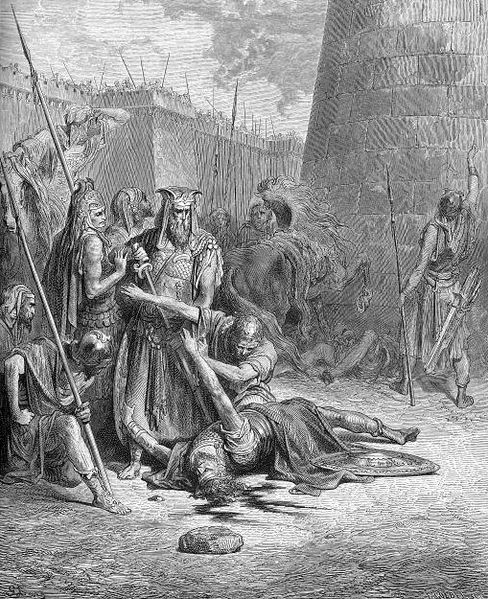
The cycle of violence includes mass mutilations, an apparent human sacrifice, and an idolatrous warrior named Abimelech who commits mass fratricide, killing seventy of his brothers in a single day, in order to become king, then commits a horrific war crime—burning alive one thousand men and women who had sought refuge in a tunnel. But they are avenged when Abimelech besieges the town of Thebez and an unnamed woman drops a millstone from the ramparts onto his head and cracks open his skull. He orders his attendant to kill him with a dagger so that no one will say that a woman killed him. (Judges 9:53-55).
Gustave Doré: The Death of Abimelech
When I first set out to read the Bible in its entirety more than thirty years ago, I went with a traditional Hebrew Bible in English translation. No explanatory notes. Just the Hebrew text on the right-hand pages with a clunky King James Version-style translation on the facing pages.
The King James Bible (KJV) is a towering achievement, and countless terms and phrases in its majestic language have entered our language. But sometimes its poetic qualities can present an obstacle to understanding the plain meaning of the text. One of my favorite examples comes when Sarah tells Abraham to cast her handmaid Hagar, and Abraham’s firstborn son Ishmael, into the wilderness. Abraham is torn, and asks God for advice. In the KJV, God replies:
Let it not be grievous in thy sight because of the lad, and because of thy bondwoman; in all that Sarah hath said unto thee, hearken unto her voice; for in Isaac shall thy seed be called. (Gen. 21:12)
Hearken unto her voice. Beautiful poetry, even Shakespearean in style. But what does it mean in today’s English? The Jewish Publication Society’s (JPS) modern translation is as follows:
Whatever Sarah tells you, do as she says.
Do as she says. A bit stronger than hearken unto her voice, isn’t it? And this is God speaking. Our media-savvy Bible-thumping moralists never seem to quote that one: Do what your wife says.
So the language of the KJV can obscure meaning, and I’m willing to admit that on my first read-through, my sometimes rudimentary following of an unfamiliar narrative meant that the sudden depictions of violence seemed to leap at me from out of nowhere.
Like the assassination of King Eglon of Moab, whom we are told is “very fat,” with its startlingly specific detail:
And Ehud took the sword from his right thigh and thrust it into the king’s belly; and the haft went in after the blade, and the fat closed upon the blade so that he could not draw the weapon out, and the filth came out. (Judges 3:21-22)
The Hebrew is unclear, but the filth came out most likely means the king, upon receiving a mortal wound, loses control of his bowels and craps himself. Yeah, that’s in the Bible.
Then there’s an especially disturbing scene where a mob of men rape and abuse an unnamed woman all night long, leaving her for dead. When her husband finds her unresponsive the next morning, he heads home and cuts her body up into twelve parts and sends a part to each of the twelve tribal territories of Israel as a sign that “an outrageous act of depravity has been committed in Israel” (JPS, Judges 20:6). This leads to a devastating intertribal war that brings more rape, death and destruction.
But the violent event that stood out the most to me was the story of Jael (Ya’el in Hebrew), who kills a powerful warrior named Sisera by nailing his head to the ground with a mallet and tent peg. Needless to say, I did not see that coming.
Gustave Doré: Ya’el and Sisera
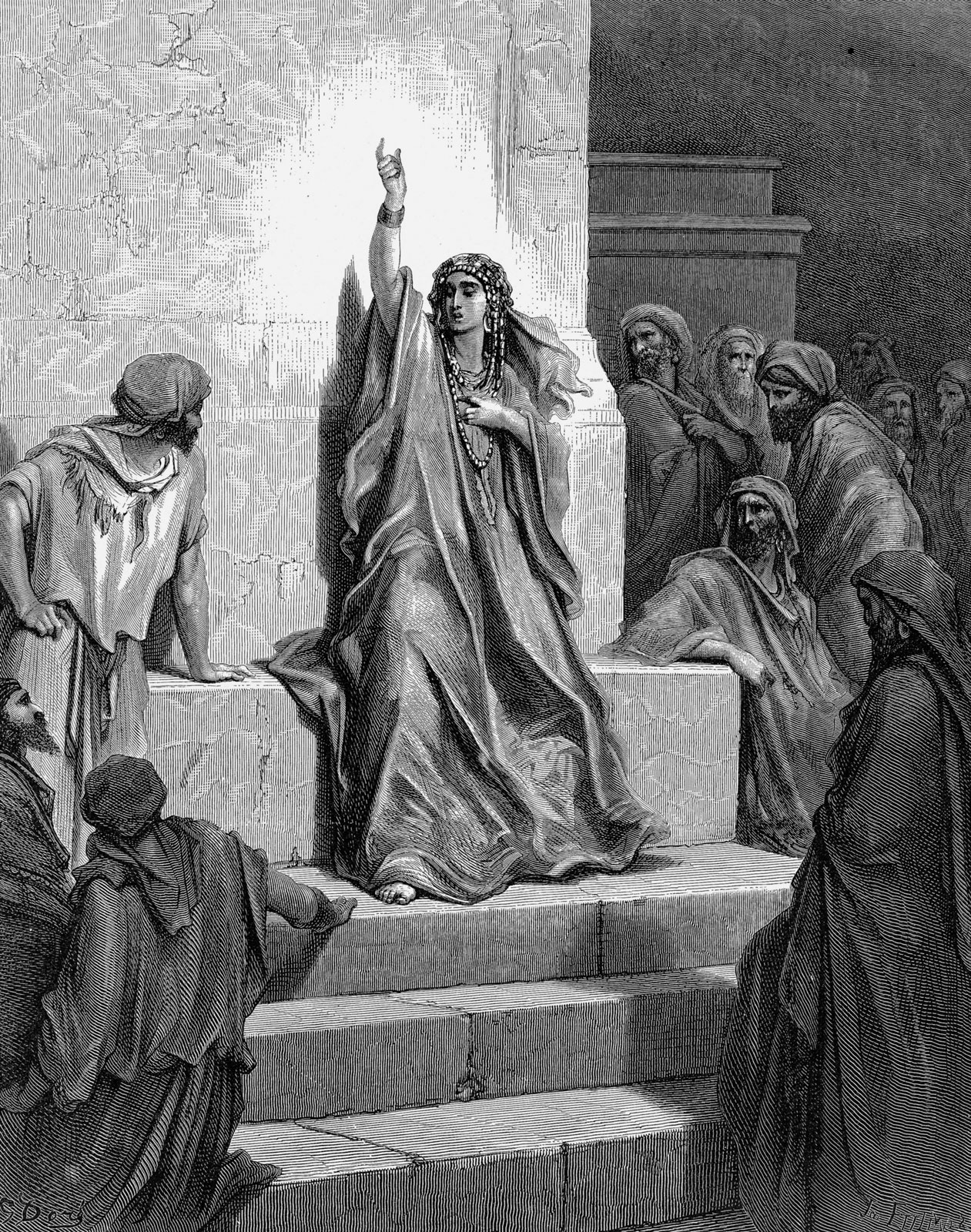
The whole incident is described in five short verses (Judges 4:17-21), then repeated with a bit more detail in the Song of Deborah (Judges 5). It’s worth noting that Bible scholars believe that The Song of Deborah and the Song of the Sea (Exodus 15:1-18) are among the oldest passages in the Bible, possibly dating from around 1000 BCE or even earlier.
Gustave Doré: The Song of Deborah
So who was this Ya’el? The text identifies her as the wife of Hever the Kenite, not as an Israelite, and we’re told that there was friendship between her husband and Sisera’s commander, King Yabin of Hatzor. So why does she do what she does? The Bible offers no explanation. In short, she has no motive.
Until now . . .
From that day, more than thirty years ago, I was determined to flesh out the story of Ya’el, but it wasn’t until recently, after doing extensive biblical and archeological research for my current novel-in-progress, that I finally had the background knowledge to expand on this brief biblical vignette.
As part of my research for a novel based on the story of one of the strongest women in the Bible, I re-read the Hebrew Bible (a.k.a. the Old Testament) along with a shelf-load of books of commentary ranging from the ultra-Orthodox Artscroll Mesorah series to a collection of essays by group of feminist rabbis.
One particularly provocative observation I learned from all this research is that the stereotypical biblical descriptions of women as the source of all that is evil and dirty (see: the Whore of Babylon) are almost entirely in the (ahem) New Testament. Women may not have much of a voice in the Old Testament, but when they do speak up, their demands are heard.
I’ve always been attracted to strong female characters, and there are some mighty strong women in the Bible. (Deborah is depicted as being a stronger leader than a warrior named Barak, who appears to be her husband, until he assumes command of an army of ten thousand and charges down Mount Tabor in Judges 4.) And I’m thrilled to have had the privilege of dramatizing this striking incident from a lawless era when there was no king over Israel and some kickass women had to take matters into their own hands.
Elizabeth Zelvin, LCSW, is a three-time Derringer and Agatha Award nominee and the author of the Bruce Kohler mysteries among other series. She is the editor of Where Crime Never Sleeps: Murder New York Style 4 as well as Me Too Short Stories: An Anthology, which releases today from Level Best Books. The theme of the anthology is crimes against women, tales of retribution and healing. Here she talks about the motivations of women killers in mystery fiction.
I don’t like violent men. I’ve never had a soft spot for Hannibal Lecter. I read Silence of the Lambs only because it was the only reading matter available in a hotel room one night. I slept very badly, and I’ve been wishing ever since that I could unread it. Chewing off a prison guard’s skin so he could hide beneath it to escape? Yuck. I don’t care how the movie managed that scene. I’ve never seen it, and I never will.
But I write murder mysteries, so I do write about murder. And of course I read about murder. I even talk about interesting ways to kill at the dinner table. Most mystery writers do. I wrote my first murder mysteries—never published, thank goodness—in the 1970s. My model was the traditional detective story. My protagonists were amateur sleuths. Mysteries were mysteries. There was a crime, an investigation, and a solution. The investigator was the star, the one who figured out whodunit.
When I started writing fiction again many years later, the genre had changed. Crime fiction now consisted of mystery and thrillers—different breeds— in a variety of subgenres, from cozies to hard-boiled. What I wanted to write didn’t quite fit in anywhere. I called it over easy and slightly crispy around the edges.
My first series was a New York murder mystery with a male amateur sleuth—the protagonist, recovering alcoholic Bruce Kohler. I was less interested in the mechanics of the murder than in developing Bruce’s voice, his growth in recovery, and his relationships with his friends. In the first short story, I didn’t even give the murderer a motive. The story ended at the moment when Bruce figured out whodunit. In the first novel, the killer was basically nuts. In the second short story, the three suspects had all had one-night stands with the victim. The motive for the guilty one was plausible, but tenuous.
When I wrote the second novel, something happened. I meant the killer to be a literary agent. I made him deeply irritating. It was fun. But as I wrote, I realized I had a better candidate. And as I wrote her final confrontation with Bruce, she found her voice. This is the moment that writers live for, when the character starts to speak for herself, regardless of what the author planned.
I had several possible motivations worked out for what she had done. She mentioned none of them. She had killed in a state of rage, killed again to cover her tracks, and was ready to kill Bruce if he tried to stop her from getting away. But behind the rage was a profound sense of hurt and betrayal. Readers can empathize with the pain of a woman who’s been betrayed. Even though justice must be done, the killer who arouses compassion is more authentic, more fully developed. The story itself is more authentic, whether it’s a short story or a novel.
The next step in my own evolution was to make my protagonist the murderer, to put the killer, not the detective, in the center of the frame. I didn’t plan this. It welled up out of that mysterious source that has been called “inspiration,” “the unconscious,” “the muse,” “a higher power,” and “a still, small voice.” Short stories were the perfect format in which to explore this, once I realized it was happening, since they take two weeks rather than two years to write.
My first such protagonist was a femme fatale, a character I probably wouldn’t write now. She was predatory by nature. In her defense, I’ll add that the story had elements of urban fantasy. She wasn’t a human woman, and she was culling the human herd of contemptibly predatory men. That first time, I kept my distance from my killer protagonist, writing the story in third person from the victims’ points of view.
But if I wanted to keep writing stories other than detective stories, I needed to reach into the minds and hearts of killers and write from their point of view. I soon realized that “killer” or “murderer” was so broad a term as to be meaningless. I had no desire to create men who kill, and not only psychopaths who do it again and again. There are already too many murderous guys out there, in real life and in fiction. I’m not interested, no, not even if the murders are so justifiable that they’d cast Tom Hanks, Liam Neeson, or Morgan Freeman in the movie.
But women, ah, women have plenty of reasons to kill that I can get behind with no problem. They may be victims, survivors, avengers. They may kill to protect those they love, including their children. They may simply have had enough—of being belittled, ridiculed, abused, or merely giving and giving without appreciation or reward. Thinking of “A Work in Progress,” my most recent story in AHMM, and other standalones, I’d say that every time a woman chooses death—for herself or someone else—it’s because on some level she has had enough.
When I selected crime stories for my new anthology, Me Too Short Stories, abuse figured in the submissions along with murder. Many of the protagonists were children, some of whom had experienced abuse from a very early age. Imagine how powerless a little girl feels when she is abused by a trusted adult. Remember that for every action—no one’s repealed Newton’s third law of motion, have they?—there’s an equal and opposite reaction. Consider the intensity of the powerlessness such a child feels. If the reaction, once she grows up, is to kill—as the author who’s writing her into being, I say, Go for it!
Kansas-based author and English instructor Cheryl Skupa writes book reviews (Among Worlds) and poetry (Phoenix, Oklahoma Council of Teachers of English). Here she talks about writing with the supernatural in mind and about crafting her debut short story publication, “Ghost in the Nemaha County Courthouse” (from our current March/April 2019 issue).
I always perk up when I hear local folklore and superstitions, especially when told with relish by someone connected, however distantly (perhaps nebulously) to the people and places in the story. These little snippets of local history and tragedy have the deliciousness of gossip. Ghostly tales have the power to transform even the drabbest places on earth into something magical—and creepy!
“Ghost in the Nemaha County Courthouse” was born out of local stories and my penchant for driving out of my way, sometimes down gravel roads to visit small-town courthouses, little cemeteries, and old churches. The courthouse in my rural county and those in surrounding areas provided plenty of atmosphere—old clanking radiators, broom closets which were once jail rooms, fainting couches, shadows, dust, and the knowledge that many anguished people had passed through these halls over the years. Intensely personal tragedies and triumphs have been absorbed into the old ornate woodwork with the smell of the furniture polish.
The cleaning lady, Evelyn Eichman, was, of course, based on me. Who knew that all those hours working my way through college, pushing my cleaning cart down halls, sweeping, mopping, and dusting would somehow find its way into my writing? My least-favorite college job became the best writing fodder—but then, writers use everything; they are composters of experience! Thank you, fiction and AHMM, for sanctifying those lonely, boring experiences!
The only drawback of writing about ghosts was that humankind has been telling these stories since the beginning. For me as a writer to veer off into fresh territory, I needed to understand what was happening to my cleaning lady, Evelyn Eichman, as she experienced the visions of the white woman and her stained dress. That took some thought and time. I scoured the local small-town newspapers, especially the sections which recalled local events in history. I reread the account of my small town’s informal historian (a local school teacher.) I tried to recall old stories my grandma had told me, and cursed the gaps in my memory.
In the end, I did what writers do—told the story that I most loved to read. Ghost stories always remind us, not only of past sins, but also that death may not be the end, that insignificant people, places, and actions matter, and that tragedy, however devastating, may become immortal in the retelling!
Mark Milstein is a Michigan author and restaurant owner. He is currently working on a historical whodunit, but here he tells us about writing his story “A Curious Transaction” from the current March/April 2019 issue of AHMM.”
Is there a story in that?
It’s a question I ask myself daily, as I suspect many writers do. You can wait for inspiration to strike, out of the blue, like the proverbial bolt of lightning. But I prefer to hunt it down aggressively, armed only with a mug of steaming coffee, a pair of earbuds, a mouse, and, increasingly, the tips of my thumbs. Two of my favorite silos of inspiration are NPR and The Drudge Report. Yeah, I know: strange bedfellows indeed.
I hit the Goebbels-esque clickbait on Drudge shamelessly, like a hungry smallmouth bass slamming a topwater plug. “Muslim Takeover of America,” it proclaimed. I was redirected to a story about Hamtramck, Michigan, where the tension between the growing population of Muslim immigrants and the Polish citizens who have long occupied the city was on the rise. The Poles were concerned, understandably, that their way of life was changing forever, disappearing. There was a lot of anger over a loudspeaker that called Muslims to prayer at a local mosque five times a day, justified by the largely symbolic argument that it was drowning out church bells from nearby, predominantly Catholic churches. There was even—gasp—a Muslim majority on the city council. I asked myself if this wasn’t appropriate for a representative democracy.
I also asked if there was a short story in all this. Turns out there was—it was the birth of “A Curious Transaction,” which appears in the March/April 2019 issue of Alfred Hitchcock’s Mystery Magazine. I knew right away I didn’t want the focus to be on the ethnic tension in the city. It is there, of course, lurking just behind the scenes. But I wanted to focus instead on how very different people, of all ethnicities and creeds, can work together, complement each other, and even thrive. And, oh yeah, since the story was intended for the illustrious AHMM, and wasn’t dark and twisty and sleep-depriving, it would need to be one heckuva mystery. Perhaps a new and original Pakistani sleuth who solves complex crimes by asking three simple questions? It was a tall order for a short story; I was pleased and a bit surprised to pull it off without straying into novella territory.
The fictional setting, a quick-service restaurant named Burgie’s, was a no-brainer, as I happen to own an establishment in Northern Michigan just like it. What better way to inject authenticity without wasting precious time on research? Every one of my employees, even the high-schoolers who can’t see past their smartphones, would instantly recognize their workplace, which is an integral part of the plot. While the old writer’s adage “Write about what you know” isn’t set in stone, it’s a good highway to take when you can get away with it.
The protagonist, Saalim Sayyid, a devout Muslim immigrant from Pakistan, is the general manager at Burgie’s, working toward a college degree in criminal justice. He has convinced the Polish owner of the restaurant, Mr. Micolajczak—whose name was chosen, I guiltily confess, as the most likely entry in an online group of Polish surnames to frustrate a reader attempting to pronounce it—to begin serving Halal food, which has significantly increased the customer base, and hence the sales. Saalim is also a burgeoning detective, and this story chronicles his first case (hint: not his last), which he must solve in order to prevent his incarceration and deportation.
Whoa, how can the son of a Russian Jewish father and a Swedish Lutheran mother write about the immigration experience of a Pakistani Muslim? Is that even allowed? Well, of course it is. Great writers (no implication intended) have for centuries brought every conceivable character in the universe to life, no matter the ethnic, cultural and ideological chasm between author and character. This they accomplish by avoiding stereotypes at all costs, doing an appropriate amount of research, and, most importantly, making their characters believable and intrinsically human (even the Vulcan Mr. Spock is essentially human at his core). Saalim is brilliant, confident, calm, kind, responsible and eternally optimistic. He also, like most people in the world—Agatha Christie wasn’t translated into every conceivable language for nothing—relishes a good mystery, and has a particular affinity for Hercule Poirot, whom he is able to emulate at the conclusion of the story.
I don’t believe it is possible to be even an average writer without being a voracious reader. Sadly, I find that many young people I know today aren’t passionate readers. There are many reasons for this, but I am grateful that my parents encouraged me to read at a very young age. They didn’t define or limit the subject matter, instead encouraging me to read whatever brought me joy. This included the latest issue of AHMM on my father’s nightstand, right next to the Playboy, which I of course, as a discerning young lad of ten years, avoided like the plague.
I literally grew up with AHMM; we were both Eisenhower babies, born in 1955. The magazine, a lifelong friend, has brought me a lifetime of joy. My favorite author was Jack Ritchie. I would scan the table of contents and jump to his stories first; they never failed to bring me joy. He was a master of dialog, and spinning a tale implicitly, between the lines. He was incredibly witty, with a wonderful, macabre sense of humor. Attempting to emulate him, an impossible exercise, fostered in me a passion for writing. I wouldn’t be appearing as a guest author on this blog today without Jack Ritchie and AHMM. I am deeply honored, beyond mere words, to appear in AHMM and as a guest author on Trace Evidence. I wish to express my warmest appreciation to Linda Landrigan and Jackie Sherbow for helping to make my dreams come true, and I sincerely hope that all of you can someday know how that feels.
California writer James Tipton is the author of Annette Vallon: A Novel of the French Revolution(HarperCollins, 2008) and the upcoming collection Adventures Without Sherlock. You can find his short stories and poetry in Nostos and Blue Unicorn. His first tale in AHMM to feature Dr. Watson was “The Vampire of Edinburgh” (September/October 2017), and here he talks about that character, the series, and his story in the current issue, “Shiva’s Eye”—just in time for belated celebrations of Sherlock Holmes’s birthday. (Editor’s note: The phrase “twenty-five hundred strong” at the top of page 86 of the current issue of AHMM, the fifth page of “Shiva’s Eye,” was misprinted as “twenty-five thousand strong.” We regret the error.)
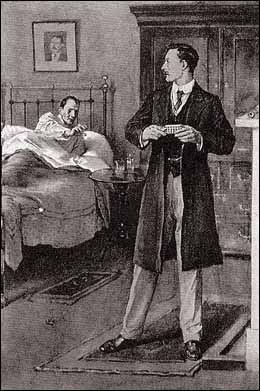
Doctor John H. Watson is one of the great overshadowed characters of literature (for others, see Jim in The Adventures of Huckleberry Finn and Nausikaa in The Odyssey; there are many). Sherlock Holmes is not being ironic when, in “A Scandal in Bohemia,” he says, “I’m lost without my Boswell.” He would not only have been lost to current recognition and to posterity, but in his own self-absorption and ego. In this blog, however, I’m not writing about Holmes, but about his companion, who, in the story “Shiva’s Eye,” encounters mysteries long before he ever encountered his famous friend. Moreover, we must admit it’s because of Doctor Watson’s writing that his friend became famous.
“Shiva’s Eye” can be read as a prequel to the Sherlock Holmes canon. Watson tells us in the beginning of his narration of the first Holmes novella, A Study in Scarlet, that the Afghan campaign in which he participated brought him “nothing but misfortune and disaster . . . I served at the fatal battle of Maiwand. There I was struck on the shoulder [in later stories we also find he was wounded in the leg] by a Jezail bullet, which shattered the bone and grazed the subclavian artery.” After he had “rallied” at the base hospital at Peshawar, he “was struck down by enteric fever [typhoid], that curse of our Indian possessions.” The battle of Maiwand was a major and unexpected defeat for the British in the second Anglo-Afghan war. Watson tells us that his “nerves are shaken,” and when he meets Holmes, the detective’s first words to him are, “You have been in Afghanistan, I perceive.” “Shiva’s Eye” sees this campaign, its disastrous outcome, and its seeming supernatural mysteries unfold through Watson’s eyes.
I am grateful to the Alfred Hitchcock Mystery Magazine for giving a chance for these Doctor Watson adventures to come out to the world. AHMM published “The Vampire of Edinburgh” in September/October of 2017, and now is set to publish two more of them after “Shiva’s Eye.”
These stories come from a collection of fourteen that I’m working on to be called Adventures Without Sherlock. There have been countless spin-offs of Sherlock Holmes in print and in film, but none that I know of which only features Dr. Watson, without the help of his illustrious friend. I’ve endeavored to stay true to the narrative voice of the Sir Arthur Conan Doyle stories, but mine develop the doctor’s character much further, covering the range of Watson’s adult life: from a failed romance in the Highlands that resurfaces in the gold country of California (the latter refers to an unpublished play by Doyle in which Watson ventures to the Wild West); to his participation in the Afghan campaign; to his years with Holmes when he was on his own—either on holiday or shortly after his first wife’s death, and then Holmes’s presumed death; to his later years when he visits Ireland on the verge of Civil War; or a trip to Berlin in 1933, when, in his eighties, while being honored by his German publisher, he encounters the beginning of the Nazi terror. We also see Doctor Watson giving a nod to his friend, or perhaps in silent competition with him; for instance, in an early story we find that Watson hunted a demon cat on the craggy fells of the Lake District long before Holmes stalked a hell-hound on the misty moors of Devonshire. A post-World War I story even features Conan Doyle, who, as Watson’s editor and friend, asks the doctor to join him on a search for fairies.
So in these stories Watson finally gets his due. Through his presentational immediacy and objective but deeply personal involvement, we feel the presence of a brave, compassionate, and highly moral man. Traditionally, these qualities have been applied to his protagonist, but we must remember that Sherlock Holmes is filtered through the perspective and the values of Doctor Watson. Once we are familiar with Watson as a narrator, we cannot help but think of him, unlike Holmes, as a very human and most likable human being—as that rare thing among writers: a genial personality.
Doctor Watson is well overdue to be the hero of his own series. As readers of the Holmes stories, we are aware of the doctor’s keen sense of observation, his fine ear for dialogue, and his pacing to give a sense of suspense and adventure (the last being a quality for which Holmes chided him). We are also aware of Watson’s self-effacing habit of always putting himself in the background; the stories are not about him. In my stories, although Watson is still loath to talk too much about his personal life, we can’t help but see his character more: his self-reflections, doubts, epiphanies, his dedicated persistence in arriving at truth—and we see him growing in his abilities as a detective. In “Shiva’s Eye” we also see him go where the cold reason of Holmes would never venture: into the possibility that there is more to life than the rational mind can understand.
With any and all readers keeping in mind that they are following the adventures of Doctor Watson, not of Sherlock Holmes, and therefore may be exposed not to singular analytical reasoning from effects to causes but to a dogged, quotidian effort to get at the truth (or in “Shiva’s Eye” assistance from an unexpected source), I offer these stories to whomever may have a few quiet minutes to spend with the good doctor.








 I don’t like violent men. I’ve never had a soft spot for Hannibal Lecter. I read Silence of the Lambs only because it was the only reading matter available in a hotel room one night. I slept very badly, and I’ve been wishing ever since that I could unread it. Chewing off a prison guard’s skin so he could hide beneath it to escape? Yuck. I don’t care how the movie managed that scene. I’ve never seen it, and I never will.

 Doctor John H. Watson is one of the great overshadowed characters of literature (for others, see Jim in The Adventures of Huckleberry Finn and Nausikaa in The Odyssey; there are many). Sherlock Holmes is not being ironic when, in “A Scandal in Bohemia,” he says, “I’m lost without my Boswell.” He would not only have been lost to current recognition and to posterity, but in his own self-absorption and ego. In this blog, however, I’m not writing about Holmes, but about his companion, who, in the story “Shiva’s Eye,” encounters mysteries long before he ever encountered his famous friend. Moreover, we must admit it’s because of Doctor Watson’s writing that his friend became famous.
 Trace Evidence