How I Came to Write “The Hawaii Murder Case” by Terence Faherty


Terence Faherty is the author of The Quiet Woman as well as the Owen Keane and Scott Elliott mystery series. His recent short-story collection Tales of the Star Republic is available from Gisbourne Press. Here he talks about the inspiration behind and the writing of his story “The Hawaii Murder Case” from the January/February 2017 issue of AHMM.

My wife and I enjoy traveling, and I thought it would be fun to write a new short story for each place we visited. Instead of forcing a whodunit format on each locale, I decided to let the setting suggest the proper story to tell. For example, St. Simons Island, where we stayed in a creaking old carriage house, seemed like a good place for a ghost story. When we visited Scotland, we encountered the life and legend of Mary Queen of Scots everywhere we went, so I came up with a suspense story that used the famous queen.

But I was hoping for more inspiration than just what type of story to write. Years ago, I came across a writer’s block remedy. It consisted of a deck of cards that would randomly generate certain basics of a story, like setting, protagonist, and problem. Trying to weave together those random elements was supposed to stimulate creativity. I never used the card system, but it occurred to me that I could let our trips serve the same role. I began traveling with my notebook at the ready, so I could jot down random elements that I would later weave together in a story. I’m happy to report that the system worked. And it not only served as a creativity stimulus, it made each story a scrapbook of that particular vacation.

“The Hawaii Murder Case,” as the title reveals, was inspired by our vacation on Kawai. I came back with the following story elements. 1) During the trip, I was reading a Philo Vance mystery, The Kidnap Murder Case. 2) While we were standing at the edge of a remote waterfall, a branch the size of a suburban tree fell from the forest canopy and narrowly missed us. 3) To access the beach nearest our condo, we had to go up and down a long, steep stairway that was out of sight of anyone not on the stairway itself. 4) On the beach, we observed a May/December couple who barely spoke to one another. 5) Our condo building contained three units, all of which were owned by the same person and decorated identically.

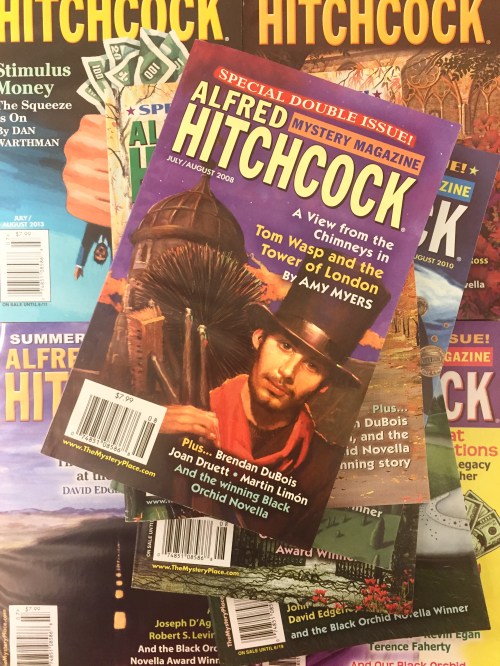
From those major elements, and a dozen minor ones, I came up the story of a vacationer who is conked on the head by a falling tree branch and begins to take on the characteristics of the fictional detective he’s been reading about. There follows a sudden death, of course. I made it a comic mystery—told by the “famous” detective’s harried wife—because the crazy premise pointed that way and because I enjoy writing funny stories. They’re a nice break from the grim stuff. You can check out the results in Alfred Hitchcock’s Mystery Magazine’s January/February double issue. And if you’re ever facing writer’s block, try the random detail remedy. I recommend trying it in Hawaii.

1 Comment

Filed under How'd That Happen

On the 10th Anniversary of the Black Orchid Novella Award

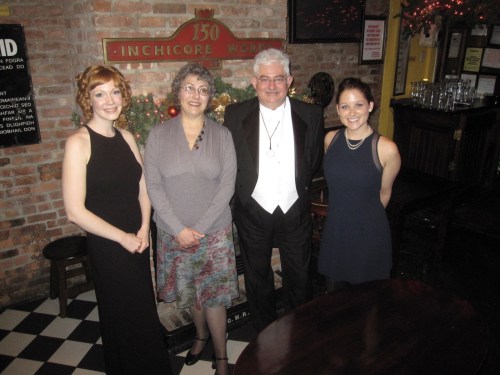
Linda Landrigan, Steve Liskow, Jane K. Cleland, December 3, 2016

Linda Landrigan, Steve Liskow, Jane K. Cleland, December 3, 2016

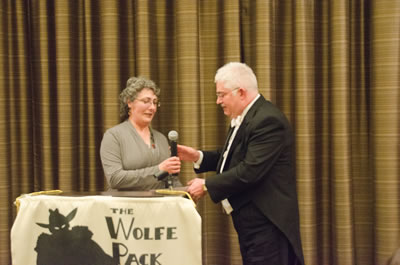
Earlier this month, as is usual for the evening of the first Saturday in December (chosen to coincide with Rex Stout’s December 1st birthday), we attended The Wolfe Pack’s Black Orchid Banquet. Among the night’s features are toasts (one of which associate editor Jackie Sherbow gave) and the presentation of the Black Orchid Novella Award, given by our editor Linda Landrigan in conjunction with BONA awards chair Jane K. Cleland. This year’s winner is a BONA first, as Steve Liskow garnered his second win—this time for his story “Look What They’ve Done to My Song, Ma,” which will appear in the July/August 2017 issue. The occasion was also special because it marks the award’s tenth year. We asked the BONA winners from years past to share their memories, and we’re sharing some of them with you here.

I loved spending time in New York City for the banquet. I was born in Manhattan and my parents moved to Long Island when I was a child. My grandfather was a NYC cab driver. . . . It was especially fun . . . during the holiday season, so being in the city for the banquet at that time was especially meaningful for me. I got to visit old haunts and even met up with Santa Claus in Macy’s.

The banquet itself was wonderful. Jane Cleland is one of the most fun people I’ve ever met. . . . It was an honor and pleasure to meet Linda Landrigan. She was so welcoming and so great to talk to that it made me a whole lot less nervous about delivering my acceptance speech. . . . I had such a good time and have such warm memories of the banquet. It was a magical experience set in a city I love during a time of year I love and I’ll be forever grateful.—Susan Thibadeau, 2013 winner

*

The banquet was a few months after Hurricane Sandy, which led to real difficulty getting in and a smaller-than-average, though very enthusiastic crowd. . . .

In the few months after receiving the BONA I sold stories to two very hard-to-crack markets. Was it a coincidence or did they notice the award? I have no evidence, but I have an opinion.

It was a great honor, especially since AHMM is my favorite magazine, and I have been a fan of Stout and Wolfe since sixth grade—Robert Lopresti, 2012 winner. For more BONA reminiscences, visit Rob Lopresti’s related blog I’m Dreaming of a Black Orchid, Picking More Black Orchids, and Addressing the Red Envelope

*

The old saw that being a writer is the most solitary of occupations is completely wrong. Honestly, I can’t think of a more social activity, because a writer is nobody without readers, and readers form a community, as this gathering tonight so clearly demonstrates. . . . . Of course [the armchair detective in my novella] Miss Enola is not alone. She has Erica to keep her company, even if she spends most of her time in her own head. Mostly, though, she will never be alone as long as there are people who love to read detective stories. I hope that when “Inner Fire” is published in Alfred Hitchcock’s Mystery Magazine this coming summer, you will all have the opportunity to read it. I wrote it for you, and I am deeply and humbly grateful for the honor you have done me in granting me this award. I tell you from the bottom of my heart that it is one of the brightest highlights of my career as an author of crime fiction.—From the acceptance speech of James Lincoln Warren, 2011 winner

Emily Hockaday, Linda Landrigan, James Lincoln Warren, Jackie Sherbow, 2011

Emily Hockaday, Linda Landrigan, James Lincoln Warren, Jackie Sherbow, 2011

Linda Landrigan, James Lincoln Warren, 2011

Linda Landrigan, James Lincoln Warren, 2011

*

I recall:

  • My wife Helen and I making the 4 + hour drive to NYC from Vermont and scurrying across town in time for the banquet’s 6:30 cocktail hour.
  • Realizing early on that Wow, these Wolfe Pack folks are really into their Rex Stout.
  • Taking part in a table-versus-table competition of songwriting with a Nero Wolfe theme. Our table accepted my suggestion of using the tune from the 1950’s Davy Crockett show. As I recall, we acquitted ourselves admirably.
  • Taking the podium to accept my award. For my acceptance speech, I began, I’ve recently committed the complete cannon of Nero Wolfe to memory and will now recite it . . . I then began rattling off the opening passage of the first Wolfe novel, Fer-de-Lance, (which I had memorized for the occasion). After three or four lines, I stopped and said, You know . . . I realize now, you probably all have memorized his complete works yourselves, so I’m just being redundant. I’ll move on . . . Laughter ensued.
  • Laughter not ensuing when I tried to make some jokes about Stout’s early efforts to name his detective. I suggested that prior to becoming Nero Wolfe, the character was originally called Caligula Bobcat. That joke died in the air, swiftly and soundly.
  • After the banquet, leaving at the same time as Linda. She graciously led Helen and I down the city streets and gave us a tour of the various shop window Christmas displays. A splendid end to a splendid night!—Michael Nethercott, 2008 winner
Linda Landrigan, Michael Nethercott, 2008

Linda Landrigan, Michael Nethercott, 2008

*

When I accepted the award, I mentioned how I was mostly a science fiction author. After the banquet was ending, a long-time mystery writer (who got his start in the science fiction pulp magazines in the 1950s) shook my hand, said, “Get the hell out of science fiction!” and walked away. I have taken his advice to heart and haven’t written a science fiction story since then!—John Betancourt, 2007 winner

Leave a comment

Filed under Awards

Holiday Double Issue (January/February 2017)

P.I.’s and fixers, burglars and soldiers all join together in our HOLIDAY DOUBLE ISSUE to send you the best wishes of the season! We visit winter locales past and present, chilly and tropical. Michael Nethercott takes readers back to the Fifties with a new tale featuring his Connecticut sleuths Lee Plunket and Mr. O’Nelligan, while S. J. Rozan sets her new series in Manhattan’s Chinatown with matriarch Yong-Yun. Brendan DuBois revisits a facet of rural New England life—kvetching at the town dump. Jay Carey’s Police Chief Eureka Kilburn deals with crime in a time of post global warming Sarasota, and Terence Faherty has an amusing take on Philo Vance that is set in Hawaii. In addition with we have a Mystery Classic treat: a suspenseful puzzler by Hugh Pentecost featuring hotel manager Pierre Chambrun—and you won’t want to miss Marvin Lachman’s insightful introduction for modern-day readers. Happy holidays from AHMM!

1 Comment

Filed under Uncategorized

Bruce Arthurs on “Beks and the Second Note”

Bruce Arthurs is a writer in the mystery, science-fiction, and fantasy genres across several different mediums, including television and, occasionally, poetry. Here he talks about his story “Beks and the Second Note” from the December issue—his first to appear in a mystery-specific publication.

In “Beks and the Second Note” the takeaway quote is this:

I thought about why I was a detective, about wanting to understand the why of people’s stories, not just the what.”

I’m not a detective, but that question—Why do people do the things they do?—has been a puzzle my entire life. It’s a common question, one almost everyone asks at some point, or at lots of points, in their lives. Why do good people make bad choices? Why do bad people sometimes make good choices?

In the universe inside my head, I’m writing this wonderful script where everyone in the world behaves rationally and understandably; everyone makes sense. In the real world outside my head, everyone keeps ad-libbing. It’s terribly frustrating.

Writing fiction is one way I deal with that frustration. In a story, the writer is in control of characters and events and motivations. It can help to make sense of, and deal with, real life.

“Beks and the Second Note” arose from a stew of news items from recent years: police shootings of black men; economic hardship and homelessness; the increasing presence of surveillance technology; the legalization of concealed carry in many states and the myth of the Good Guy With A Gun. All this simmered in the back of my mind for months until that “Ah-ha!” moment when the potential for a story fell into place.

And the oddly-named Bok Beks seemed the right character to tell that story. It’s not his first appearance; Bok first appeared over a decade ago in a very-small-press chapbook-sized anthology of stories about radioactive monkeys. (Yes, really. Small press can get very weird.) He has a pretty extensive backstory in my head, and I’m hoping future work will occasionally return to reveal more of Bok’s own story and the choices he’s made. But that probably involves a lot more simmering on my brain’s back burner.

My scattershot bibliography has mostly been in the science fiction and fantasy genres, a reflection of my primary reading over the years. The first book I remember reading, at age six, was Todd Ruthven’s Space Cat. But mystery and detective fiction has always been a close second (the Encyclopedia Brown stories are another memory of early reading), and almost every story I’ve written has fallen into one genre or the other. And occasionally, as with “Clues,” the episode I wrote for Star Trek: The Next Generation, something falls solidly into both genres.

But I’m pleased as Punch to break into Alfred Hitchcock’s with “Beks and the Second Note.” It’s my first sale to a specifically-mystery market, and it’s especially satisfying to make it to one of the most important markets for short mystery fiction.

1 Comment

Filed under How'd That Happen

The Story Behind “Lady Appleton and the Creature of the Night” by Kathy Lynn Emerson

Kathy Lynn Emerson/Kaitlyn Dunnett is the author of over fifty books written under several names. She won the Agatha Award for best mystery nonfiction of 2008 and was an Agatha Award finalist in 2015. Currently she writes the contemporary Liss MacCrimmon Mysteries (Kilt at the Highland Games) as Kaitlyn and the historical Mistress Jaffrey Mysteries (Murder in the Merchant’s Hall) as Kathy. Here, she talks about the newest tale in her Lady Appleton series, “Lady Appleton and the Creature of the Night,” in the current issue of AHMM.

I’ve been writing about Lady Appleton and her friends, on and off, for twenty years, ever since she first appeared in Face Down in the Marrow-Bone Pie, published in 1997. In all those novels and short stories, I’ve tried my best to be accurate in my presentation of life in sixteenth-century England. As much as I enjoy reading a good paranormal tale, I’ve been meticulous about sticking to reality when I write historical mysteries.

Until now.

What can I say? The sixteenth century was a superstitious time. Even a rational woman like Lady Appleton would have been unable to explain everything in the world around her. In Face Down Under the Wych Elm, she helped clear a woman of an accusation of witchcraft, knowing full well that some plants are poisonous and require no supernatural assistance to kill. But witches weren’t the only unnatural beings that were real to people of that time. They also believed in pixies, fairies, and ghosts. In Cornwall, it was thought that tommy-knockers lived in mines and gave warning of cave-ins. To prevent the restless dead from walking, suicides (who had committed the crime of self-murder) were supposed to be buried in a public highway between nine and midnight . . . after a stake had been driven into the body. At least in legend, there were creatures who were only half human, or who could change from human to animal.

Back in 2004, I first had the idea to write about a fictional sixteenth-century English family with a dark secret—they were weres. Not werewolves. There were already too many werewolf stories out there. I was thinking of something in the cat family, maybe a lynx or a Scottish wildcat. Unfortunately, I couldn’t come up with a angle that worked. I couldn’t even decide on the decade in which to set the story. One false start (“The King’s Weres”) had members of the Catsby family at the court of Henry VIII early in his reign. Another (“On Little Cat Feet”) let Princess (later Queen) Elizabeth discover their secret and vow to keep it, so long as they would serve her loyally. A separate problem was whether to go all-out paranormal or provide an alternate, rational explanation for everything that happened in my story.

Eventually, “Lady Appleton and the Creature of the Night” began to take shape in my mind. It still took me more than six months to write and when I finished it, I wasn’t sure that anyone would want such an odd little tale. Fortunately, it did find a home. Now I just have to hope that sticklers for historical accuracy will forgive me this little side-trip into the supernatural world, one the Elizabethans believed could exist side by side with their own.

3 Comments

Filed under How'd That Happen

Press Release from The Wolfe Pack— 2016 Nero Award and Black Orchid Novella Award Winners

NEWS RELEASE
FOR IMMEDIATE RELEASE
December 4, 2016
The Wolfe Pack
New York, NY

2016 NERO AWARD & BLACK ORCHID NOVELLA AWARD WINNERS

The Nero Award is presented each year to an author for the best American Mystery written in the tradition of Rex Stout’s Nero Wolfe stories. It is presented at the Black Orchid Banquet, traditionally held on the first Saturday in December in New York City. The “Nero” is considered one of the premier awards granted to authors of crime fiction. This year, the winner is David C. Taylor’s Night Life, (A Forge Book Published by Tom Doherty Associates, LLC).

The Black Orchid Novella Award is presented jointly by The Wolfe Pack and Alfred Hitchcock Mystery Magazine to celebrate the novella format popularized by Rex Stout. This year’s winner is… for the second time…  Steve Liskow.  The novella is titled “Look What They’ve Done to My Song, Ma.” (Steve also won in 2009.)

About the Wolfe Pack

The Wolfe Pack, founded in 1977, is a forum to discuss, explore, and enjoy the 72 Nero Wolfe books and novellas written by Rex Stout. The organization promotes fellowship and extends friendship to those who enjoy these great literary works of mystery through a series of events, book discussions, and a journal devoted to the study of the genius detective, Nero Wolfe, and his intrepid assistant, Archie Goodwin. The organization has more than 500 members worldwide. For further information, please see http://www.nerowolfe.org.

Leave a comment

Filed under Awards

“Channeling Sally Field” by Doug Allyn

Doug Allyn is the author of novels including The Burning of Rachel Hayes and the forthcoming The Jukebox King, and a multiple winner of the Edgar Award for Best Short Story as well as the EQMM Readers Award. His last tale to appear in AHMM was “Message from the Morgue” (January/February 2015). Here, on the reflective occasion of our 60th anniversary, he talks about publishing his first short story “Final Rites” in the December 1985 issue—and winning the Robert L. Fish Award for it.

Some memories never fade. Your first kiss. First car. First serious love affair. (Not necessarily in that order, but often as not, I suspect.)

But for writers, the First that ranks right up there with the aforementioned big 3, is the First Story that doesn’t come limping home with a business card stapled to page one: Sorry, but your pathetic offering doesn’t measure up to our lofty standards, mwa-ha-ha-ha. (Or words to that effect.)

Instead, you get a brief letter of acceptance and a contract. And after the initial confusion, (what? No rejection card?) you realize you’ve actually made your First Sale.

Wow. What a freaking rush! A high equal to the best buzz sex, drugs, and rock’n’roll can offer, and I’m speaking from experience. (Well, okay, maybe not quite as good as sex. And Shanghai speed can be—but I digress.)

The rush of elation is, for most writers, geometrically intensified by the number of rejections we received prior to that First Acceptance.

And that truly is the feeling. Acceptance. Some far off, godlike editor in the Big Apple (in my case, Cathleen Jordan, of AHMM) was offering to publish my puny little story.

Remember the night Sally Field won her Oscar? “You like me,” she babbled. “You really like me.” And the world chuckled indulgently. And maybe her speech was inane, but it was from the heart, and a lot more moving than some vapid diva thanking everybody from Krishna to her pool boy.

That’s the feeling of a First Sale. Sally Field on Oscar night. A once-in-a-lifetime rush that has nothing to do with the numbers at the bottom of the contract.

My First Sale was a story called “Final Rites.” Often, I have no idea where stories come from, but “Final Rites”? That one’s easy. One of my son’s high school buddies had a summer job as a gravedigger. A tough kid, a football player, hardcore jock.

“What’s it like, digging graves?” I asked.

“It gets weird sometimes,” he said. “If I’m down in the hole, squaring it up, and the mist rolls in off the river . . . ? Whoah!” And the burly football player shivered.

And gave me a story. About a gravedigger, who shivered, when he was down in a hole.

I still remember that rush. Even now, a hundred-plus stories later, I get that same lift when I find a story that needs telling.

But for “Final Rites”? The amazing First Buzz was about to get even better.

A few months after the story appeared in Alfred Hitchcock’s Mystery Magazine, Cathleen Jordan called to inform me that “Final Rites” had won the Robert L. Fish Award, for best first story.

I was stunned, overwhelmed, reduced to tears, right? Wrong. I had no idea what she was talking about. Literary awards? I grew up in northern Michigan where wealth is measured in wives, dogs, and rifles. (Just kidding. About the wives part.)

“If you’re serious about a writing career,” Cathleen said, “I strongly suggest that you come to New York to accept your award.”

“Do I have to wear a tie?” (I didn’t own one.)

“It’s black tie,” she said.

“I have to wear a black tie?”

“No, you putz, it is black tie. It’s the Edgars, the Oscars of the mystery world. It’s . . . New York! Formal dress, tuxes and evening gowns.” (Cathleen didn’t actually say ‘you putz’, she was far too refined. Bet she was thinking it, though.)

Without further ado, my wife and I were off to NYC, to party for a week, collect the award, (plus a check). And Cathleen was exactly right.

That first story, and the award it won, got my career up and running. In addition to meeting the staff at Dell Magazines (Cathleen, Eleanor Sullivan, et al, I acquired an agent, had lunch with Ruth Cavin, the legendary editor of St. Martin’s Press, who published my first five novels. (My eleventh, The Jukebox King, will be released by Stark House in February.)

All this, from a gravedigger’s shiver, and a first story Cathleen rescued from Dell’s towering slush pile.

Some memories never fade. Some debts can never be repaid. I will be forever grateful to the folks at Dell, for inviting me into this game, and letting me play.

And I’ll never forget Sally Field’s Oscar speech, either.

Because I know exactly how she felt.

Leave a comment

Filed under Awards

60 Is the New . . . (December 2016)

Editing a magazine is all about novelty—the next issue, the new stories, the new authors. One of the nice things about a significant anniversary is the occasion to pause and reflect. As we notch our sixtieth year, we thought it would be fun to invite some other voices that have long been associated with the magazine, contributors and a few staffers, to reflect on AHMM in this month’s special feature (The Case File).

But it’s the stories and authors that are the magazine’s raison d’être, and this celebratory issue is also a fine representation of AHMM’s recent decades. We are delighted to welcome Lawrence Block back to our pages with “Whatever It Takes”; Mr. Block first published a story in AHMM in 1963. And we are also delighted to welcome Bruce Arthurs, who makes his AHMM debut this month with “Beks and the Second Note.” And in between those extremes, we have new stories from other writers who have long associations with the magazine: John C. Boland (first AHMM story in 1976); Kristine Kathryn Rusch (1989); David Edgerley Gates (1991); Kathy Lynn Emerson (2001); and Stephen Ross (2010).

I wish I had the room to list the hundreds of authors who have graced AHMM’s pages with stories that have delighted and horrified and intrigued our readers for 60 years. We are grateful to them all.

Leave a comment

Filed under Uncategorized

Clues Examined—B. K. Stevens’ Post on SleuthSayers

AHMM regular B. K. Stevens drops an insightful post on SleuthSayers for mystery writers as well as readers.

Leave a comment

Filed under Uncategorized

“Writing Iron Chef” by Eve Fisher

Eve Fisher is a novelist, playwright, and short-story writer living in South Dakota. She volunteers with The Alternatives to Violence Project and blogs at SleuthSayers. Her stories in AHMM include many set in Laskin, SD, and here she talks about her story “Iron Chef” from the current November 2016 issue.

“Iron Chef” began as a rant. I’ve worked in the judicial system in Tennessee and South Dakota; been a college history professor; and for the last few years I’ve been doing volunteer work in the prison with the Alternatives to Violence Project. Along the line I’ve gotten to know many, many, many teenage addicts, who come and go through the judicial system because of course they know they have no problems whatsoever.

Finally, one day, I started ranting:

There’s nothing more gullible than a teenage addict. He thinks he’s smart because he can read. He thinks he’s street-smart because someone showed him how to make a Band-Aid from toilet paper and masking tape. He thinks bragging proves whatever he’s bragging about, from being tough to being a player. He thinks he’s a lady’s man because he wants to get laid.

When he’s trying to get some stuff, he believes everything the dealer says. When he’s high, he believes anything that will get him more stuff. If someone tells him he can make two, three, four, five thousand a week, he believes it. If someone tells him he won’t get caught, he believes that, too.

He believes that his dealer will help keep him out of trouble and get him out of jail. He believes that his dealer, his girlfriend, his baby mamma, and the woman currently giving him a lap dance all think he’s wonderful. He believes that the judge, the sheriff, and the state’s attorney all have it in for him personally. He believes that he is unjustly accused, tried, and convicted. He believes that with the right attorney he could have gotten off.

He believes that he doesn’t have to play the game in prison, whatever the game is. He usually gets beaten out of that. After that, he believes every rumor he hears, every tale he is told. He believes that when he gets out, he will never come back. He believes, often against all evidence, that he has a home to go to. He believes that he deserves a wonderful first day home, complete with alcohol, sex, drugs, and long drives. He believes that his old friends will still be his old friends whether he does drugs or not. He believes that there is a thing as social meth.

And at that point, I stopped ranting, because I was crying. There’s nothing more heartbreaking than a teenage addict, because you know how much he’s going to have to go through before (if!) he gets a clue, grows up, gets a life. And so many don’t . . .

And that’s when I started writing “Iron Chef.”

Leave a comment

Filed under How'd That Happen