
Category Archives: Uncategorized
Past, Present, Future Crime: December 2015 issue
Reviewing our annual index (on pages 108–109 of the current issue) puts 2015 in perspective. We published 79 short stories that represented all subgenres of mystery fiction and ranged in tone from humorous to ironic to tragic. Our authors came from the four corners of the earth with stories just as far-ranging in their settings. Which is not surprising: Crime is part of the human condition, and crime fiction captures the universal struggle of human beings under extraordinary conditions.
Many of the stories in our December issue also take a retrospective turn. Long submerged memories surface for a retiree in Theresa E. Lehr’s cover story “Lake People.” Turn-of-the-century bounty hunter Placido Geist discovers the last surviving participant in a botched bank robbery ten years on in “The Sleep of Death” by David Edgerley Gates. Suspicious coincidences put a teen in the CIA’s scope for fifty years in “Larry’s Story” by David Braly. And Marianne Wilski Strong sets her tale “Warsaw” in the heady days before the fall of the Soviet Union. More contemporary issues surface in Catherine Dilts’s “Industrial Gray” and Neil Schofield’s “The Purslow Particle,” both of which touch upon work-a-day maladies.
In this issue we offer up great stories now, just as we’ve been doing since AHMM first came on the scene in 1956—and there’s plenty more great fiction to come in the future!
Filed under Uncategorized
Reasons to Cheer: November 2015 issue
November is our Bouchercon issue. As we prepare to travel to Raleigh, North Carolina, for the conference, the AHMM staff is in a celebratory mood. For one thing, this issue introduces a brand new series from Elaine Viets: death investigator Angela Richman makes her debut in “Gotta Go.” We also celebrate the return to these pages of some reader favorites: John F. Dobbyn with “The Golden Skull”; William Burton McCormick with “Hagiophobia”; Russel D. McLean with “The Water’s Edge”; Chris Muessig with “A Boy’s Will”; Janice Law with “The Dressmaker”; and Joseph D’Agnese with “The Truth of What You’ve Become.” And in the spirit of Bouchercon, we celebrate the genre with an essay by Ken Wishnia on the shifting boundaries of Noir.
Contributing to the celebratory mood, we note the publication of books with AHMM roots. We are proud to publish Loren D. Estleman’s Four Horseman stories set in WWII–era Detroit; he has now collected them in Detroit Is Our Beat (Tyrus Books). John C. Boland has a new collection of stories featuring his “unromantic” spy Charles Marley in The Spy Who Knew Nothing (Perfect Crime Books), all but one of which first appeared here. And B. K. Stevens’s American Sign Language interpreter Jane Ciardi, who first appeared in these pages, is now featured in a new novel, Interpretation of Murder (Black Opal Books).
Filed under Uncategorized
By Hook or by Crook . . .
On her blog The First Two Pages, B. K. Stevens is engaging other writers on the perennial challenge of “capturing the reader’s attention.” It’s a topic of particular concern for the short story writer, who in the briefest of spans must convince the reader that what follows is new and fresh. AHMM readers will see some familiar contributors there, including Robert Mangeot, who analyzes the opening of his story “Two Bad Hamiltons and a Hirsuit Jackson” which was published in our May 2015 issue.
Filed under Uncategorized
Double Trouble
Our summer double issue is boiling over with crime and unrest. Two stories feature slices of the recent American past: Bill Cameron’s Vietnam-era “Heat Death,” and Robert Lopresti’s “Shooting at Firemen,” set in the turbulent sixties. (Check out Rob’s post at SleuthSayers.org for a bit of background on his story.) Similarly, Robert S. Levinson’s “Little Miss Somebody“ turns on a Hollywood mystery from Tinseltown’s Golden Age.
Beyond the U.S. borders, Nick Spencer offers a tale of a Peace Corps teacher in Africa who witnesses a field fire where a body is later discovered, in “A Death in the Village.“ Joseph D’Agnese shows that Rome is the Eternal City in more ways than one in “Scintilla.” While on the border, David Edgerley Gates brings back Pete Montoya, an investigator with the New Mexico state police, to dig into corruption in a small town in our cover story, “In for a Penny.” And for a bit of international intrigue, two stories examine the private lives of spies and double agents: Albert Ashforth’s retired spy Alex Klear investigates the untimely death of a colleague in “Tangled Webs,” and a housewife in Janice Law’s “A Domestic Incident” unravels a net of secrets.
As usual with the July/August double issue, we are pleased to feature the latest winner of the Black Orchid Novella Award: “Dyed to Death” by K. G. McAbee. Congratulations to the author! AHMM co-sponsors the BONA with the Wolfe Pack.
Finally, this issue features the final AHMM story by Donald Moffitt, “A Handful of Clay,” featuring the scribe Nabu-zir from ancient Sumeria. Sadly, Donald Moffitt died just as we were starting to put this issue together. Though he was known mainly for his science fiction, Mr. Moffitt had turned his attention to historical mysteries these past few years. We were delighted to publish them in AHMM and to work with a charming man and all around pro.
Filed under Uncategorized
Listening to Stories
Not too long ago I attended the Malice Domestic conference in Bethesda, Maryland, where the lovers of cozy mysteries meet once a year. I always enjoy my time there catching up with old friends and discovering what new books are out. This time around I had the pleasure of moderating the “Make It Snappy” panel, where I had a chance to probe the nominees for the Agatha award for Best Short Story about the finer points of writing short fiction.
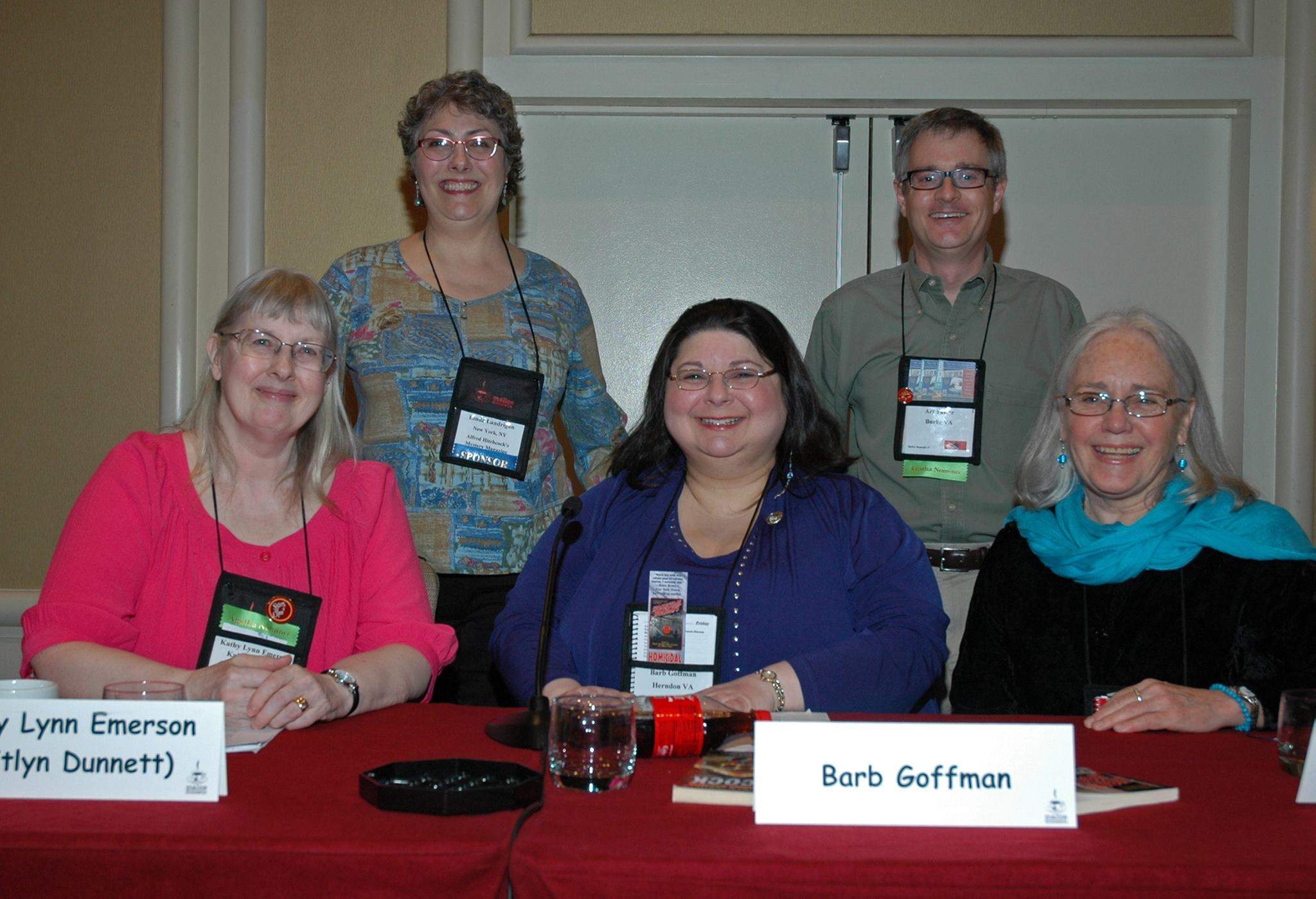
Kathy Lynn Emerson, Linda Landrigan, Barb Goffman, Art Taylor, Edith Maxwell
Malice also gave me a chance to meet up with and record a new podcast with Leslie Budewitz, who lives in Montana. Leslie read her 2006 story “The End of the Line,” and after that we talked about her inspiration for the story, how she manages two culinary series, and her non-fiction book, Books, Crooks and Counselors, which is a must-have legal reference for mystery writers. Continue reading
Filed under Uncategorized
Repercussions
A criminal act is never an isolated event: There are always consequences. Victims want vengeance; detectives want truth; citizens want justice.
In Marianne Wilski Strong’s “The Breaker,” an old coal processing plant is haunted—a consequence of the exploitative treatment of its workers, including children. In Brian Tobin’s “Entwined,” a moment’s distraction leads to the death of a professor, a man who touched many lives. A history of brutality entangles young lovers and parents alike in William Dylan Powell’s dark family drama “Sewing on Sunday.” And Elizabeth Zelvin’s nuanced “The Man in the Dick Tracy Hat,” set in the Cold War fifties, examines the results of a decision to become a traitor of sorts.
In other stories, Key West P.I. Megan Trevor boards a dowdy gambling cruise to find out where the money is leaking out in John C. Boland’s “Her Father’s Daughter.” Bob Tippee brings us a tale of the corporate snares that await the young and ambitious in “The PLT.” And for our Mystery Classic this month, Evan Lewis introduces us to a hardworking journalist from another era in Richard Sale’s “Flash!”
But in all these stories, the intended consequence is reading pleasure.
Filed under Uncategorized
As Luck Would Have It: Our May Issue
Some investigators and criminals are blessed with brains and nerve, some with sheer dumb luck. How else to explain the ability of hapless housebreakers Yarnell and Beaumont, in R. T. Lawton’s holiday burglar series, to dig themselves out of impossible situations—literally so in “Groundhog Day”—albeit none the wiser, or richer? And luck also serves efficiency-obsessed industrial engineer Vi Celucci, in Robert Mangeot’s “Two Bad Hamiltons and a Hirsute Jackson,” when it sends some counterfeit bills her way, prompting her to trace their source.
Luck, or fate, detours Brian Ellis on his way to a regional sales meeting, but the film buff handles the resulting situation with aplomb, and a few good lines, in John M. Floyd’s “Dreamland.” The young Chinese clerk called Rabbit feels he has encountered some bad luck when a professional thief calling in his markers demands that he draft an unusual will in “Rabbit and the Missing Daughter” by Leah Cutter. And Evan Lewis has a little fun with genre conventions in his story “The Continental Opposite,” introducing young P.I. Peter Collins (whose name, in underworld parlance, means “nobody”).
Finally, we welcome the return to these pages of Sheriff Huck Finn, Deputy Joe, and the other residents of turn-of-the-century Marquis, Iowa, in Joe Helgerson’s “The Case of Captain Nemo’s Half Brother,” in which another quirky character gets his day. Check back here on Friday, when Joe Helgerson will talk about his inspiration for this series.
With a lineup like this, your chance to enjoy our annual humor issue is more than just dumb luck.
Filed under Uncategorized
Creative Friction: Heating Up Crime
Crime may be personal, but it occurs within the context of social or cultural frictions that give each criminal act its particular character. Several of this month’s stories arise from the stresses of such cultural frictions.
In our cover story, Martin Limón introduces a new series character, Il Yong, an American soldier turned freelance security specialist who operates in the highly contested cultural zone where North Korea and China operate. Two stories are set amidst the ideological frictions of the Cold War: Terrie Farley Moran’s “On Target” and John C. Boland’s “Marley’s Lover.” And the generational frictions of the sixties drive “A Crown of Thorns” by David Edgerley Gates, set on the campus of the University of New Mexico. In this issue we also welcome the return of some favorite characters: Madame Selina and her young assistant Nip confront a
menacing apparition in Janice Law’s “The Ghostly Fireman,” Eureka Kilburn as a teen has a sense for what’s really going down in a hot environment in Jay Carey’s “We Are All Accomplices,” and those big-hearted fixers Akin and Jones zero in on scam artists in Dan Warthman’s “Mr. Smartphone.”
This month’s friction fiction will warm you in the cold season.
Filed under Uncategorized