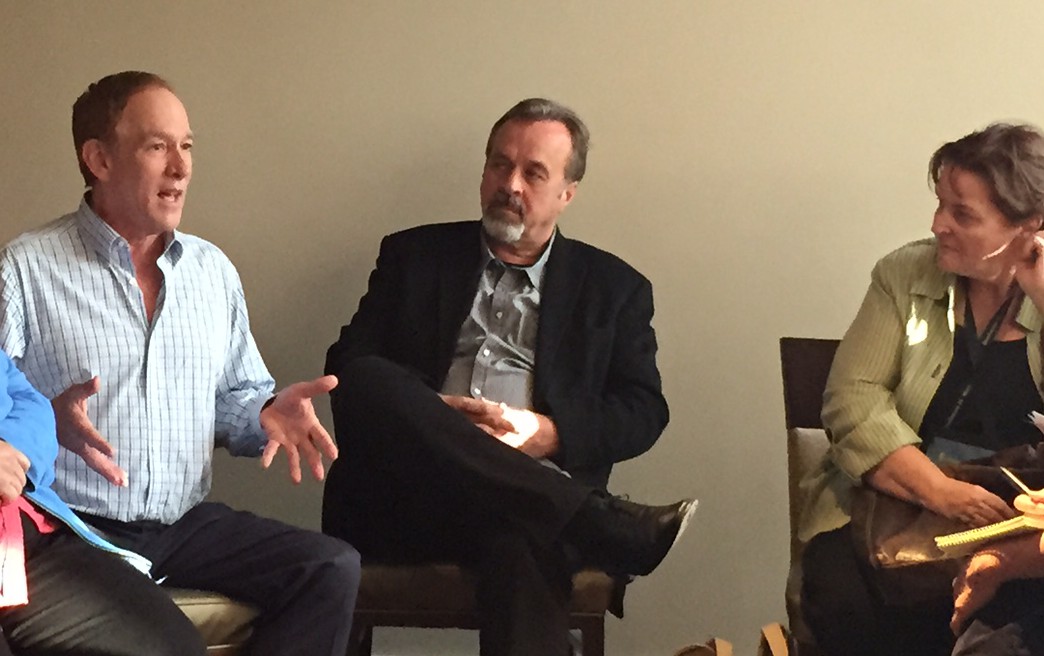
One of the pleasures of Bouchercon is the opportunity to talk shop, and when the conference is held in Long Beach, California, “shop” may include the people who write mysteries for film and television. This year I had the opportunity to attend a meet-and-greet with some of the writers and actors for the TNT show Major Crimes, and though they represent a different medium, I was struck by the similarities of concerns faced by writers everywhere.

James Duff; Mike Berchem; Terrie Farley Moran
The primary difference, of course, is the collaborative nature of the writing process. The writers begin work on a season at the very big table in the writers’ room, where they spend a few weeks hashing out the theme for the season and the story arc over 15 to 19 episodes. A spinoff from The Closer, Major Crimes is an ensemble show, which brings its own challenges. One added difficulty, according to the show creator/producer/writer James Duff, is the switch in dynamics as they are aiming for a multi-faceted view of the justice system.
Of the eleven or so regular writers, Mike Berchem, brings to the stable his knowledge of just how the system works. Before his transition to scriptwriting, he was a homicide detective in L.A. for 23 years, so he gets the final pass of each script. For his own scripts, he finds it a challenge to “write to a clock, with some rising action three or four times in a episode” to accommodate the commercial breaks and ensure that people will come back to the show. Kendall Sherwood, one of the youngest writers, noted that she is more drawn to the emotional scenes, and what she finds most challenging is “how to get a clue to come to light organically and in a way that serves the story structure.” James Duff added that even the personal stories interwoven into the procedural must track with the overarching theme of the season.
But despite the collaborative nature of the process, the writers for Major Crimes are also concerned with many of the same challenges as the other writers at Bouchercon: establishing and developing interesting characters, telling engrossing stories involving crimes, pacing the stories to engage the interest of their viewers, and moving their characters along arcs of both plot and emotional development.
These are just a few snippets from the conversation with the scriptwriters that suggested to me new ways of thinking about pulling a short story together.