One of the initial decisions that every author must make is whether to write in the first-person (I) or the third-person (he/she/they). To the reader this may seem like a technical matter with limited effect on the end product, but in the mystery story, the stakes are amplified; there is a crime to be solved, and having—or not having—access to the inner workings of the mind is of paramount importance to how the solution to the mystery is revealed.
The first-person narrator seems less popular in contemporary crime fiction as writers appear to prefer the freedom to move through time and space, from scene to scene, from character to character, and from mind to mind. But it wasn’t always this way: the Sherlock Holmes stories, the early Agatha Christie, and the Nero Wolfe novels all employ a first-person narrator. And in each case, it’s the plodding sidekick—Doctor Watson, Captain Hastings, and Archie Goodwin—who tells the story from the perspective of “I”. There is good reason for this: the reader needs to be kept a distance from the machinations of the mastermind detective’s inner thoughts. Imagine if the reader is permitted to know all that Holmes, Poirot, or Wolfe are thinking. The mystery would be solved quickly; the story would be over almost before it began. Justice would be served, but the reading experience would be short. How often is Watson forced to admit, “I confess that I was filled with curiosity, but I was aware that Holmes liked to make his disclosures at his own time and in his own way”? The good doctor is the filter between the reader and the detective, denying us access to Holmes’ omniscience.
Most of the earliest authors of the hardboiled school, who, in inventing their own style, wrote in reaction to the intellectual puzzles of the earlier mysteries, continued to write in the first-person: Hammett, with his nameless Continental Op, Chandler with Phillip Marlowe, and later, Ross MacDonald with Lew Archer. The new hardboiled detective wasn’t a genius, he was a man of action, tough and immediate. He wasn’t sitting in his armchair, smoking his pipe, thinking about whodunnit; he was knocking down doors not knocking on doors—and getting knocked down himself, if not knocked out. The detective in these early noir novels parallels the reader: the two locked together, united in purpose, chasing down the killer page by page; the detective’s discoveries are simultaneously made by the reader. There is no space between when the detective has a flash of understanding and the reader learns of it.
And it’s not just the immediacy: writing in the first-person is the most realistic of all narrative techniques. It is how we experience our world everyday: locked inside our heads, looking out at the mystery of life around us, unable to see into the black boxes of others’ psyches. In truth, the novel is the one artistic form that fully allows us into the mind of another, to know—if only on a fictional level—the voice, the thoughts and emotions, the dreams and loathings of another. (Film occasionally tries voice-over to get at this intimacy and fails miserably.) James M. Cain took it a step further and had some of his first-person narrators explain the very act of writing their stories. Frank Chambers in The Postman Always Rings Twice: “So I’m in the death house now, writing the last of this so Father McConnell can look it over and show me the places where maybe it out to be fixed up a little, for punctuation and all that.” Even the copy-editing is made transparent!
And so when I write, I’m reaching for that same feeling—to be immediate and realistic, to show the world as we experience it, to propel the reader through the pages alongside the detective, to have them in his head sharing his discoveries, failures, and doubts in real time as if they were their very own.
Alexis Stefanovich-Thomson is a writer living in Toronto. He is a past winner of the Black Orchid Novella Award, the Crime Writers of Canada Best Novella Award and the Toronto Star Short Story Contest. His first novel, The Road to Heaven, was published by Dundurn Press in 2024. Visit his website at https://www.alexisstefanovichthomson.com/
When most readers and writers think of a crime fiction series, they envision following a single protagonist and his or her sidekicks through several stories. Consider, for example, Dashiell Hammett’s Continental Op, Robert B. Parker’s Spenser, Sue Grafton’s Kinsey Millhone, and any of hundreds of other amateur and professional sleuths who come immediately to mind.
Not me. I stumbled backward into writing a series in which the setting—a fictional version of West Texas—is the reoccurring element that ties the stories together. This began with “Quarryville, Texas,” a story I wrote for The Private Eye Writers of America Presents: Fifty Shades of Grey Fedora (Riverdale Avenue Books, 2015). In the story, a private eye from Waco travels to Quarryville to solve a decades-old crime.
The quarry at the heart of Quarryville’s economic existence had closed in the early 1950s, leading to the town’s “long, slow slide into oblivion,” and the “dried-out scab of a town” is barely clinging to life at the beginning of that story. I returned to Quarryville for “Smoked,” written for Noir at the Salad Bar (Level Best Books, 2017), a story later included in The Best American Mystery Stories (2018). In “Smoked,” a former biker in the Witness Protection Program opens Quarryville Smokehouse, a barbecue joint that is soon named one of the state’s best. This unexpected publicity leads to all kinds of trouble.
The notoriety of the Quarryville Smokehouse brings visitors to Quarryville, and that sparks a “rebirth on Main Street” in “Mr. Sugarman Visits the Bookmobile,” written for Shhhh…Murder! (Darkhouse Books, 2018). As the story begins, an antiques shop and an art gallery are scheduled to open within the month.
In “Sonny’s Encore” (Black Cat Mystery Magazine #9, 2021), we visit Quarryville’s past when we experience the 1935 robbery of the quarry’s payroll office.
In subsequent stories, the town plays a minor role. Instead of featuring Quarryville, I developed the region, adding towns such as Chicken Junction and Mertz. Even so, characters visit Quarryville, spend the night in the six-room motel, dine at the Quarryville Smokehouse, or travel through on the way to somewhere else. I even set stories outside of West Texas in which characters from Quarryville play prominent or minor roles.
But I didn’t return to modern-day Quarryville as the central setting until “Barbed Wire Bison” (Alfred Hitchcock’s Mystery Magazine, November/December 2024). The smokehouse is still popular, the antiques shop and the art gallery are now open, and the town is no longer a dried-out scab.
In “Barbed Wire Bison,” a woman moving to Quarryville hires two retired barflies to help her unload her rented moving van. There aren’t many secrets in a small town, and before long they wonder what she’s hiding or who she’s hiding from. When violence comes to town, they learn the reason behind her relocation.
This is far from my last West Texas story. There’s one coming up in a future issue of AHMM about a young woman from Quarryville who travels to Hollywood to seek her fame and fortune, and there are others in the pipeline.
While every West Texas story can be read and enjoyed without reading any of the others, seeing how they all tie together provides readers with a richer experience.
And, as I discovered by accident, a series doesn’t need to feature a reoccurring protagonist. Sometimes the right location can tie everything together.
Michael Bracken (www.CrimeFictionWriter.com) is an Edgar Award and Shamus Award nominee whose crime fiction has appeared in The Best American Mystery Stories, The Best Mystery Stories of the Year, and many other publications. Additionally, Bracken is the editor of Black Cat Mystery Magazine and several anthologies, including the Anthony Award-nominated The Eyes of Texas. In 2024, he was inducted into the Texas Institute of Letters for his contributions to Texas literature. He lives, writes, and edits in Texas.
If you’ve visited my website, the first thing to catch your eye was probably the dragon. It’s perched on a mountaintop only slightly smaller than itself, wings spread as if to fly off the screen. Or perhaps it was the image of the cowboy with the smoking gun, my recurring Texan private eye, Trip Allison. Or, maybe the haunted graveyard struck you, with its askew tombstones jutting out of the mists. (There were supposed to be zombies, but I ran out of money for my Web designer.)
As for me, my personal favorite is the alien spacecraft hovering above all of these disparate elements. Suspended against a star-studded sky, a beam shines down from the ship’s belly, highlighting these words:
WORLDS ABOVE & WORLDS BELOW
The Fiction of James A. Hearn
Confused yet? You’re not the only one, my friend. You see, I’m a multi-genre writer. Or at least I’m trying to be.
HUMBLE BEGINNINGS . . .
Science fiction, fantasy, and horror were my first loves. As a kid, my brother Sidney and I consumed thousands of hours of genre fiction in the form of comics, television, and movies. Our favorites were Superman, StarTrek, and StarWars. I wouldn’t be the writer I am today without my brother’s creative mind lighting the way, that’s for sure.
These weren’t idle pursuits for Sidney, or for me. You see, Sidney had Down Syndrome and was afflicted with a degenerative hip that confined him to a wheelchair in his final years. Genre fiction—with its fantastic, reality-shattering elements—enabled him to literally live out his dreams, to take his mind places his body couldn’t go. And by extension, because I understood my big brother through these stories, I was able to understand what he was saying when others couldn’t. To borrow a StarTrek concept, I became his universal translator in later years. (To read more about Sidney, visit my guest post in SleuthSayers, “An Evening at the Opera House.”)
Naturally, when it came to writing, I returned to my favorite genres. It never occurred to me that I could write crime fiction until the summer of 2017, when I crossed paths with Michael Bracken.
WHEN REAL LIFE GOT TOO REAL . . .
In 2016, after losing a comfortable job and basically hitting rock bottom, I returned to writing fiction. I’d gained valuable life experiences. Joy. Grief. Getting married on the beach in Maui to my best friend. The death of both parents to cancer. Sidney’s passing in 2019. The everyday triumphs and everyday trials that make up the sum of who and what we are.
But instead of novels I couldn’t quite finish, short stories were coming out. I wrote about aliens, robots, vampires, and wizards. Unfortunately, none of these stories sold at the time. My only encouragement came in the form of nicely worded, non-generic rejection letters. Editors had read my stories to the end, at least, but had decided to pass for one reason or another.
I pressed on, becoming a two-time Finalist in Writers of the Future. WotF is a quarterly contest for amateur science fiction and fantasy writers. Winning would’ve been like getting the Golden Ticket to Willy Wonka’s chocolate factory—you go to Hollywood, you meet contest judges like Orson Scott Card and Brandon Sanderson, and you get into a kick-ass anthology.
But I didn’t win. I kept wondering if I was any good, and there was a nagging suspicion that I wasn’t.
A SALE! THE EDGARS! BAMS!
I first met writer and editor Michael Bracken at a science fiction and fantasy convention in Austin, Texas. Actually, let me back up; that’s not quite true. He was participating on a panel about writing for anthologies and I was safely, anonymously, in the audience.
I am by nature a shy person and public speaking of any form is my greatest fear. (I don’t know why public writing doesn’t bother me.) Anyway, I wanted to introduce myself to Michael and tell him I was interested in writing a story for The Eyes of Texas, a private eye anthology he was pitching.
But I didn’t. Despite never having written a private eye story in my life, I was determined to write one for The Eyes of Texas. A few weeks later, “Trip Among the Bluebonnets,” my first sale, was born.
Other sales soon followed, including a horror story, “Tunnel Visions,” to Monsters, Movies & Mayhem. Later, Michael and I co-wrote “Blindsided” and sold it to AHMM. When I walked into a brick-and-mortar bookstore and bought that issue, I fulfilled a lifelong dream. Yes, I cried (read Trace Evidence, “A Writer’s Tears”).
In 2022, “Blindsided” was nominated for an Edgar. I traveled to New York City and got to meet some great writers, including R.T. Lawton (the winner). Here’s a secret: I wanted to win, of course . . . but a part of me was actually relieved that I didn’t have to get up on that stage and read my little speech.
Michael doesn’t know it, but I still have his voicemail saved to my phone from the day he called to say we’d been nominated. Whenever I’m feeling a little down, when Imposter Syndrome rears its ugly head, I pick up my phone and play that message. I have no doubt when my obituary is written, hopefully years and years from now, Michael Bracken’s name will be mentioned. Hey, it’s not every day that two guys are nominated for an Edgar for Best Short Story!
I’m not sure anything will top the Edgars (other than winning), but having “Home Is the Hunter” chosen for Best American Mystery and Suspense 2023 comes pretty darn close. Written for my Dad, a hunter, “Home” is pure noir and a search for the childhood home I’ve lost. Every once in a while, a reader will contact me through my website and tell me how much they enjoyed that story. I’m blown away that random strangers will take time out of their lives to send me a few kind words. It means a lot.
CROSS-GENRES . . .
I guess it’s only logical that my other genres bleed over into my crime fiction. “The Nine Lives of Dr. Impossible” is my fourth story for AHMM, and it is by far the most unconventional. “Blindsided” dealt with the aftermath of crime; “When the Dams Break” was a mystery about a missing woman; “For Lydia” was a private eye and confidence game story. As such, these fit squarely within the pages of AHMM.
But “The Nine Lives of Dr. Impossible” doesn’t fit the mold of the traditional crime story. It’s a genre-bender; there’s a TV superhero, his mysterious “ensorcelled” mask, a romance gone wrong, an attempted murder, and a Christmas miracle. It’s Adam West’s Batman meets Charles Dickens’s A Christmas Carol; it’s a weird story and I love it because it’s weird.
I’ve written other genre-benders. “The Third Wish” (Black Cat Weekly #69) is about a troubled child of divorce who goes to live with her mother and her new husband, a ruthless gangster. Though set at Christmas, this story has a sinister streak reminiscent of TheOmen, one of my favorite movies. It’s a blend of crime and horror, but it’s also noir.
“Here Comes the Judge” is a novella in Michael Bracken’s Chop Shop series, an anthology about Dallas car thieves. In my story, brothers Brad and Rolly steal The Judge, an ultra-rare vintage GTO, from a funeral home for the biggest payday of their careers. But instead of cruising Easy Street, the discovery of cursed tarot cards and an unwelcome guest in the trunk sends them on a collision course with the afterlife. It’s a crime caper, a ghost story, and a comedy.
THE FUTURE . . .
I’m still writing about robots and wizards, and I have a dream to write a fantasy novel where I can build the world from the ground up. In short, I’m keeping my weirdly themed dragon-spaceship-graveyard-P.I. website. Truth be told, I’ve had much more success in crime and mystery fiction than my original loves of science fiction, fantasy, and horror.
And that’s fine by me. In middle-age, just when you’re thinking you’ve likely experienced “the best” in everything, from music to movies to books, it’s an absolute blessing to discover something new. That’s what crime fiction and all its subgenres are to me. In addition to a slew of modern short story masters in AHMM and EQMM, I’m diving headlong into Raymond Chandler, Mickey Spillane, Agatha Christie, and James M. Cain, to name a few.
Honestly, I kinda feel like my brother Sidney is here with me, looking over my shoulder as I read. The way he did when I used to read comics to him. With every new book and short story, we’re Captain Kirk and Mr. Spock on the Enterprise, boldly exploring new frontiers in genre fiction. Sid’s playing Kirk, of course, but that’s as it should be.
Live long and prosper, y’all.
An Edgar Award nominee for Best Short Story, James A. Hearn writes in a variety of genres, including mystery, crime, science fiction, fantasy, and horror. In addition to Alfred Hitchcock’s Mystery Magazine, his work has appeared in numerous anthologies, including Monsters, Movies & Mayhem and Best American Mystery and Suspense. Visit his website at http://www.jamesahearn.com.
It took me far too long to come to terms with the fact that a central part of writing is not writing.
Way back in the late 1980s I took a year out after university to write full-time. At that point, I’d only sold a couple of pieces of writing to small-press magazines, and I had very little money to live on, so it was a huge gamble. Because of this massive commitment, I felt I had to prove myself by being at my desk all day, every day. It was a good discipline, and it certainly worked: in the first twelve months I’d completed a novel and I had started to sell short fiction to professional magazines and anthologies. On the back of this, I gave myself an extra six months and during that time I sold my novel to a major publisher; somehow that year out lasted ten years, before the erratic lifestyle – and income – of a writer was no longer enough for my growing family responsibilities and I finally had to get a real job.
It was probably only when I stopped writing full-time that I realised how important the whole not-writing thing was. Just because I was away from my writing desk, it didn’t mean the creative part of my brain was switched off, and often it seemed to function better away from the blank page: no matter what I was doing, that part of my brain was bubbling away in the background. I’d get ideas for new stories or plot twists or random stray images while I was commuting to work, or in a day-job meeting, or chatting to someone while we waited for the kettle to boil.
A writer never stops.
The need to pay the bills and support my family kept me in day jobs through until ten years ago. When I finally returned to the life of a full-time writer, it was as if I had unlearned that lesson. All over again, I felt the need to justify myself: I had to be at my desk, and I had to feel that everyone could see that I wasn’t slacking just because I was my own boss again.
It took me at least a couple more years to convince myself that it was just as important to be away from the desk as at it. One day I might write a thousand words of new material; another day I might edit a couple of chapters, fixing all those shoddy words I’d churned out a few weeks before; and another day I might go for a ten-mile walk and have a single idea that comes from nowhere but which will move my work-in-progress forwards, or which might twist the plot in unanticipated directions, or simply give me a new insight into why my characters are the way that they are. Which of those days is more productive? None: they’re all vital parts of the process.
Most days now I go for a walk, even when I’m writing hard and fast; some days, going for a walk is all I do. One way I helped myself to accept the importance of all this not-writing was that I started to call it my Outdoor Office, and I’d post photos online of my Outdoor Office of the Day. Sharing photos on social media has been appreciated by many of my friends, but I do know that it’s also irritating: reminding them that they’re stuck in their offices and classrooms while I’m out hiking. But what can I do? It’s part of the job. Honest, it is!
One of the unexpected bonuses of this is that it has reawakened my love of photography. Back when I was a teenager, my ambitions were to become either a writer or a photographer. (Or a rock star, but that was never going to happen.) The writing won, and for all kinds of reasons the photography fell by the wayside. The Outdoor Office social media postings started out as simple photos taken with my phone, but soon that old passion was reignited. Now, my Outdoor Office days are rarely without a proper camera and a couple of lenses. In fact, they can be so much about the photography that I’m in danger of forgetting the real justification for my time away from the desk (“It’s work. Honest it is!”) But then I’ll stumble across a ruined old building, or a minor detail in the landscape, and I’ll get absorbed in how to find a composition that will make an image that will tell the story of the place… and then I’ll start thinking about that story, and what might have happened here; I might latch onto that or my mind might start skipping in all kinds of random directions, and I’ll get that one idea or insight that is worth those thousand words at the desk, and it will all make sense.
It really is my job, doing all this, and I love it!
The roots of the story “Las Hermanas Cubanas”—The Cuban Sisters—go back several years. In 2014, after retiring from my “real” job, my wife and I sold everything and left our home in Oregon for the beautiful colonial city of Cuenca, Ecuador.
The first Ecuadorian that we interacted with was Emilio Morocho. Emilio owned a taxi, and we had hired him online to take us from the airport in Guayaquil to our new home—a four-hour journey from sea level to 8500 feet elevation in the Andes Mountains. The journey showcased some of the most jaw-droppingly spectacular scenery you will ever witness, but in all honesty, I was most impressed by our driver. Emilio, like many Ecuadorian males of his age—mid-thirties—had spent several years in the United States, so his English was quite good. If the Ecuadorian people had hand-picked an ambassador to welcome us to our adopted country, they couldn’t have chosen a better one. He had an intimate knowledge of the history of the country as well as the current political and economic climate.
Emilio left Cuenca for Minneapolis around 2005 and had just recently returned. It struck me as we talked how terrifying it must have been for him at the age of twenty-five to relocate to a city 3,500 miles away where he barely spoke the language. Conversely, what must it have been like returning almost ten years later, with all the changes that his hometown had undergone.
I am a writer of mysteries and so I’m always looking for new characters. I knew that I had found one. Fortunately for Emilio and his family, but unfortunately for me, he was the personification of a hard-working family man. So, I loaded him up with a raft of insecurities and a drinking problem and sent him out onto the streets of Cuenca as Wilson Salinas, Investigador Privado.
I needed characters for Wilson to interact with. Over the next couple of years as I refined Wilson, I created a cast of supporting characters, most of them based loosely on Ecuadorians I had met or observed in my daily life. A couple of those characters figure prominently in this story:
Javier (Javi) Morales, another friend from childhood who had become a transit cop but used his knowledge of the inner workings of Cuenca’s myriad bureaucracies to augment his income.
Capitán Ernesto Guillén, a corrupt detective with Ecuador’s policía nacional. Wilson and Guillén meet in my first mystery published in AHMM—“The Karaoke Singers”—March / April 2018; https://tinyurl.com/Karaoke-Singers
Guillén quickly became a favorite of mine to the point that I started another series of Ecuadorian mysteries featuring him. I made him a bit less corrupt and more competent as a detective, rather than just a foil for Wilson.
But, back to the story at hand. I have over the years begun stories where Wilson and Guillén might interact not as comrades but as reluctant co-conspirators. Most of them fell by the wayside, but I think this one hits the mark.
“The Cuban Sisters” grew out of a day trip my wife and I took to Azogues, a colorful city of 75,000 souls about twenty miles northeast of Cuenca. I was struck by the number of likenesses of Ernesto “Che” Guevarra that we saw around town—on walls, lampposts and on the front of a small restaurant aptly named Café Che. The story came to me like most of them do, as an imaginary scene inspired by an actual setting.
I originally envisioned this story as a vehicle to highlight the character, Javi Morales. Although Javi appears in many Wilson Salinas mysteries, this is the first time that he plays a major role.
I soon realized that this might be the story where Wilson must work with Guillén, his sworn enemy. Guillén needs Wilson’s help to locate Javi, whom he suspects of murdering his brother-in-law. Wilson agrees to help him, in the hopes of at least derailing the investigation into his friend, or at best, proving his innocence.
I enjoy writing—and reading—character-driven versus plot-driven stories. I enjoy crafting interesting but believable characters. The most challenging aspect of writing for me—and paradoxically the most satisfying—is creating situations to put the characters into and finding unusual but realistic ways to get them out.
As a side note, I have to say that writing about Ecuador has made this aspect much easier. Frequently over the course of the six years we spent in Cuenca I heard expats and visitors proclaiming, “Ecuador is like the U.S. was in the fifties and sixties.” I will let others debate if that is a good or a bad thing. But from my view as a writer, the relative “technological innocence” of the Ecuadorian people as well as the lack of network connectivity between bureaucracies allows me to emphasize the characters rather than the “CSI” aspect. In my opinion a story such as this one would not work if set in the modern-day U.S.
BTW: The characters of Virginia and Carla are based (very loosely) on two elderly Cuban sisters I met on a visit to an old sugar mill that had been run by their father.
“Las Hermans Cubanas” is Tom Larsen’s fourteenth contribution to Alfred Hitchcock Mystery Magazine. His stories have been published in Black Cat Mystery Magazine,Mystery Tribune, Sherlock Holmes Mystery Magazine and others. Tom’s short story, “The Body in the Barrel” AHMM July/August 2021; https://tinyurl.com/Body-in-the-Barrell received the 2021 Black Orchid NovellaAward and appeared in “The Best Mystery Stories of the year, 2022.” His story, “Poor Maria” AHMM January / February 2022; https://tinyurl.com/Poor-Maria appeared in “The Best Mystery Stories of the year, 2023.” Tom Lives with his wife in the beautiful Pacific Northwest. You can read some of his work here: http://www.amazon.com/TOM-LARSEN/e/B00N00JLZM
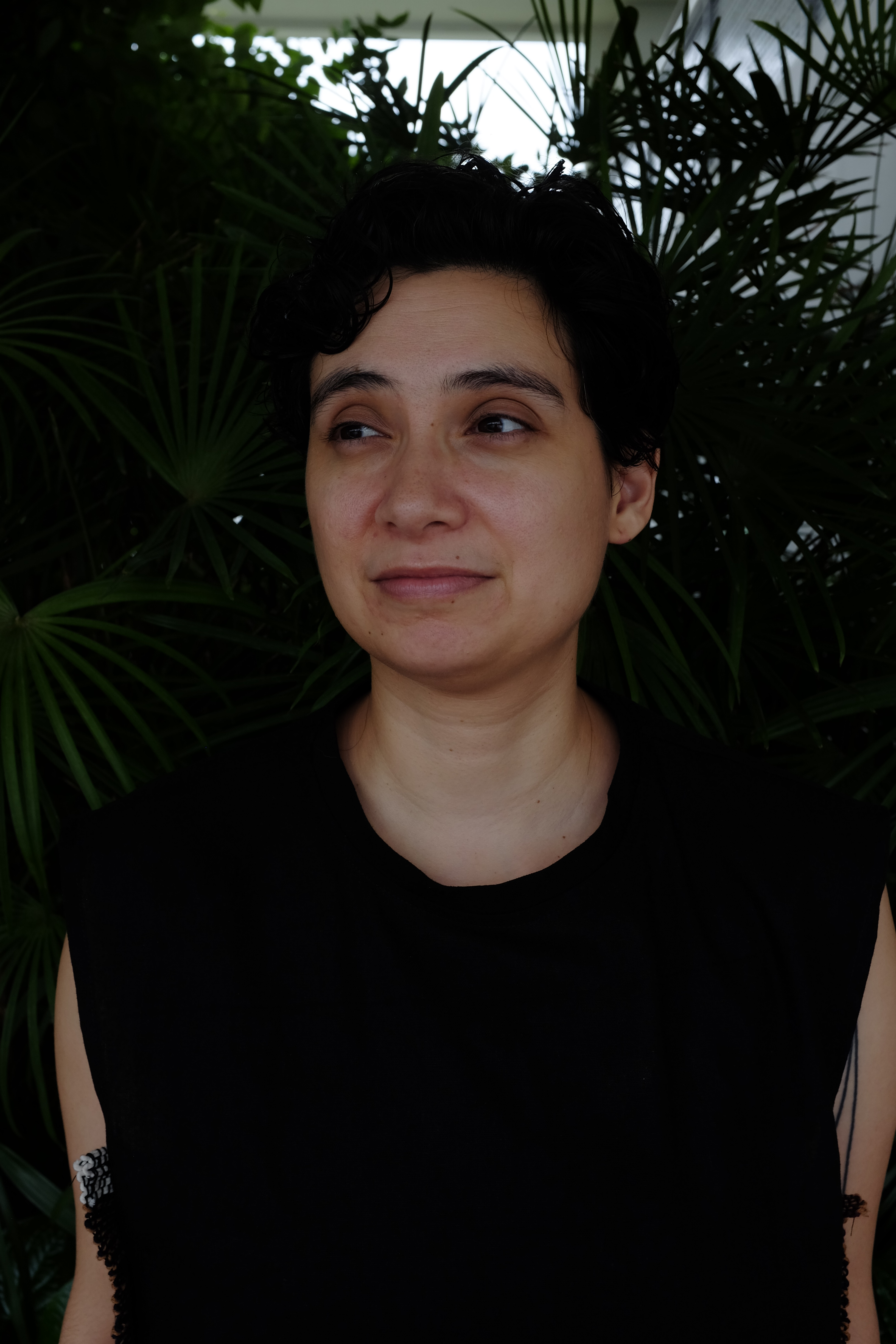
Laurel Flores Fantauzzo began penning AHMM’s Booked & Printed column in our March/April 2019 issue. Readers may recognize her name from our masthead; she previously served as the magazine’s assistant editor. Laurel is the author of The First Impulse (Anvil, 2017) and the upcoming The Heartbreak of Corazon Tigubio (HarperTeen, 2021). Her work has appeared in the New York Times, World Literature Today, and the Mekong Review, and she is an assistant professor at the University of Hawaii at Manoa. AHMM managing editor Jackie Sherbow had the opportunity to ask Laurel some questions about her work, reviewing, literary citizenship, and more.
Laurel Flores Fantauzzo. Photo courtesy of the author.
Jackie Sherbow: The First Impulse is a work of nonfiction about the lives and unsolved murders of film journalists Alexis Tioseco and Nika Bohinc. Can you talk a little bit about your experience writing this book and what you learned during the process?
Laurel Fantauzzo: In 2010 I went to Metro Manila, my mother’s birth country, on a Fulbright scholarship. I started meeting young artists, filmmakers, writers, NGO workers and activists. They were haunted by the sudden murders of their friends, Alexis and Nika, and the case remained unsolved. I identified with Alexis; a mixed-race young man of the Philippines, who chose to stay there, and with Nika, who went to the country because she loved him. They were both young writers too—film journalists.
Because the case was unsolved—and three suspects remain at large to this day—I realized it would be a book humanizing both the victims, and the country in which they died. So much of true crime lionizes the perpetrators, the killers—the victims are often props left behind. My book spends more time on the reverberations of loss, and the presence of the victims that remains, while placing the crime in context with the social, postcolonial pain of the country.
Considering the epidemic of homicide in the Philippines now, I’ve been told the book was prescient. I do wish that were not so.
JS: How do mysteries and crime fiction fit into the general literary tradition and sociopolitical/cultural landscape?
LF: I had an advisor, the writer Patricia Foster, tell me this: a crime is like a Rorschach test for a society. A reader will witness it and perceive any number of elements. Humans are drawn to questions of wrongdoing, to questions of injustice, to the puzzles of incompleteness. That’s my theory, anyway, as to the role of mysteries and crime fiction.
In America in particular, violence and killers hold a lot of power in the larger imagination, often for entertainment. It’s a trend about which I have many reservations.
JS: Your reviews include nonfiction, children’s books, novelty books, and other works in addition to traditional crime novels. How do you source books for review?
LF: I follow my curiosity, and I also keep an eye out for any trends that seem to address some larger societal question or anxiety. I did a column on the anxieties of social media in novels, for example. I’m deliberately eclectic.
More practically, I look at social media and industry magazines to see what’s coming up. I also like to find anything that may have flown under the radar. I don’t look at any other reviews of a book before writing mine.
I’m less likely to review literary heavyweights that may approach household names; I like pointing out emerging writers, or writers who’ve worked for a long time without much recognition.
JS: What type of literary citizenship in a community do you believe book reviews serve?
LF: It’s healthy to think out loud about books; to join in conversation about them, to express our praise and reservations and questions about books. It’s also healthy to point out works that may have gone unnoticed, if not for some public discussion of it in a magazine like AHMM.
JS: What do you look for in a book to review?
LF: I have no prescriptive rubric! I do like writers who spend time developing every character; for whom no character is a device, but a fully realized person, even if just for a page. I also like to see a context illuminated, be that of a place, an era, or some other kind of larger background.
Because I’m also in academia with a full-time teaching load, and writing books of my own and completing a PhD, I typically read the first two pages of a review copy to decide if it’s for me. If I’m a little curious, I’ll read the whole first chapter. If I’m still compelled after that chapter, I’ll likely review the book. The method has worked for me so far.
JS: For you, what constitutes a complete review of a book?
LF: The reader should know what the book is about, have some context for what the author is attempting to portray, and the reviewer’s opinion as to whether that attempt succeeded or not.
JS: What should any publisher know when sending a book to your attention?
LF: True crime books that spend a majority of time attending to the perpetrators, not the victims, are likely not for me. I do like unique voices, and narrators we may never have met before.
JS: What type of books do you personally enjoy to read/what are you reading right now that won’t make it into the Booked and Printed column?
LF: I read a lot of longform nonfiction, either in book form or on literary or journalistic websites. I enjoy lightly speculative literary fiction, young adult fiction, and graphic novels. I also reread favorite novels from my childhood and adolescence. I necessarily read academic books about mixed race, trauma and recovery, the Philippines, and Asian-America.
JS: Tell us about what else you’re working on right now.
LF: I’m completing a young adult novel for HarperCollins, The Heartbreak of Corazon Tagubio. It’s set in Los Angeles and Manila, Philippines, and while it’s not a crime novel, I think it takes some taboo risks.
Thank you, Laurel! You can read Laurel’s book-review column in every issue of AHMM—and keep an eye out for her upcoming novel The Heartbreak of Corazon Tagubio from HarperTeen in winter 2021.
Earlier this year, The Center For Fiction moved from its Manhattan site to a new home in downtown Brooklyn. EQMM and AHMM managing editor Jackie Sherbow had a chance to speak with Allison Escoto, the Center’s head librarian, about the Center and its Raven Award winning mystery and detective fiction collection, her work and goals for the library, the organization’s history, and her thoughts on the mystery genre and other literature. Allison, a New Yorker by way of New Orleans, is a graduate of SUNY New Paltz and Queens College and has worked as a librarian for seventeen years. She is also a poet, copywriter, and the associate editor of Newtown Literary. Here is the first half of our conversation; the second half will appear tomorrow at SOMETHING IS GOING TO HAPPEN, the Ellery Queen’s Mystery Magazine blog.
Allison Escoto. Photo courtesy of The Center for Fiction.
Jackie Sherbow: You’ve had your hands full—literally and metaphorically—during the Center’s move to Brooklyn. What can you share about what the move has meant for the library and for your role there?
Allison Escoto: The Center for Fiction was previously known as the Mercantile Library of New York, an organization that had been in existence since 1820 and has had various homes throughout NYC in the ensuing years. Our building at 17 East 47th Street had been its home since the 1930s so you can imagine how much had been accumulated in that building, especially the library! I came onboard as the Head Librarian right before we moved out so I didn’t really get too much time to spend with the collection but now that we are settling in, I am really getting to know the collection. My vision in the coming years is to continue to add to the amazing titles we have collected over the years and to really take my time getting to know the great fiction that has been decades in the making.
JS: What was the relocation’s timeline, and what can you tell us about the new building?
AE: Our relocation from East 47th Street has been in the works for at least ten years, from the sale of our old location, to the design and planning of this new one. The new building is incredible! There are so many beautiful aspects to the design but my favorite part is of course, the library, which occupies all three levels. There can be little wrong with books everywhere!
JS: You joined the Center’s staff at a transitional moment in its history. How has it been for you to have such an intimate start to your time there?
AE: The unique thing about an organization that has been around for centuries is that even though it evolves and changes with the time, you can always sense the past all around you. I’ve been so lucky to see both the traditional and well-loved building with all its history and memories as well as to witness this exciting phase in an impressive new place. It has been great!
JS: What are you looking forward to now that the move is over?
AE: I am very much looking forward to meeting and greeting new members and program attendees. I’ve witnessed firsthand just how much blood, sweat, and tears have gone into making this Center a literary gathering place to celebrate fiction and I think welcoming people here is going to be great. I’m also looking forward to getting my hands on the collection!
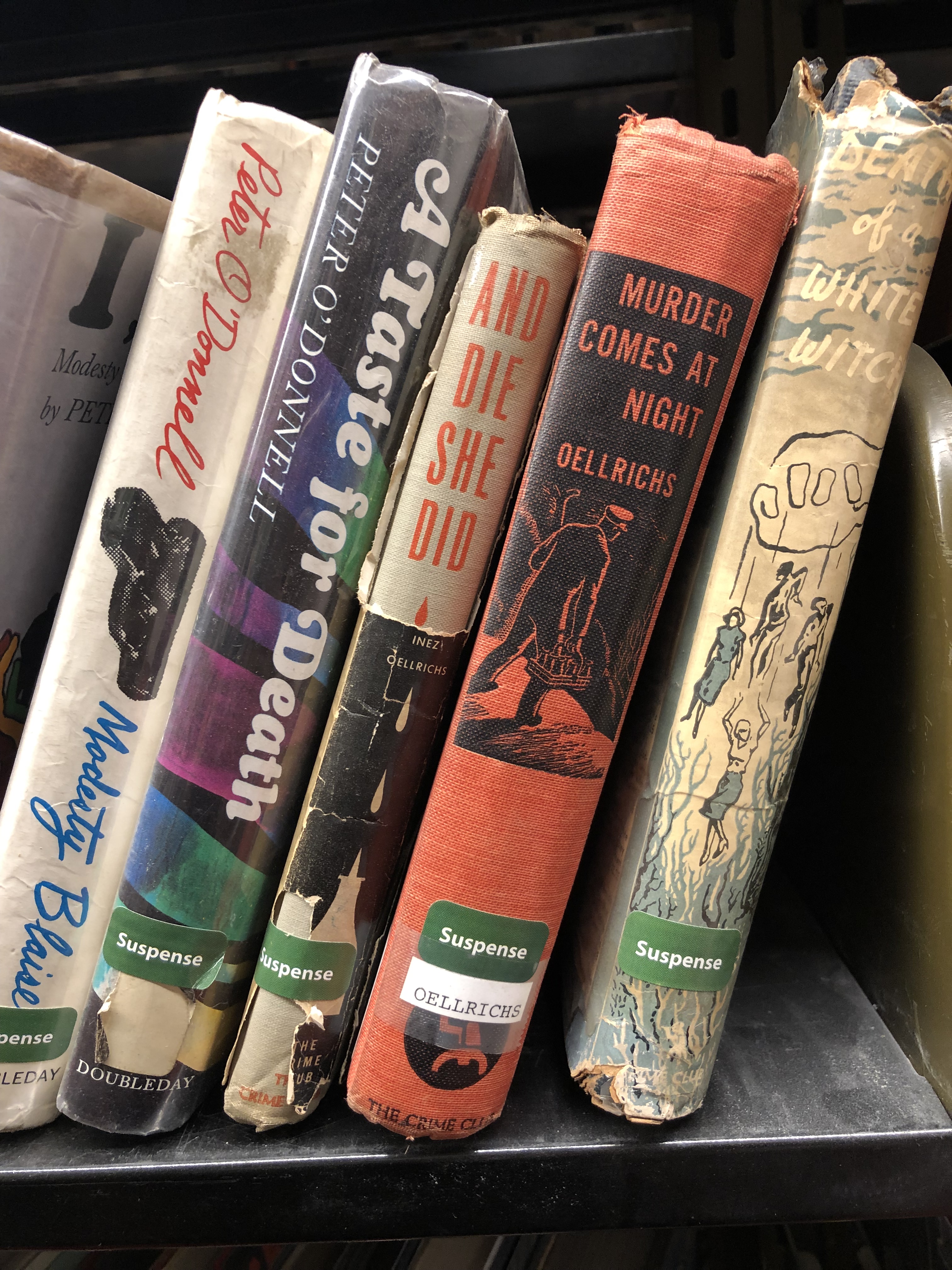
One corner of the Center’s extensive mystery/detective/suspense fiction collection. Photo by Jackie Sherbow.
JS: The Center for Fiction is the only organization in the U.S. devoted solely to the art of fiction. What is it like to work with a collection having a singular (yet vast) focus?
AE: As a lifelong and voracious reader, working with an entirely fiction collection has been a dream come true. In my previous jobs in a variety of libraries, fiction was my consistent favorite and to be able to focus on it here has been enlightening. I get to talk about, think about, and work around fiction all day!
JS: What can you tell us about the library’s award-winning mystery and detective- fiction collection?
AE: The mystery and suspense collection is the recipient of a Raven Award and it is a part of the collection we are very proud to have. Our in-depth collection is housed in the cellar of our new space, with over 16,000 titles of mystery and suspense, including rare titles and full runs of many mystery writers including Cyril Hare and Mary Roberts Rinehart as well as extensive collections from the golden age of detective fiction authors such as John Rhode and Ellery Queen. Our contemporary mystery and suspense is growing right along with us as a Center as well with the most dynamic and exciting new mystery fiction.
Photo by Jackie Sherbow.
JS: How often do you acquire new (or new to the collection) works of mystery?
AE: I order new books every month and throughout the year, I always have my eyes and ears open for brand new publications to add to our collection.
Photo by Jackie Sherbow
AH: Why do you think the mystery genre came to play such a big role in the library’s collection and the Center’s focus?
AE: From the inception of the Mercantile Library in the 19th Century, it was clear to the founders that their members wanted to read for entertainment and enjoyment, along with education. This organization has been collecting fiction and what they called “the best imaginative works” for the members and a huge part of that ended up being mysteries and suspense novels. The tradition was carried through the years and over time we amassed a great collection of the genre.
Kansas-based author and English instructor Cheryl Skupa writes book reviews (Among Worlds) and poetry (Phoenix, Oklahoma Council of Teachers of English). Here she talks about writing with the supernatural in mind and about crafting her debut short story publication, “Ghost in the Nemaha County Courthouse” (from our current March/April 2019 issue).
I always perk up when I hear local folklore and superstitions, especially when told with relish by someone connected, however distantly (perhaps nebulously) to the people and places in the story. These little snippets of local history and tragedy have the deliciousness of gossip. Ghostly tales have the power to transform even the drabbest places on earth into something magical—and creepy!
“Ghost in the Nemaha County Courthouse” was born out of local stories and my penchant for driving out of my way, sometimes down gravel roads to visit small-town courthouses, little cemeteries, and old churches. The courthouse in my rural county and those in surrounding areas provided plenty of atmosphere—old clanking radiators, broom closets which were once jail rooms, fainting couches, shadows, dust, and the knowledge that many anguished people had passed through these halls over the years. Intensely personal tragedies and triumphs have been absorbed into the old ornate woodwork with the smell of the furniture polish.
The cleaning lady, Evelyn Eichman, was, of course, based on me. Who knew that all those hours working my way through college, pushing my cleaning cart down halls, sweeping, mopping, and dusting would somehow find its way into my writing? My least-favorite college job became the best writing fodder—but then, writers use everything; they are composters of experience! Thank you, fiction and AHMM, for sanctifying those lonely, boring experiences!
The only drawback of writing about ghosts was that humankind has been telling these stories since the beginning. For me as a writer to veer off into fresh territory, I needed to understand what was happening to my cleaning lady, Evelyn Eichman, as she experienced the visions of the white woman and her stained dress. That took some thought and time. I scoured the local small-town newspapers, especially the sections which recalled local events in history. I reread the account of my small town’s informal historian (a local school teacher.) I tried to recall old stories my grandma had told me, and cursed the gaps in my memory.
In the end, I did what writers do—told the story that I most loved to read. Ghost stories always remind us, not only of past sins, but also that death may not be the end, that insignificant people, places, and actions matter, and that tragedy, however devastating, may become immortal in the retelling!
California writer James Tipton is the author of Annette Vallon: A Novel of the French Revolution(HarperCollins, 2008) and the upcoming collection Adventures Without Sherlock. You can find his short stories and poetry in Nostos and Blue Unicorn. His first tale in AHMM to feature Dr. Watson was “The Vampire of Edinburgh” (September/October 2017), and here he talks about that character, the series, and his story in the current issue, “Shiva’s Eye”—just in time for belated celebrations of Sherlock Holmes’s birthday. (Editor’s note: The phrase “twenty-five hundred strong” at the top of page 86 of the current issue of AHMM, the fifth page of “Shiva’s Eye,” was misprinted as “twenty-five thousand strong.” We regret the error.)
Doctor John H. Watson is one of the great overshadowed characters of literature (for others, see Jim in The Adventures of Huckleberry Finn and Nausikaa in The Odyssey; there are many). Sherlock Holmes is not being ironic when, in “A Scandal in Bohemia,” he says, “I’m lost without my Boswell.” He would not only have been lost to current recognition and to posterity, but in his own self-absorption and ego. In this blog, however, I’m not writing about Holmes, but about his companion, who, in the story “Shiva’s Eye,” encounters mysteries long before he ever encountered his famous friend. Moreover, we must admit it’s because of Doctor Watson’s writing that his friend became famous.
“Shiva’s Eye” can be read as a prequel to the Sherlock Holmes canon. Watson tells us in the beginning of his narration of the first Holmes novella, A Study in Scarlet, that the Afghan campaign in which he participated brought him “nothing but misfortune and disaster . . . I served at the fatal battle of Maiwand. There I was struck on the shoulder [in later stories we also find he was wounded in the leg] by a Jezail bullet, which shattered the bone and grazed the subclavian artery.” After he had “rallied” at the base hospital at Peshawar, he “was struck down by enteric fever [typhoid], that curse of our Indian possessions.” The battle of Maiwand was a major and unexpected defeat for the British in the second Anglo-Afghan war. Watson tells us that his “nerves are shaken,” and when he meets Holmes, the detective’s first words to him are, “You have been in Afghanistan, I perceive.” “Shiva’s Eye” sees this campaign, its disastrous outcome, and its seeming supernatural mysteries unfold through Watson’s eyes.
I am grateful to the Alfred Hitchcock Mystery Magazine for giving a chance for these Doctor Watson adventures to come out to the world. AHMM published “The Vampire of Edinburgh” in September/October of 2017, and now is set to publish two more of them after “Shiva’s Eye.”
These stories come from a collection of fourteen that I’m working on to be called Adventures Without Sherlock. There have been countless spin-offs of Sherlock Holmes in print and in film, but none that I know of which only features Dr. Watson, without the help of his illustrious friend. I’ve endeavored to stay true to the narrative voice of the Sir Arthur Conan Doyle stories, but mine develop the doctor’s character much further, covering the range of Watson’s adult life: from a failed romance in the Highlands that resurfaces in the gold country of California (the latter refers to an unpublished play by Doyle in which Watson ventures to the Wild West); to his participation in the Afghan campaign; to his years with Holmes when he was on his own—either on holiday or shortly after his first wife’s death, and then Holmes’s presumed death; to his later years when he visits Ireland on the verge of Civil War; or a trip to Berlin in 1933, when, in his eighties, while being honored by his German publisher, he encounters the beginning of the Nazi terror. We also see Doctor Watson giving a nod to his friend, or perhaps in silent competition with him; for instance, in an early story we find that Watson hunted a demon cat on the craggy fells of the Lake District long before Holmes stalked a hell-hound on the misty moors of Devonshire. A post-World War I story even features Conan Doyle, who, as Watson’s editor and friend, asks the doctor to join him on a search for fairies.
So in these stories Watson finally gets his due. Through his presentational immediacy and objective but deeply personal involvement, we feel the presence of a brave, compassionate, and highly moral man. Traditionally, these qualities have been applied to his protagonist, but we must remember that Sherlock Holmes is filtered through the perspective and the values of Doctor Watson. Once we are familiar with Watson as a narrator, we cannot help but think of him, unlike Holmes, as a very human and most likable human being—as that rare thing among writers: a genial personality.
Doctor Watson is well overdue to be the hero of his own series. As readers of the Holmes stories, we are aware of the doctor’s keen sense of observation, his fine ear for dialogue, and his pacing to give a sense of suspense and adventure (the last being a quality for which Holmes chided him). We are also aware of Watson’s self-effacing habit of always putting himself in the background; the stories are not about him. In my stories, although Watson is still loath to talk too much about his personal life, we can’t help but see his character more: his self-reflections, doubts, epiphanies, his dedicated persistence in arriving at truth—and we see him growing in his abilities as a detective. In “Shiva’s Eye” we also see him go where the cold reason of Holmes would never venture: into the possibility that there is more to life than the rational mind can understand.
With any and all readers keeping in mind that they are following the adventures of Doctor Watson, not of Sherlock Holmes, and therefore may be exposed not to singular analytical reasoning from effects to causes but to a dogged, quotidian effort to get at the truth (or in “Shiva’s Eye” assistance from an unexpected source), I offer these stories to whomever may have a few quiet minutes to spend with the good doctor.
Matthew Wilson’s first short story appeared in EQMM in January 2018. Here he talks about his story “The Cook Off” from the current issue and his approach to writing in settings he both knows and doesn’t.
Right now I’m trying to write a mystery story set in Las Vegas. My only problem is I’ve only been to Las Vegas once. I stayed overnight in a Motel 6 on a cross-country move—me, my wife, two cats, and a U-Haul. Needless to say, we didn’t have a lot of time to do Vegas. I remember my wife emptying a jar full of quarters into a slot machine. That was about the extent of our Vegas adventure. But lately I’ve gotten this idea for a story set there, so I found myself facing the dilemma of “write what you know” when I don’t know much at all.
In his book How to Not Write Bad, Ben Yagoda takes on the old adage of “write what you know.” Yagoda says writers too often interpret “write what you know” to mean “write what you already know.” But what would that look like? A lot stories with writers as protagonists? A murder mystery involving paper cuts, query letters, and rejections? No, of course not. “Write what you know,” Yagoda argues, should mean that if we “read, research, investigate, and learn,” we can write beyond our immediate personal experience, and ultimately we will be writing what we know.
I’ve been thinking about this a lot lately because as I try to write mystery stories, I find myself attracted to characters and situations that come from both what I know and what I don’t know. My story “The Cook Off” is just such an example. I started out with what I already knew. The tiny American village not far from the Iron Curtain border that split Germany for forty years—that was home to me as a young teenager when my father was stationed near the spa town of Bad Kissingen. The gymnasium full of soldiers where my story culminates—that was a kind of home for me too—I spent many hours there trying to become a basketball player and not succeeding. The late 70s GIs who inhabit this gym in the story—in their Pumas and tube socks—they are inspired by the real GIs I met in all my sweat and hopeless effort.
What I didn’t know much about was Grafenwöhr, the training area where accidents could kill men rehearsing for war. But I had heard about it, from the same young GIs I shared that gym with, and from my father, who would disappear from our family for weeks at a time to go to Graf, as everyone called it. What I already knew about Graf was that it was cold and miserable, that every GI griped about it, and that when it was a man’s turn to go, he dreaded it. Who could blame him—Bad Kissingen was a resort, and the beer was good. I think it was this not knowing much about Graf that made me want to write about it. I had also heard about a strange thing called a “cook off” from my father, and of a man killed by one. A dangerous place no one wanted to be and an unusual way to die—it sounded like a good mystery story to me.
Since Graf was mostly outside of what I already knew, I did what Ben Yagoda suggests—read, research, investigate, learn. There are a lot of ways to start such research. First person accounts are always the best place to start, and I had my father. I also wanted to know more about armored cavalry units, live fire exercises, training accidents, the history of Grafenwöhr, and that thing called a “cook off.”
Tom Clancy wrote a series of military reference books, and his Armored Cav edition taught me much. From this book, I learned what an armored cavalry unit actually does (the dangerous job of reconnaissance, often behind enemy lines), and what a live fire exercise is like (with all of its noise and destruction, there are also plenty of safety precautions and stationary plywood targets).
I learned much about Graf through a deep graze of the web. Back in 1910 the Kaiser requisitioned eighty-three square miles of Bavaria near the town of Grafenwöhr to train a military that would fight the next two world wars, only to see it all carpet bombed and then re-requisitioned by a new tenant, the U.S. Army. Graf became the home especially for what was called Reforger, an enormous annual exercise meant to simulate a NATO response to a Soviet invasion. I also learned that Graf, with all of its tanks and guns and bombs, had been the setting for more than a few fatal training accidents. The most tragic occurred in 1960, when a 200 pound artillery shell overshot its target and killed 15 men billeted in tents. All of this was good background for Graf, but part of me also wanted to sense the place, and although I could not feel the cold or smell the fumes, I could at least see the place. Absent a time machine, I would have to rely on other means, mostly photos and videos collected from books and web sources. Here is one of my favorites. Yes, that’s Elvis Presley in Grafenwöhr. It’s cold and you can tell—he’s got his field jacket on, and his Elvis hair is hiding under the standard issue cold weather MQ1 pile cap.
The “cook off” was another investigation. I had heard my father’s story of a man accidently killed when a belt-fed .50 caliber kept firing even after the gunner took his finger off the trigger. This is due to the intense heat in the firing chamber, which literally cooks any remaining rounds unless the gunner clears the belt from the chamber. A cook off is not uncommon, although a fatal one is.
In my search for background on Daley Barracks, the American garrison adjacent to Bad Kissingen, I often visited Eaglehorse, a site dedicated to the history of the armored cavalry unit stationed at Daley Barracks for many years. There is a lot to look at on the site, with a great collection of photos and first-person accounts going far back. And here is the story memorializing a man killed by a cook off, the same soldier my father had told me of. I can tell because the date is perfect for when we lived there in the late 1970s. I printed this memorial out and sent it to my father, who is close to eighty now. For years, I have often wondered how much of my father’s army stories were factual and how much were more akin to legend. When he received the printout, we had a good talk on the phone, and he said, “Yes, that was the man I told you about. It was a cook off, and it was a shame because it should have never happened.” After we hung up, I felt the sensation of traveling in a circle. I had come back to a story my father mentioned years before, a story I already knew.
This is one of the joys I get from writing—uncovering real mysteries of places and people and times both close to me, and also quite remote. It is a bit of detective work I like to do on the way to imagining a story of detection. What I already know and what I come to know—I hope it all adds up into a good piece of mystery fiction.









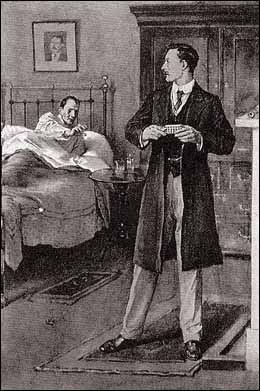 Doctor John H. Watson is one of the great overshadowed characters of literature (for others, see Jim in The Adventures of Huckleberry Finn and Nausikaa in The Odyssey; there are many). Sherlock Holmes is not being ironic when, in “A Scandal in Bohemia,” he says, “I’m lost without my Boswell.” He would not only have been lost to current recognition and to posterity, but in his own self-absorption and ego. In this blog, however, I’m not writing about Holmes, but about his companion, who, in the story “Shiva’s Eye,” encounters mysteries long before he ever encountered his famous friend. Moreover, we must admit it’s because of Doctor Watson’s writing that his friend became famous.
 Trace Evidence