If you’ve visited my website, the first thing to catch your eye was probably the dragon. It’s perched on a mountaintop only slightly smaller than itself, wings spread as if to fly off the screen. Or perhaps it was the image of the cowboy with the smoking gun, my recurring Texan private eye, Trip Allison. Or, maybe the haunted graveyard struck you, with its askew tombstones jutting out of the mists. (There were supposed to be zombies, but I ran out of money for my Web designer.)
As for me, my personal favorite is the alien spacecraft hovering above all of these disparate elements. Suspended against a star-studded sky, a beam shines down from the ship’s belly, highlighting these words:
WORLDS ABOVE & WORLDS BELOW
The Fiction of James A. Hearn
Confused yet? You’re not the only one, my friend. You see, I’m a multi-genre writer. Or at least I’m trying to be.
HUMBLE BEGINNINGS . . .
Science fiction, fantasy, and horror were my first loves. As a kid, my brother Sidney and I consumed thousands of hours of genre fiction in the form of comics, television, and movies. Our favorites were Superman, Star Trek, and Star Wars. I wouldn’t be the writer I am today without my brother’s creative mind lighting the way, that’s for sure.
These weren’t idle pursuits for Sidney, or for me. You see, Sidney had Down Syndrome and was afflicted with a degenerative hip that confined him to a wheelchair in his final years. Genre fiction—with its fantastic, reality-shattering elements—enabled him to literally live out his dreams, to take his mind places his body couldn’t go. And by extension, because I understood my big brother through these stories, I was able to understand what he was saying when others couldn’t. To borrow a Star Trek concept, I became his universal translator in later years. (To read more about Sidney, visit my guest post in SleuthSayers, “An Evening at the Opera House.”)
Naturally, when it came to writing, I returned to my favorite genres. It never occurred to me that I could write crime fiction until the summer of 2017, when I crossed paths with Michael Bracken.
WHEN REAL LIFE GOT TOO REAL . . .
In 2016, after losing a comfortable job and basically hitting rock bottom, I returned to writing fiction. I’d gained valuable life experiences. Joy. Grief. Getting married on the beach in Maui to my best friend. The death of both parents to cancer. Sidney’s passing in 2019. The everyday triumphs and everyday trials that make up the sum of who and what we are.
But instead of novels I couldn’t quite finish, short stories were coming out. I wrote about aliens, robots, vampires, and wizards. Unfortunately, none of these stories sold at the time. My only encouragement came in the form of nicely worded, non-generic rejection letters. Editors had read my stories to the end, at least, but had decided to pass for one reason or another.
I pressed on, becoming a two-time Finalist in Writers of the Future. WotF is a quarterly contest for amateur science fiction and fantasy writers. Winning would’ve been like getting the Golden Ticket to Willy Wonka’s chocolate factory—you go to Hollywood, you meet contest judges like Orson Scott Card and Brandon Sanderson, and you get into a kick-ass anthology.
But I didn’t win. I kept wondering if I was any good, and there was a nagging suspicion that I wasn’t.
A SALE! THE EDGARS! BAMS!
I first met writer and editor Michael Bracken at a science fiction and fantasy convention in Austin, Texas. Actually, let me back up; that’s not quite true. He was participating on a panel about writing for anthologies and I was safely, anonymously, in the audience.
I am by nature a shy person and public speaking of any form is my greatest fear. (I don’t know why public writing doesn’t bother me.) Anyway, I wanted to introduce myself to Michael and tell him I was interested in writing a story for The Eyes of Texas, a private eye anthology he was pitching.
But I didn’t. Despite never having written a private eye story in my life, I was determined to write one for The Eyes of Texas. A few weeks later, “Trip Among the Bluebonnets,” my first sale, was born.
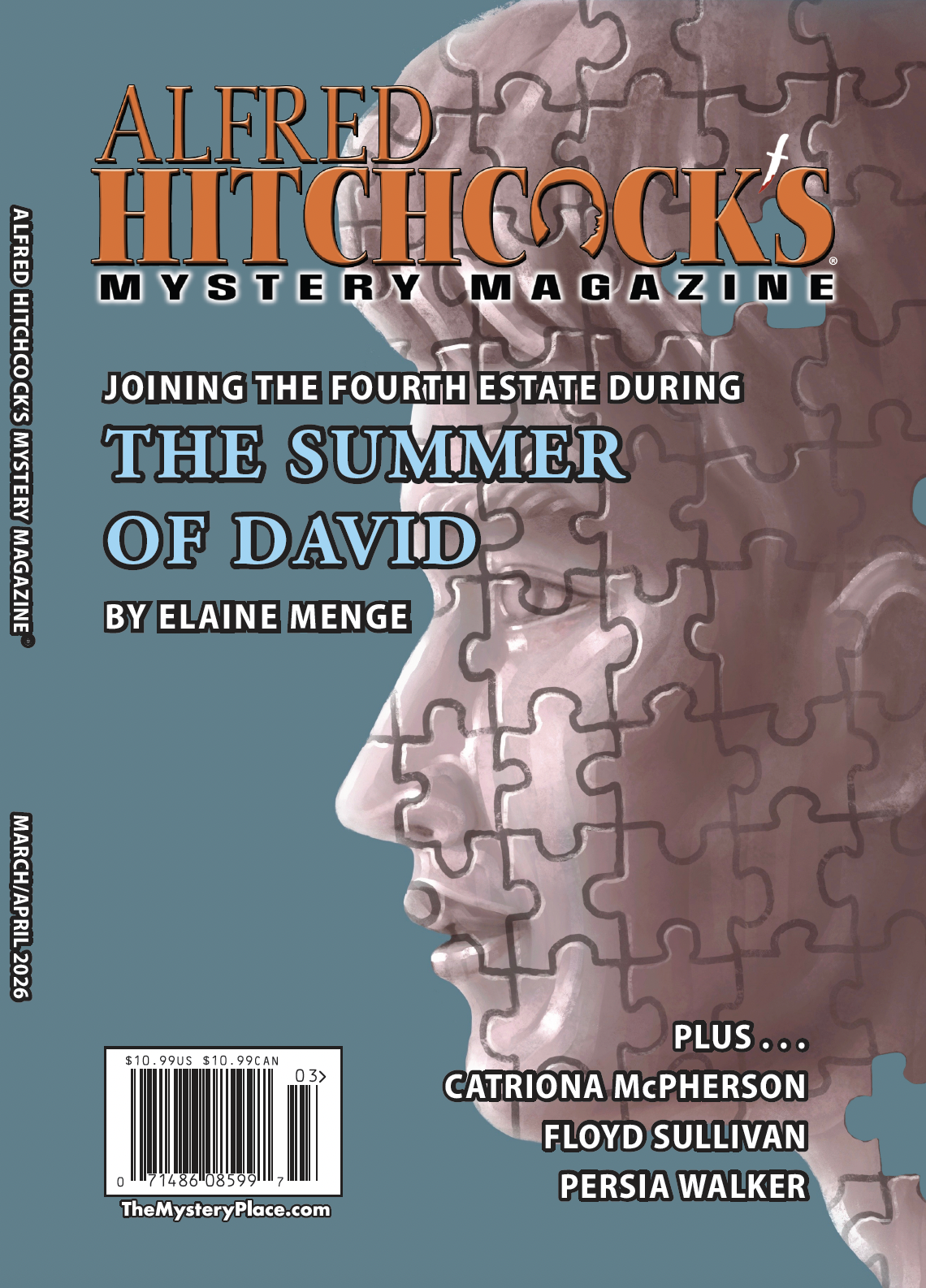
Other sales soon followed, including a horror story, “Tunnel Visions,” to Monsters, Movies & Mayhem. Later, Michael and I co-wrote “Blindsided” and sold it to AHMM. When I walked into a brick-and-mortar bookstore and bought that issue, I fulfilled a lifelong dream. Yes, I cried (read Trace Evidence, “A Writer’s Tears”).
In 2022, “Blindsided” was nominated for an Edgar. I traveled to New York City and got to meet some great writers, including R.T. Lawton (the winner). Here’s a secret: I wanted to win, of course . . . but a part of me was actually relieved that I didn’t have to get up on that stage and read my little speech.
Michael doesn’t know it, but I still have his voicemail saved to my phone from the day he called to say we’d been nominated. Whenever I’m feeling a little down, when Imposter Syndrome rears its ugly head, I pick up my phone and play that message. I have no doubt when my obituary is written, hopefully years and years from now, Michael Bracken’s name will be mentioned. Hey, it’s not every day that two guys are nominated for an Edgar for Best Short Story!
I’m not sure anything will top the Edgars (other than winning), but having “Home Is the Hunter” chosen for Best American Mystery and Suspense 2023 comes pretty darn close. Written for my Dad, a hunter, “Home” is pure noir and a search for the childhood home I’ve lost. Every once in a while, a reader will contact me through my website and tell me how much they enjoyed that story. I’m blown away that random strangers will take time out of their lives to send me a few kind words. It means a lot.
CROSS-GENRES . . .
I guess it’s only logical that my other genres bleed over into my crime fiction. “The Nine Lives of Dr. Impossible” is my fourth story for AHMM, and it is by far the most unconventional. “Blindsided” dealt with the aftermath of crime; “When the Dams Break” was a mystery about a missing woman; “For Lydia” was a private eye and confidence game story. As such, these fit squarely within the pages of AHMM.
But “The Nine Lives of Dr. Impossible” doesn’t fit the mold of the traditional crime story. It’s a genre-bender; there’s a TV superhero, his mysterious “ensorcelled” mask, a romance gone wrong, an attempted murder, and a Christmas miracle. It’s Adam West’s Batman meets Charles Dickens’s A Christmas Carol; it’s a weird story and I love it because it’s weird.
I’ve written other genre-benders. “The Third Wish” (Black Cat Weekly #69) is about a troubled child of divorce who goes to live with her mother and her new husband, a ruthless gangster. Though set at Christmas, this story has a sinister streak reminiscent of The Omen, one of my favorite movies. It’s a blend of crime and horror, but it’s also noir.
“Here Comes the Judge” is a novella in Michael Bracken’s Chop Shop series, an anthology about Dallas car thieves. In my story, brothers Brad and Rolly steal The Judge, an ultra-rare vintage GTO, from a funeral home for the biggest payday of their careers. But instead of cruising Easy Street, the discovery of cursed tarot cards and an unwelcome guest in the trunk sends them on a collision course with the afterlife. It’s a crime caper, a ghost story, and a comedy.
THE FUTURE . . .
I’m still writing about robots and wizards, and I have a dream to write a fantasy novel where I can build the world from the ground up. In short, I’m keeping my weirdly themed dragon-spaceship-graveyard-P.I. website. Truth be told, I’ve had much more success in crime and mystery fiction than my original loves of science fiction, fantasy, and horror.
And that’s fine by me. In middle-age, just when you’re thinking you’ve likely experienced “the best” in everything, from music to movies to books, it’s an absolute blessing to discover something new. That’s what crime fiction and all its subgenres are to me. In addition to a slew of modern short story masters in AHMM and EQMM, I’m diving headlong into Raymond Chandler, Mickey Spillane, Agatha Christie, and James M. Cain, to name a few.
Honestly, I kinda feel like my brother Sidney is here with me, looking over my shoulder as I read. The way he did when I used to read comics to him. With every new book and short story, we’re Captain Kirk and Mr. Spock on the Enterprise, boldly exploring new frontiers in genre fiction. Sid’s playing Kirk, of course, but that’s as it should be.
Live long and prosper, y’all.


 Trace Evidence