I made my first professional fiction sale in 2011, at the age of forty-one. The story was called “The Penthouse View,” and, as it happens, the market that I sold it to was Alfred Hitchcock’s Mystery Magazine (it appeared in the Jan/Feb 2012 issue). The fact that I would have a story in one of the two magazines that had enthralled me since I was in high school (the other being, of course, Ellery Queen) was stunning. I felt victorious; even if I never sold another story, I had succeeded in my lifetime goal of being that most exalted of beings, a published writer.
I rushed to share the news with friends and family, both live and via social media, and the outpouring of congratulations was highly gratifying. Some people went on to ask what must have seemed like a natural question: so now are you going to write a novel?
Cut to twelve years later. “Moving Day,” in the March/April 2023 AHMM, is my sixth appearance in the magazine. I’ve also had three stories published in Ellery Queen. By my count, I’ve had eighty-one stories accepted for publication in various magazines and anthologies. I’ve been nominated for a handful of awards (including, to my astonishment, an Edgar, for “Etta at the End of the World” in the May/June 2020 AHMM) and won a couple of them. I’ve been to crime writing conventions where I’ve met and chatted with many of my favorite writers. I’ve had, in other words, more success than I had any reason to expect when I sold that first story.
And still, it’s a rare month when I don’t get asked that question, in one way or another: so when’s the novel coming?
Implicit in the question is the assumption that this is the natural step to take, that the short stories are only meaningful as warm-up exercises, that it must be every writer’s destiny and desire to write a novel.
Implicit is the assumption that real writers, invariably, write novels.
Not true, of course. There have been plenty of hugely successful writers, both in and beyond the crime field, who wrote short fiction exclusively, or almost exclusively. Conversely, there are any number of novelists who never wrote shorts, and even profess to be incapable of doing so. And then there are the writers who have the unbelievable gall to be good at both forms, and seem to switch back and forth effortlessly, but the less said about them, the better. They get quite enough attention, thank you very much.
So the question isn’t when I’m going to get to that novel. The question is what kind of writer I actually am. The graduate-to-novels kind? The short-story-specialist kind?
And the answer is: I have no idea.
I know that right now, I’m having the time of my life writing short stories. It fits well with the demanding schedule of my real job, but more than that, it’s just plain fun. Whatever I’m working on at any given time, I’ll likely be working on something completely different in a couple of weeks. My writing naturally tends to the hardboiled end of the crime fiction spectrum, but I’ve dabbled in cozies. I’ve written Sherlock Holmes pastiches, a story guest-starring the Marx Brothers, and a tribute to Cornell Woolrich. I’ve written stories for themed anthologies inspired by Johnny Cash, Pink Floyd, the Allman Brothers, and Roy Orbison. I’ve written about con men and car thieves, cops and mob enforcers, and a whole lot of normal people who never saw it coming.
Given my typical writing pace, even a relatively short novel would take me, I estimate, six months to write. Mind you, that’s the first draft. Add another few months, at minimum, for revision. Then there’s the hunt for an agent, where you need to get very lucky, and then for a publisher, where you need to get even luckier. Then editing. Cover design. If you continue your lucky streak, the novel might be published the year after the contract is signed. I think about the number of short stories I could write in that time, and the choice seems easy.
Maybe I just have a short story mind. It’s true that I often have the experience, when reading a novel, of feeling like it should have been a short story (in fact, many novels really are short stories in disguise, with extra incidents and characters and subplots welded on in more or less elegant ways).
Then again, maybe what I have is a short attention span.
So before I forget, let me mention again that “Moving Day” appears in the March/April AHMM. The story is (very) loosely based on something that happened to a friend of mine, which is a good illustration of the perils of being friends with a writer. I hope you enjoy it. I promise you, it was written by a real writer.
I’ve got promotional bookmarks and everything.
Joseph S. Walker lives in Indiana and teaches college literature and composition courses. His short fiction has appeared in Alfred Hitchcock’s Mystery Magazine, Ellery Queen’s Mystery Magazine, Mystery Weekly, Tough, and a number of other magazines and anthologies. He has been nominated for the Edgar Award and the Derringer Award and has won the Bill Crider Prize for Short Fiction. He also won the Al Blanchard Award in 2019 and 2021. Follow him on Twitter @JSWalkerAuthor and visit his website at https://jswalkerauthor.com/.
The more you read, the better you’ll write. Good words to live by. Stephen King, Ray Bradbury, and numerous others have offered similar advice. From a writer’s perspective, reading a variety of stories can help you understand how to craft dialogue, plot, pacing, and how to stick the landing when you’re heading toward the end of your own work in progress. But “variety” is the key word. It doesn’t just help you to check out the classics, the greats, the bestsellers, and recommended reads in the genre in which you love to work, it might also be a big help to read stories from a genre that you’ve probably never read before or wouldn’t expect to enjoy at first blush.
I have a friend whom I’ll call Dave (mostly because that’s his name). Dave is well-read, but for years he wouldn’t touch anything if Stephen King’s name was on the cover. I’d recommend certain books, and Dave would roll his eyes. He wasn’t a fan of horror, fantasy, speculative fiction. He liked Hemingway, Faulkner, non-fiction, and crime novels. I asked if he liked the film Stand By Me. Of course, he said. I asked if he liked The Shawshank Redemption. He said yes, and added that only a moron wouldn’t like that movie. I said both were based on Stephen King novellas (The Body and Rita Hayworth and the Shawshank Redemption respectively). Dave cried and begged forgiveness.
Not really, but he did check out King’s Different Seasons, the collection which included the aforementioned novellas. He liked it, and from there he read Road Work, written under King’s pseudonym Richard Bachman, and a number of other Bachman books, and finally ended up breaking out of the crime and realism books of good ol’ Uncle Stevie and read It, Cujo, and even The Dark Tower series. He ended up becoming a fan, but he would’ve never known just how wonderful books like It, The Long Walk, Cell, or The Running Man are if he didn’t push himself out of his comfort zone and into The Dead Zone. (Sorry. I had to.)
It’s kind of like what your mom or dad might’ve told you when you were at the dinner table and turning your face up at asparagus and broccoli. How do you know you don’t like it unless you try it? Now, I’m not saying I’m going to treat you like you’re my kid, but if I find out you haven’t given at least one of these books a chance, you’re grounded and there’ll be no TV for a week.
Instead of King’s books, however, I went ahead and compiled a brief list of seven speculative and science fiction books that all mystery writers should check out. I might get a list together of seven Steve books we should all read, or seven horror books in general, but for now, we’re focusing on sci and spec.
Oh, and before I receive the obligatory why-didn’t-you-include-such-n-such book email, or before I read the assured you’re-an-idiot-because-you-didn’t-mention-such-n-such book comment, trust me, I know I’m leaving A LOT off this list, and, hey, what’s stopping you from writing one of your own after you’ve slogged through mine? After all, didn’t we already establish that the more you read, the better you’ll write?
See what I did there? Aren’t I cute?
Anyway, enough stalling. On with the list.
7. The Yiddish Policemen’s Union by Michael Chabon
From the author of Wonder Boys and The Amazing Adventures of Kavalier & Clay, comes an alternative history detective novel set in Sitka, Alaska, a post-World War II Jewish settlement. Detective Meyer Landsman investigates the murder of a man who lives in the same rundown hotel as Landsman and as the story progresses we find there a number of people in Sitka that don’t want the mystery solved. The main character draws from classic noir detectives like Sam Spade and Philip Marlow, and Chabon himself said the book was an homage to Raymond Chandler, Dashiell Hammett, and Ross Macdonald. It’s a great story that paints a vivid picture of both an evocative mystery and what could’ve been in a post-war world.
6. The Intuitionist by Colson Whitehead
“It’s a new elevator, freshly pressed to the rails, and it’s not built to fall this fast.”
Thus begins the debut novel of an amazing talent. Here we have another alternate history piece that details life of Lila Mae, the first African American female inspector for the Department of Elevators in a sprawling metropolitan city. Now, in fairness, you probably wouldn’t think the trials and tribulations of an elevator inspector wouldn’t make for a gripping spec fiction thriller, but you’d be wrong. Backstabbing, setups, intrigue, examinations of racial and gender bias, it’s all here in this amazing story.
In all, I struggled between putting this one and Whitehead’s The Underground Railroad on the list because the latter certainly deserves all the adulation it’s received since its release in 2016, winning the Pulitzer, the National Book Award, and the Arthur C. Clarke Award in the same year. I opted for The Intuitionist because I thought it was interesting to go back and check out Whitehead at the start of his career, but, really, people should read both books. In fact, just go ahead and read anything Whitehead has ever written, speculative fiction or otherwise. Hell, the guy’s grocery list is probably better than most short stories. The man is simply the best writer working today.
5. The Cavesof Steel by Issac Asimov
To say Issac Asimov was prolific would be like saying Bill Gates has a few bucks in his pocket. If you want to be in awe of the incredible number of short stories, novels, and non-fiction books the man turned out during his lifetime, check out his bibliography pages on Wikipedia, but be careful. You might wind up with a case of carpal tunnel while scrolling.
Asimov was known primarily for his Foundation, Galactic Empire, and Robot series. The Caves of Steel is part of the latter (as well as the Foundation series later on, but that’s a very long story). The interesting thing about this novel is the fact Asimov wrote it to prove science fiction could be injected into any kind of story and not just stick to the parameters of its own genre. Hence, we have a murder mystery complete with robots and interstellar travel.
Three-thousand years in the future, Earth is overpopulated. Those left behind live under massive metal domes while the luckier, wealthier earthlings move off-world and live in luxury on newly inhabited planets with their robot servants. The trouble is, the off-world types (Spacers as they’re called) don’t exactly have much love for Earth, so when a prominent scientist winds up dead, it threatens to cause a political shift where the Spacers enforce full rule over the Earth.
New York City detective Elijah Baley is partnered with R. Daneel Olivaw to solve the case. Trouble is, R. Daneel turns out to be a robot, and Elijah is prejudiced against robots. Although the world-building in this book is unmatched, and the core mystery intriguing, the budding relationship between Elijah and R. Daneel is what makes this novel one of Asimov’s best.
4. Dirk Gently’s Holistic Detective Agency by Douglas Adams
Aliens, ghosts, time travelers, the poetry of Samuel Taylor Coleridge, magic tricks, a missing cat, and . . . Well, if you’re not intrigued enough by now, you’ll probably never be.
The reason I’ve included this on the list is not just because it’s a detective story (and a sci-fi story, and a ghost story, and a romance story, etc. etc.) but because it’s a humorous detective story and Douglas Adams was simply one of the funniest human beings to have ever drawn a breath.
If you want to craft a comedic mystery yarn, you’ll do yourself a lot of favors by checking out the crime novels of Robert B. Parker, Gregory Mcdonald, Carl Hiassen, Dave Barry, or Tim Dorsey, but you should also check out this book for the sheer amount of madness Adams could weave into a few paragraphs. He knew how to pace a book as well as any bestseller, but had the comedic chops of a seasoned standup comic or sketch comedy writer. After all, this is a guy who cut his writing teeth with Monty Python, penned a few episodes of the classic Doctor Who series starring the funniest, and the best Doctor, Tom Baker (and I’ll knife-fight anyone who says different), and influenced the likes of Neil Gaiman (American Gods, Sandman, Coraline) and Dan Harmon (Community, Rik and Morty) with his magnum opus The Hitchhikers Guide to the Galaxy.
Seriously, if you don’t want to read the guy after this, I can’t help you.
3. Kindred by Octavia E. Butler
I chose this book for three primary reasons. One, it’s a good lesson in how to pace a complex story (something all mystery and thriller writers need to learn), two, the prose is outstanding, and finally, not enough is written about the late, great Octavia E. Butler.
To put it briefly, the story concerns a young African American woman named Dana who slingshots unwillingly through the spacetime continuum between late-70s Los Angeles and mid-1800s Maryland where she experiences slavery and the journey of her ancestors firsthand. It’s unflinching, painful, heartbreaking, and brilliant. And it’s seen a bit of resurgence recently thanks to the mini-series currently streaming on Hulu.
This book breathes rarified air in the sense that it’s one of the few books that fits snugly in the science/speculative fiction category but highly regarded enough by critics and those in academia to rank it alongside George Orwell’s 1984, Aldous Huxley’s Brave New World, Kurt Vonnegut’s Slaughterhouse Five, and Ray Bradbury’s Fahrenheit 451 and consider it serious literature (but those of us with taste understand already that just because a book can fit into a certain genre, it doesn’t mean that it’s kid’s stuff or lowbrow or not to be taken seriously). It should be noted that Butler was mentored early on by none other than Harlan Ellison (we’ll get to him in a minute) who sang her praises repeatedly throughout the years.
So, let’s take stock here. Asimov, Morrison, Orwell, Huxley, Vonnegut, Bradbury, and Ellison. Yes, this is the company the woman kept, and on some days I might put her above them all. She was simply that good.
Now, would anyone care to explain to me why she’s not required reading in every school on the planet?
2. Do Androids Dream of Electric Sheep? By Philip K. Dick
The book that inspired Blade Runner. Look, there have been countless articles, essays, and, yes, books about the novel, the movie, and Philp K. Dick, and to put it bluntly, I probably can’t add anything to the conversation aside from saying I love the film and the book and would count both amongst my favorites.
Even though the noir aspect is glaringly apparent when you watch the film, it is certainly found within the text. Dick draws heavily from the influences of the classic hardboiled detective genre in terms of scene, setting, and the way he crafts Rick Deckard, the haggard bounty hunter sent to “retire” renegade androids. Religious, philosophical, sexual, and identity themes seep in as they do in many of Dick’s works, but here, with the protagonist approaching his job coolly at first and becoming more and more despondent and dour as the story chugs along, one could easily see Deckard standing alongside the classic detectives or the busted-up drunk dicks haunting the pages of a pulp mag found on the dime store racks back in the 40s. If your only experience with this world is the film, you’re in for a treat when you crack this sucker open.
1. The Top of the Volcano: the Award-Winning Stories by Harlan Ellison
Admittedly, this one’s kind of a cheat. Not all the stories in this collection are speculative fiction. Some are horror, some are crime, some are something different entirely. But the common thread between them all is the unmistakable prose that only Harlan Ellison could put together.
I could’ve picked just about any short story collection by Ellison, of which there are many. The Deadly Streets and Gentleman Junkie and Other Stories of the Hung-Up Generation are from his early years and focus primarily on crime fiction or gritty urban lit. Paingod and Other Delusions comes right as he made a name for himself as a unique voice in speculative fiction. Shatterday, Strange Wine, No Doors, No Windows, are all good, brilliant really, but The Top of the Volcano is like a perfect greatest hits collection, hence a good intro to his career if you’ve never read him.
If author John Dickson Carr is correct in his statement that the natural habitat for a mystery story lies more within the parameters of a short story than a novel, anyone looking to refine their approach to short fiction absolutely, one hundred percent needs to read and study Harlan Ellison, no questions asked. He, in my not so humble opinion, ranks alongside Hemingway, O’Connor, Kafka, Poe, Dubus, Chekov, O. Henry, Oates, Twain, and Bradbury as one of the best short story writers the world ever produced.
Want to see a good example of how to inject heartache and loss in your story? Read “Jefty is Five.” Want to know how to craft a sense of dread and foreboding? Read “The Whimper of Whipped Dogs” (which garnered the man his first Edgar Award). And if you want unrelenting terror, then you need to do yourself a favor and study “I Have No Mouth and I Must Scream.” The story doesn’t make your skin crawl, it doesn’t make the hairs on the back of your neck stand up, it reduces your nervous system to mush, melts your bones, and leaves whatever’s left in a twisted, horrible wreck. Pardon my language, but the thing is a fucking masterpiece.
There are many more stories to list from Volcano and many more examples of how Ellison influenced generation upon generation of writers, filmmakers, video game designers, TV producers, and more. I could go on, but let me put a bow on all this by stating there’s a reason why Ellison was one of the most awarded writers of his or any generation (six Bram Stoker Awards, two Edgar Awards, ten and a half Hugo’s, five Nebula’s, four Writer’s Guild Awards, and eighteen Locus Poll Awards, amongst others). He was an unparalleled talent, and although his personality could be brash, to say the very least, the literary world is worse off without him, but at the very least, we have plenty of stories to enjoy far, far into the future.
The theater is my happy place. There is almost no place I’d rather be. My favorite moment in life is that instance when the curtain, literally or figuratively, rises. It’s like being transported into a different universe—one where people might speak in iambic pentameter or break into song. I can be a fly on the wall watching a family unravel, or an onlooker as a flawed king falls from his pedestal. Sometimes I leave the theater filled with joy for the human condition. Other times I break out in uncontrollable, ugly sobs wondering how anyone can live in such an unforgiving world. The best theater has made me feel both things simultaneously.
At various stages of my life, I have been an actor, a playwright and a director. I’ve hung lights and torn down sets. I have my share of paint splattered clothing, and a library of dog-eared and highlighted scripts. I am a theater person, so it is no wonder that I have chosen to set more than one of my short murder mystery stories in a theatrical setting.
There are so many ways to kill and be killed in the theater. There are, first and foremost, the many physical obstacles. Open trapdoors, dangling sandbags, and hastily constructed set pieces could all become deadly, especially when navigating a backstage space in the dark.
There are also the emotional perils associated with the theater. Backstage romances, bad reviews . . . I’m not saying that I’ve ever wanted to commit murder when I checked my name on a cast list, but I can certainly image that motive.
And let’s not forget the unsavory characters that the theater seems to attract. Emotional actors, egotistical directors and overly ambitious understudies are just a few that come to mind. After all, what kind of people want to spend their time pretending to be other people, except perhaps those who have something to hide?
Theater and murder have enjoyed a symbiotic relationship that can be traced back to Ancient Greece. From Medea to Macbeth to Mousetrap, audiences have flocked to see murder on stage for thousands of years. Twelve Angry Men by Reginald Rose, which served as the inspiration for “Twelve Angry Actors” is just one of many great plays that revolves around a murder. I imagine that I will continue to write murder mysteries inspired by the theater. After all, the theater might be my happy place, but when the lights go out, anything can happen.
Nina Mansfield is a Cos Cob, CT based author, playwright, screenwriter and educator. Nina’s short fiction has appeared in a variety of publications and anthologies including Ellery Queen Mystery Magazine, Mysterical-E, Crime Syndicate Magazine and most recently Alfred Hitchcock’s Mystery Magazine. Her YA mystery novel Swimming Aloneis published by Fire & Ice YA. Nina’s ten-minute and one-act plays have received over 100 productions in the United States and around the world, and are published by Smith & Kraus, Stage Partners, YouthPLAYS, Original Works Publishing, and One Act Play Depot. Nina is a member of MWA, SCBWI, ITW, The Dramatists Guild, and she is a Co-Vice-President of the NY/Tri-State Chapter of Sisters in Crime. Connect with Nina on her website www.ninamansfield.com or on Facebook, Instagram and Twitter.
The older we get, the more we look back and yearn for the good old days—usually forgetting that the good old days were what we used to complain about when we were struggling through them. But for some of those people involved in writing for a living the past is beginning to look more and more attractive, the frustration with the present day’s mounting difficulties making many wish they really had left school pursuing their ambition to be bin men—or whatever they’re called nowadays.
The people looking back with nostalgia are the freelance writers, those earning a living by selling articles and stories to newspapers and magazines in the UK and elsewhere. For the freelancer, the world has changed dramatically. The freelance photographer is also affected by those changes. Suddenly, publishers who would answer quickly and pay reasonably well for articles and photographs are able to get almost everything free. Just as some people will do anything at all to see themselves grinning and capering on television, so there are millions of people worldwide willing to accept zero payment for articles or photographs. Their reward is to see their literary or photographic efforts published in the pages of a magazine—which means another letter of rejection pops through yet another hard-working professional’s letter box.
Or perhaps not.
Perhaps it’s an email, pinging.
Or perhaps it’s . . . well, nothing at all.
Before I moved into novel writing, I used to concentrate on writing and selling short stories. Several were accepted by Alfred Hitchcock Mystery Magazine, bless them, and my latest will be published in AHMM in the March 2023 issue. That magazine, and Ellery Queen Mystery Magazine, remain unchanged apart from alterations in design, format, and the number of issues published each year. The quality of their crime stories was and is exceptional (and that’s me blowing my own trumpet!). However, their response times when a story is submitted now varies greatly, from weeks to several months.
It was inevitable
We all know the reason for the sometimes long delay between submission (as in sending in, not giving up) and reply. All kids nowadays pop out of the womb with fingers punching the keys on laptops, tablets or smart phones; and, since word processors came onto the scene, manuscripts fluttering about in editors’ offices are like plagues of locusts. And another reason why work might be rejected is that magazines publishing anything that takes more than ten seconds to read can be counted on the fingers of one hand—with a calculator, of course.
Did I mention that as well as markets disappearing, standards are dropping?
This, by the way, is not a rant by a frustrated author sitting staring at a blank screen. Back in 1995, after decades of writing articles and short stories, my novels began selling. In the twenty-seven odd years since then I’ve had sixty published, plus several non-fiction books on writing technique. Most have gone to large-print editions, but although the sheer volume of work puts me in the top 3% for PLR (Public Lending Right) earnings here in the UK, I’m still undeniably a mid-list writer. Or perhaps that’s me having delusions of grandeur. But whatever it is, I mentioned all that because it does lead neatly into another topic.
Look Back with Resignation
A friend of mine (now deceased) began selling novels some 30 years ago. The genre doesn’t matter, but at that time he got a flat fee for each book he sold. Since then, let’s say it’s from 1985 to the present day, average incomes for staff in most publishing firms have probably increased tenfold—and even that might be a conservative estimate. But my friend was a writer, an author, one of those unique, indispensable talents without which no publisher would have a business. So my friend’s flat fee for his novels didn’t increase tenfold, nor even fivefold. There was no increase at all. He was getting, in his final writing days, exactly what he got in 1985, which means that his flat fee had been decimated: it really was worth one tenth of what it was back then.
Remember? The good old days?
We talked from time to time, he and I. And, as you’ve probably twigged by now, we both wrote for the same publisher (now also gone to the happy hunting ground) so everything I’ve said about my friend applies equally to me. You’ll also have worked out that I’m way past retirement age, the income from writing doesn’t really matter. A hobby’s a hobby—and I appear to be stuck on one of those horses.
I’ll stay in the saddle for the moment, because I haven’t yet mentioned the internet. Not because I don’t use it, but because it’s too damned vast to comprehend. Yes, there are new markets out there. And, yes, some of them pay quite well. But it occurred to me the other day when thinking about magazines made from paper covered in real print that if college students can download essays and paste them into their exam papers, surely magazine editors could do the same. Find articles—I’m talking non-fiction here – in the bottomless Blue Nowhere and paste them on to the pages of their magazine. Because there used to be something called the public domain. I presume it still exists. But couldn’t that term apply to the internet? There are domain names, after all. And if anything is public, surely it’s the wonderful worldwide web (wwww?).
I mentioned falling standards a little earlier, and with written work that can be difficult to judge. But I also mentioned photography and, although everything is subjective, there the decline is quite clear. In the past, the covers of the magazines we’ve been talking about nearly always used images taken with medium- or large-format cameras, and the clarity was amazing. Then along came digital cameras. Suddenly everything was so simple. Images arrived at editorial offices as digital files sent as attachments to emails, and could be pasted straight on to a magazine’s pages. Convenient, but the cost was in loss of quality. Grass and distant trees began to look like watercolour smudges. Flesh tones could be peculiar. As for definition, that’s always been limited by the magazine printing process, but it’s been estimated that for a digital file to equal the clarity and definition of even a 35mm film transparency, it must be taken by a camera with a 25 megapixel plus sensor, at the very least. Nowadays that figure is beginning to look old hat (think mobile phones), and yet . . .
Which brings us back to the writing
If magazine covers are not what they used to be, what about the inside pages? Should we assume that the same drop in standards is evident there? And not because our (the professional writers) standards are dropping, but because—and here I’ll use a word I hate—some material is sourced from non-professionals willing to work for nothing. It can be understood—barely—but it fills a space, it’s free, so it’s used.
So where does all this leave us—or, to be more specific, those who need to earn their living from freelance writing? Soldiering on is probably the right term. If looking back nostalgically is always a waste of time, surely looking forward with optimism is to be preferred—isn’t it?
I’ll let a well known writer have the last word on that:
The man who is a pessimist before forty-eight knows too much;
If he is an optimist after it, he knows too little.
Years ago, I attended a geophysical society’s convention with a smart, amiable guy who had moved to Texas from the East Coast to run business operations for the trade magazine I edited. Because the convention addressed oil and gas exploration, my colleague, as most newcomers would, expected the event to feature the metal and muscle of drilling, the clattering work with which most people are at least vaguely familiar. It was amusing to watch his preconceptions implode as we cruised exhibit-area displays of humming supercomputers, colorful seismic records, three-dimensional earth models, and demonstrations of virtual-reality and visualization technologies then in their infancy–with nary a drill bit or hardhat in sight.
The memory of this awakening of the uninitiated helped me contrive “Imperfect Data.” I wanted to write a story of detection to prove I still could do it. I had succeeded with that type of story once before with “Intensity” in the May 1994 issue of AHMM. Since then, however, I have avoided writing traditional whodunits, much as I enjoy reading them. The subgenre’s prominence of plot discourages me. When I conjure stories, plot tries to overpower the process. If I let that happen, overdeveloped problems strangle underdeveloped characters and everything stalls. I have to force myself to concentrate on characterization, conflict, and consequences and let plot simply evolve. For stories of detection, that approach doesn’t work.
With “Imperfect Data,” I uncharacteristically free-reined plot and encountered another hurdle. I knew my sleuths and had invented a hybrid investigative role for them. I knew I wanted them to grapple with corporate espionage leading to murder. I knew how and why the crimes would occur. But the elements needed a framework within which to interact and come alive.
An exotic setting, I knew, can lend structure and energy to otherwise disparate story fragments. Yet corporate espionage inescapably occurs in, well, corporations, stereotypically uncolorful palaces of cautious uniformity. How could I make a corporate setting exotic?
It was while struggling with that question that I recalled the way my colleague brightened in his first brush with the multihued electro-abstraction of modern geoscience. Like him, most mystery readers probably lack exposure to the arcane world of exploration geophysics and its principal tool: the seismic survey. In simplest possible terms, seismic surveys use reflected sound to make pictures of the dark, complicated realm deep below our feet. The collection and interpretation of seismic data are intricate, computationally intensive activities conducted by powerfully degreed scientists, mathematicians, and computer wizards. Much of the interpretive work occurs in “visualization centers” able to simulate immersion in the underground–or “subsurface” as the pros prefer. To readers in an electrifying culture lately reverential of all things STEM (science, technology, engineering, and mathematics), a geophysical corporation centered on a high-tech visualization center might, I thought, feel exotic.
A geophysical setting further helped by fortifying an analogy already shaping my ideas about the story. Deciding where and where not to drill oil and gas wells is much like investigating crimes. Both activities attempt to solve inaccessible puzzles. Criminal investigations use physical evidence at hand to formulate hypotheses about phenomena inaccessible in time. Geophysical methods use indirect observations to analyze rock layers inaccessible in visual space. Criminal investigations recreate the past. Geophysical methods depict the unseeable.
I worked some of this high-wire comparison into “Imperfect Data” but tried not to get carried away with it. The story does not (I think) depend on it. The creation of the story, though, most certainly did. An undergirding analogy, I have found many times, can leverage ideas and illuminate meanings. I’ll squeeze this detection-geophysics analogy for one more confession about the making of “Imperfect Data.” Detection and exploration geophysics both must accommodate uncertainty and approximation. Typical crime-scene evidence is haphazardly distributed and physically disturbed. Geophysical recordings are scrambled by subsurface irregularities and limited in precision by length of the foremost assessment mechanism: a sound wave. For these and other reasons, detectives and geophysicists alike must be comfortable with sparse information and flawed measurement. My title pays homage to the courage of anyone who acts decisively–in criminal investigations, in geophysical evaluations, or in life–while acknowledging that decision parameters sometimes are wrong.
It was just over ninety-five years ago, December 1927, that The Royal Magazine published a short story by Agatha Christie called “The Tuesday Night Club.” It marked the first appearance of one of Christie’s most long-lasting sleuths, the shrewd village spinster, Jane Marple.
But the story marked another kind of first (as far as I can determine) and that is what I want to discuss. In the tale a group of friends gather and one of them tells a yarn of murder, encouraging the others to solve the crime. After all the clever, erudite people admit to being stumped Miss Marple reveals the solution.
This story is an example of what we might call the Least Likely Detective motif, but it is certainly not the first of those. They go back at least to G.K. Chesterton’s invention of Father Brown in 1910.
No, I am referring to what we might call the Armchair Detective Club, where one member of a group tells a tale and the others are invited to solve it. Christie wrote a whole book of these tales, published as The Thirteen Problems, and in the U.S. as The Tuesday Club Murders.
The next example I could find that seems to fit the category is a novel by E. and M.A. Radford called Death and the Professor (1961). I haven’t read it but it involves regular meetings of the Dilettantes Club, where a member called the Professor solves the enigmas.
A few years later Ellery Queen (the author) invented the Puzzle Club, whose members devised fictional criminal tales to be solved by Ellery Queen (the character). Josh Pachter recently added five more stories to this series and The Adventures of the Puzzle Club was published as a book by Crippen and Landru last year.
In 1972 Isaac Asimov wrote “The Acquisitive Chuckle,” introducing the Black Widowers, an organization inspired by the Trap Door Spiders, a club he belonged to. In this story a guest at the club’s monthly dinner posed a mystery which could only be solved by the waiter, Henry.
The tale featured a nice surprise but not as big a shock as Asimov received when the story appeared in Ellery Queen’s Mystery Magazine and editor Frederick Dannay announced it was the first in a series. That was news to its author.
But the ever-prolific Asimov was up to the challenge. He wrote more than sixty tales of the Black Widowers, filling five books. (And by the way, he acknowledged Christie’s Tuesday Club as his inspiration.) In each tale the shrewd and sophisticated club members pose countless theories on the crime, only to be upstaged by modest Henry, a classic Least Likely Detective.
The fun of dine-and-detect stories, of course, is that they are fair play tales (you know everything the detective does!), with the extra benefit of continuing characters interacting.
I contributed my own piece to the subgenre with a story about a group of “underemployed private eyes” who met in a bar to armchair-investigate the torching of a dollhouse. “A Small Case of Arson” appeared in P.I. Magazine in 1991. Alas, as occurred so often in what I laughingly call my writing career, I couldn’t think of a second adventure for the gumshoes.
But a few years ago I was pondering this subgenre and the writer chunk of my brain suddenly kicked in with a question: Why not reverse it?
These stories are always based on good guys trying to figure out how a crime was committed, or by whom. What if the club members were all criminals and the storyteller challenged them to figure out how he had pulled off his latest caper?
That sounded like fun. The result is “The Accessories Club,” appearing in the March/April issue of Alfred Hitchcock’s Mystery Magazine. And unlike the fate of my sad, orphaned private eye characters, I have already written a sequel for this sneaky crowd to lurk in. I don’t know whether it will see the light of publication, but you can read the first tale now and see what you think.
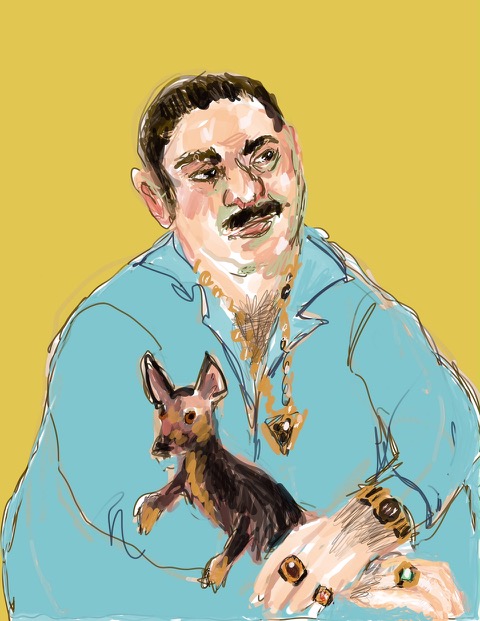
(Janice Law’s illustration of El Gordo, a character in her latest story for AHMM, “The Bosky Dell”)
“The Bosky Dell” was an unusual story for me, because the idea arrived nearly complete. No little hint of an idea followed by a frustrating search for what should come next. No big revisions needed, no second thoughts. There on two handwritten pages of my writing notebook was the whole thing, characters, setting, and, always most difficult for me, plot. A real gift of the Muse.
This was odd in one way, because I do few stories with any touch of the supernatural. Fantasy isn’t my thing, and like Steve, the true crime writer in “The Bosky Dell,” I have little enthusiasm for the elf realm and the stories of princes and princesses that feature so profitably in his Martha’s literary output.
But certain things are universal. Who among us has not wanted to a do over? A mulligan in golf, a word unsaid, an act undone. Or regretted, conversely, some sin of omission? Writers, especially writers like Steve and most of the rest of us of the middling sort, are very prone to this desire. With so many scribblers of equivalent talent, success and profit do often depend on lucky reviews, powerful contacts, chance meetings, or good timing.
Absent these, writers can easily fall, as Steve does, into envy, condescension, and bitterness. Against all his principles, he passes through the bosky dell that his wife sees as a charming fairyland feature of their property into another time and place.
He discovers what the previous owner had hinted at: opportunity. In his case, the opportunity to secure the narco killer’s interview that, Steve is sure, would have made his first book a success and changed his life.
This turn of plot produced the second thing different about this story, namely the need to create a plausible, yet not totally realistic, alternate time line with a plausible, but not strictly realistic, El Gordo, the flamboyant killer. Logically, he should have been based in Mexico or Colombia or in some obscure corner of the States.
I drew instead on a visit to Chile, to the far south, reflected in the name of our hotel, Finisterra, the end of the earth. The architecture looks Scottish—a product of the Scots sheep men who settled there. The country side is open and windswept; the night sky, unfamiliar and only sparsely populated by stars.
I tried for a sense of difference, of things being not quite what they seem in that part of The Bosky Dell, because time travel would certainly represent a profound psychological shift, such as Steve experiences. We are not, after all, Dr. Who, for whom traversing an eon or two before lunch is all in a day’s work. Time travel is unnatural, and just as in the dark old fairy tales, the unnatural must be paid for.
This story also illustrated something about the limits of my imagination. Just for my own amusement, I sometimes do illustrations for my work, and my new iPad and drawing program make this easy. I tried three times to do a bosky dell, none were satisfactory. But when I turned to El Gordo with his pastel leisure suit and his Chihuahuas, I had no trouble. Magic landscapes are not my thing, but crooks and killers of the literary, and apparently the graphic, persuasion are right down my alley.
****
Janice Law’s The Falling Men, a novel with strong mystery elements, has been issued as an ebook on Amazon Kindle. Also on kindle: The Complete Madame Selina Stories.
The Man Who Met the Elf Queen with two other fanciful short stories and 4 illustrations and The Dictator’s Double, 3 short mysteries and 4 illustrations, are available from Apple Books.
A funny thing happened on my way to publishing a best-selling crime novel: My agent said it stunk.
Well, not in so many words. But that was the message that came through. The way he all but held his nose when he talked about it with me was one clue, and, sadly, that wasn’t the only one. (I’m good at picking up on clues. I write mysteries.) His refusal to even consider sending it around was another, as was the unceremonious way he dumped me less than a year later. (To unceremonious I might add rude and unprofessional, considering he was not working out of his garage—I don’t think—but, rather, was an agent with an established and venerable New York City literary agency.)
[Sidebar: I know you’re curious as to how an agent in an established and venerable agency rudely and unprofessionally dumps his client. He quit answering my emails is how. That was it. The old silent treatment. No explanations, no I’m-sorry-buts, no letting me down gently. Just the silence that follows after you drop your email down an empty well. After about a year or so, I finally took the hint (I’m better at picking up clues than hints).]
So there I was, with no agent, and a spanking new crime novel.
Well, I figured I’d show him. What did he know? Here I was, an established crime writer, having had a goodly number of stories published in Alfred Hitchcock’s Mystery Magazine, Ellery Queen’s Mystery Magazine and in The Best American Mystery Story series. Not to mention national literary journals galore. I waited a couple of months to let it settle, worked on other things, cleared my mind. Then I got out the novel, dusted it off, and dived back in.
That’s when another funny thing happened. I found myself agreeing with my agent. My ex-agent. The book actually did kind of stink a little. I might have stopped answering my emails too.
Maybe I could have salvaged it. Maybe I could have made it . . . if not best-selling, then at least publishable. But it would have taken a lot of work, and I’m getting old. Old enough to avoid buying ripe bananas. Too old to be diving back into lengthy projects.
In desperate times such as those, you tend to remember the words of your grandmother. Or, if not your own grandmother, the words of some grandmother somewhere. Now, I know a lot of grandmothers tend to speak in cliches such as waste not, want not, or when life hands you lemons, make lemonade. Or when the going gets tough, the tough get going, or use it up, wear it out, make it do, or do without. That sort of thing.
Not my grandmother. What my grandmother once told me was, Denny, when you write a novel that’s not very good, and you’re not inclined to invest the time and effort to try and make it better, you should see if you can’t at least glean a good short story or two out of it.
Well, not in so many words. But that was the message that came through.
To make a long story short, I made a long story short.
As a matter of fact, I made a long story two shorts. I put on my gleaning hat and sat down and picked out a couple of plot lines, a few good scenes, some dialogue and characters, and carefully excised them from the novel that stunk, harvesting two short stories that apparently did not. One was already published, and the other is “The Poet Laureate of Dagus Mines,” included in the March/April issue of Alfred Hitchcock’s Mystery Magazine.
Don’t miss it. You’ll enjoy it more than you would a bad crime novel.
Whenever I’m asked the standard questions for writers such as “Where do you get your ideas?” or “Do you write by hand or on a computer?” I tend to give standard answers. These aren’t all that imaginative or accurate. “Everywhere you look there’s a story,” or “I saw a woman on the subway and thought she looked like someone who worked in the back of” fill in the blank. I can’t use any of the usual replies for Ginny Means, however, the main character in my short story in the November/December 2022 issue of AHMM. I’m not sure where she came from.
Family stories play a role in our lives by teaching us how the adults in our world behave, what they believe in and would work or fight for, but often the story carries another lesson, one that may be unintended but is far more potent. Those were the kinds of stories my father told. When he reminisced about the farm where my brothers and I were born, I scarfed up his stories about the other farmers, their quirks and histories. One in particular stayed with me.
This was a hair-raising tale about a Swedish farmer, someone he admired immensely, who had one nearly fatal flaw. That incident rattled around in my head for years until its usefulness became clear. I wrote “How Do You Know What You Want?” for the AHMM March/April 2017 issue with an unnamed walk-on character because I needed a social worker in child welfare to deliver a foster child to a farm family. I didn’t think to name her at the outset but remember distinctly describing her outfit because though she made more money than most of her foster parents (and it wasn’t a lot), she knew a social worker shouldn’t dress like it. Ginny Means, finally named, appeared to do the job, and I didn’t expect to see her again.
Opening the door to the peculiar, sometimes heart-breaking stories I was privy to in that job as a social worker in child welfare had unexpected consequences. Clients—both foster parents and foster children—I had long forgotten about tumbled into my brain, and their histories transformed into stories far more complex than anything they’d ever lived through. The second story in what was verging on a series came in the November/December 2019 issue. “Just Another Runaway” zeroed in on one of the recurring issues with foster teens—the boys who run away and are never found. Some join the army, glad to have regular work hours, square meals, and clear boundaries for their lives, while others set out to find birth parents or a single friend who moved away.
Young women were also prone to the same questions as the teenage boys—what were they going to do in their lives as adults? One girl in my caseload was determined to join the church as a nun, to the skepticism of those around her who didn’t believe she had a calling. That’s the inspiration for “The Deacon’s Mistake.”
The Ginny Means stories aren’t about any of the individual foster children or families I knew, but rather about the issues their lives raise for the rest of us. I don’t have the answers, but I continue to poke and prod a system that hasn’t changed much in the last fifty years. Over the decades we’ve developed new terms, new best-practices, new agencies, but the problems remain the same, expressions of intractable human nature that continue to defy our best solutions.
Now that Ginny Means has moved into my imagination, I want to know more about her. To that end I’ve put her in a novel, or at least a first draft. She’s turning out to be different from what I expected, and I’m enjoying discovering who she is.
The first mystery story I published was “Burg’s Hobby Case” in the Department of First Stories, over at Alfred Hitchcock’s sister publication, Ellery Queen Mystery Magazine. It features Hans Burg, an aging German detective haunted by his war memories. I had set the story in 1977 in the spa town of Bad Kissingen. I was a kid in Bad Kissingen in 1977, brought there by my father’s work as a soldier in the U.S. Army, so I knew it through a kid’s eyes, and it was fun to imagine an intriguing, grown-up suspense story taking place at that time and in that place.
I was so fond of Burg, that I decided to write a few more stories with him as my lead. But instead of setting them all in the 1970s, something I had seen done by Martin Limón with his Sueño and Bascom series set in South Korea, I decided I wanted to move Burg around a bit, to imagine him at different moments his career, and I decided on the time frame of 1945-1989. I find these years particularly interesting in the history of modern Germany, from the moment the war ended and the Third Reich crumbled, through the years of two Germanys, to the night the Berlin Wall fell (or as the historian Mary Elise Sarotte suggests, accidentally opened).
In my notebook, I started jotting down ideas, and these came out as sentence fragments: A Cadillac joyride in Bad Kissingen. Honor among pickpockets. A Bad Kissingen war widow and her suitors. A defector takes a spa. Ideas like these often go nowhere. They are only momentary flights of imagination. Sometimes I take one of these ideas and write a few paragraphs, not a story at all, but more like a rough treatment of a story, often with a beginning, some trouble in the middle, but no specific ending. And then somehow, I’m not really sure how other than stubborn persistence, a whole story comes out. This is the case with my current story, “Elvis Duty.”
I started it with just this little fragment: Elvis comes to Bad Kissingen. I liked the idea because now, instead of the aging detective approaching retirement, Burg is in the middle of his career. It’s 1959 and the biggest pop star on the planet has made his way to Germany, and he happens to wind up in Burg’s spa town. Elvis in Germany has always intrigued me because of the family legend of my parents meeting him in the Munich Hauptbahnhof a few days after their wedding. My mother would say Elvis looked like other GIs except for the diamond rings on his fingers, and my father would say Elvis complimented his jacket. They were both boys from the South and they had similar tastes in style. This was a story I’d found thrilling as a child but grew skeptical of in adulthood. How many people exaggerate their brushes with the very famous? It was an idea I came to use to open the story, as you will see in the first paragraph. Later, I lost my skepticism after reading Peter Guralnuik’s Careless Love: The Unmaking of Elvis Presley. I was able to confirm that Elvis had, in fact, traveled to Munich on a three day pass around the same date as my parent’s wedding. So I thought, if my parents could meet Private Presley, so could Hans Burg.
Still, I needed a plot. That came to me from another story from my parents, and another book. When I was three years old, my mother left me and my two brothers in the care of a neighbor so she could travel to Hawaii to spend a week with my father, who had been granted R&R from his duty in Vietnam. All I can remember is crying for a week. But I’ve seen the pictures of them in their swimsuits on the beach in Waikiki, my mother with her fair skin, my father with arms and neck burned by the tropical sun of Southeast Asia. In my mother’s recollection, my father was jumpy at the sound of slamming doors. The banging must have echoed the explosions in a war he was only a few hours removed from, and to which he would soon return. My mother also remembered the pills. She said my father popped them in his mouth regularly, and when she asked about them, he said, “It’s just medicine.” She let it go at that, but she was suspicious.
Later, I read about the “pep pills” distributed to soldiers during my father’s war. In “The Drugs That Built a Super Soldier” (The Atlantic, April 18, 2016), Lukasz Kamienski describes how the Vietnam War became known as the “first pharmacological war.” But I discovered that was not quite accurate after reading Norman Ohler’s Blitzed: Drugs in the Third Reich. Ohler writes of the pervasive use of amphetamines in the German military, particularly during their rapid invasions of Poland and France. Because the German attacks relied so heavily on up-tempo movement of forces, there was no time to rest, so a systematic use of amphetamines allowed combatants to “go on working for thirty-six to fifty hours without feeling any noticeable fatigue.” The GIs in Germany in the 1950s were most likely introduced to similar “pep pills.” Indeed, Guralnuik notes of Elvis that “with the pills that a sergeant had introduced him to when they were on maneuvers at Grafenwöhr, he was so full of energy he never had to slow down.”
With Hans Burg a veteran of that German army of the Blitzkrieg, and with Elvis’s army of 1959 almost certainly dabbling in similar pharmaceuticals, I could see some trouble, and from that trouble, I could see my plot. Now, I just needed an ending, which I will leave for you to discover when you read “Elvis Duty” in this month’s Alfred Hitchcock Mystery Magazine. I hope you enjoy it.







 Trace Evidence