On the Job: the November 2014 Issue

Tragedy is part of life—but comedy can be murder. This month’s issue is bookended by Harriet Rzetelny’s “Tag Line” and Joseph Goodrich’s “Red Alert,” both set in the high-intensity world of television sketch comedy. In their different ways, both suggest that working relationships can be fraught—and sometimes deadly.

Also on the job, Eric Rutter’s police sniper finds that certain personal interests can undermine his focus in “The Shot.” P.I. Jack O’Shea, the “deception specialist,” returns to our pages in John Shepphird’s “Of Dogs and Deceit” to unpack a con he’s familiar with—sort of. And “The Bride Wore Blood” by Elaine Viets, an expert on job-related mayhem, reveals the challenges a cruise ship’s crew faces when a volatile bride and groom destroy their suite on their wedding night. Meanwhile, another young bridelife is upended on her honeymoon when her groom is killed in the remote Oregon Caves in Kristine Kathryn Rusch’s historical “Crossing the River Styx.”

After reading this month’s stories, you may never look at your coworkers the same way again.

Leave a comment

Filed under Uncategorized

Jerry Healy

I returned from a brief vacation to learn with sorrow of the death of Jeremiah “Jerry” Healy, longtime friend and supporter of the magazine.

Jerry’s first story for AHMM, “Till Tuesday,” appeared in the April 1988 issue, and his January/February 2005 story “Two Birds with One Stone” was a finalist for the Shamus Award for Best Private Eye Short Story. While some of his stories featured his popular series characters, Jerry also took the opportunity of his appearances in Hitchcock to stretch and try new things.

Not just a contributor, Jerry was an enthusiastic advocate for both AHMM and our sister magazine Ellery Queen’s Mystery Magazine. At conferences his larger-than-life presence and infectious laughter were a pleasure to all who were near. Generous with his time, support, and goodwill, Jerry will be missed not just by our staff, but also by many in the mystery community.

Leave a comment

Filed under Uncategorized

Cooking the Books: Robert C. Hahn on reviewing mysteries for AHMM

Alfred Hitchcock’s Mystery Magazine’s Booked & Printed columnist, Robert C. Hahn, passed a milestone recently with his 100th column. Here he shares his thoughts about the health of the mystery field.

Starting with the January 2003 issue of AHMM and reaching to the July/August 2014 issue, I have written over a hundred columns covering roughly 350 books for this iconic magazine. It has been, and remains, a pleasure. Over the past 25 years I have reviewed well over 2,000 books, primarily mystery and suspense, for AHMM, Publishers Weekly, the now defunct Cincinnati Post, and other publications.

Some observations on how the publishing world has changed:

The advent of e-books has opened the doors for many new authors to be published and reach an audience effectively ending the monopoly print publishers had on the gateway to publishing success.

While big publishers continue to market bestsellers and create new bestselling authors, a growing number of niche publishers are giving new authors a start and allowing them to build impressive backlists.

Continue reading

Leave a comment

Filed under Uncategorized

“Shanks Holds the Line” by Robert Lopresti

Robert Lopresti writes the very popular Shanks stories for AHMM, but this one is a little different. He sent it to us with the request that it go on our blog immediately. He explained that it is “based on a scam that recently did major damage to the mother of a friend of mine. . . . I consider the story a kind of public service, since it warns people about this thing.” Here it is. Enjoy, and be warned!

“Please hang on,” said Leopold Longshanks. “I’ll have to start up my computer. It’s down in the basement.”

“Of course,” said Jake. “I’ll wait.”

“You’re too kind,” said Shanks. He was in his home office, checking his e-mail. His publisher had replied, in a cranky mood, concerning Shanks’s complaint about the proposed cover for his new novel. The artist had apparently been unaware that only the bullet is fired out of a gun, not the entire cartridge. You would think the publisher would be grateful Shanks caught it before they all got laughed at, but no.

There was also an email from the organizers of a conference, reminding him that he had agreed to speak. Shanks was happy to do so, good publicity, but was less than thrilled by the topic they had assigned him. He was supposed to find something new to say about that old classic: Why do people read mysteries?

The question we should be asking is why more people don’t. If we could double the readership I could buy a better computer, and a new smartphone—

Phone. He picked it up. “Jake? You still there?”

Continue reading

4 Comments

Filed under Uncategorized

Proud of Petrin

It’s a great pleasure to congratulate Jas. R. Petrin, whose AHMM story “Under Cap Ste. Claire” (October 2013) has been named a finalist for the 2014 Arthur Ellis Award, given by the Crime Writers of Canada. Petrin is a previous winner in this category with his AHMM story “Killer in the House” and he has been named a finalist for an AHMM story every year since 2010. The 2014 winners will be announced on Thursday, June 5 at the Arts & Letters Club in Toronto.

Leave a comment

Filed under Awards

Kevin Egan: Writing What I know—Not Always So Easy

Kevin Egan’s newest novel, Midnight (Forge)—named a Best Book of 2013 by Kirkus Reviews—takes place in and around the New York County Courthouse. His story in our June issue, “Term Life,” draws its characters from the same milieu. Here, the author explains his fascination with the what goes on behind the bench.

“Write what you know.” It is a standard writing instructor mantra.

As a college senior I took two creative writing classes. The first professor insisted we write what we know. I didn’t know anything about anything. The second professor encouraged us to write about anything in the world. I chose a slave in ancient Rome. But years later, and after much hard work, I was able to steer a course between writing what I knew and writing about anything in the world. I published one science fiction novel and three cozy mysteries. Then I decided to write about something I knew well – my job.

I am a lawyer and have worked my entire career in the New York state court system, mostly as a judge’s law clerk. I also work at the New York County Courthouse, famous from the opening credits of Law & Order as well as other television and movie productions. It seemed like a natural combination: Add my insider’s view on interesting cases to a landmark setting and, voila, dramatic fiction would follow.

But dramatic fiction did not follow.

Continue reading

2 Comments

Filed under How'd That Happen

“The Full Value of the Idea of Comparison”

There’s an interesting profile of the short story writer Lydia Davis in the March 17th New Yorker. Davis is known for her very short, spare, evocative stories, and in the article by Dana Goodyear, she has some interesting things to say about the intersection of real life and the creative imagination.

But I wanted to share here another passage, one that demonstrates an ideal to which all writers can aspire:

 One recent morning, Davis sat at her kitchen table with a pocket-size black notebook and a hardcover novel by a popular writer, whom she asked me not to name. “I don’t like to hurt people’s feelings, and I don’t like to knock other writers as a matter of principle,” she said. Though enjoyably soap-operatic, the novel, that month’s selection for her book club—local women, wine, family talk—was full of mixed metaphors. “I’ve gotten very alert not just to mixed metaphor but to any writing mistake,” she said. “A little bell goes off in my head first. I know something’s wrong here. Then secondly I see what it is.” She opened the notebook and read a sentence about an acute intimacy that had eroded into something dull. “Acute is sharp, and then eroded is an earth metaphor,” she said. She read another: “ ‘A paper bag stuffed with empty wine bottles.’ I thought about that. You’d think he could get away with it, but he can’t, because ‘stuffed’ is a verb that comes from material. It’s soft, so it’s a problem to stuff it with something hard.” There were sentences about camouflaging with a veneer, and girding with an orb, and boomeranging parallels. “Whenever I read this kind of thing, it tells me the writer is not sensitive to the full value of the idea of comparison,” she said.

How many of us are so alert to such writing mistakes? In my own writing, which is always a struggle, not so much. But in the works of others, sure, that’s the editor in me—though unlike Davis, I don’t always stop to analyze in such detail why the “little bell” is ringing.

I admire the depth of her engagement with language, her dedication to the discipline of scrutinizing each word in its relationship in the sentence. I think it behooves all writers to look at their writing with such a critical eye.

Mystery writers, I think I can safely say, love their metaphors and similes. Consider Raymond Chandler, whose prose still blinds us with its startling vividness:

 His chin came down and I hit it. I hit it as if I was driving the last spike on the first continental railroad. (“Red Wind”)

It was blonde. A blonde to make a bishop kick a hole in a stained glass window. (Farewell, My Lovely)

The voice of the hot dog merchant split the dusk like an axe. (Farewell, My Lovely)

Continue reading

Leave a comment

Filed under Uncategorized

PULP FICTION: Embracing the Inner Smart-Aleck by Evan Lewis

Evan Lewis’s stories featuring the ghost of Davy Crockett and his descendant David Crockett are distinguished by the lively verbal jousting of the principals, though when the two can simmer down, they make a great pair of sleuths, as demonstrated in “Mr. Crockett and the Longrifle” in our May issue. Here, however, we’re delighted to offer Mr. Lewis’s reflections on a very different kind of mystery writing.

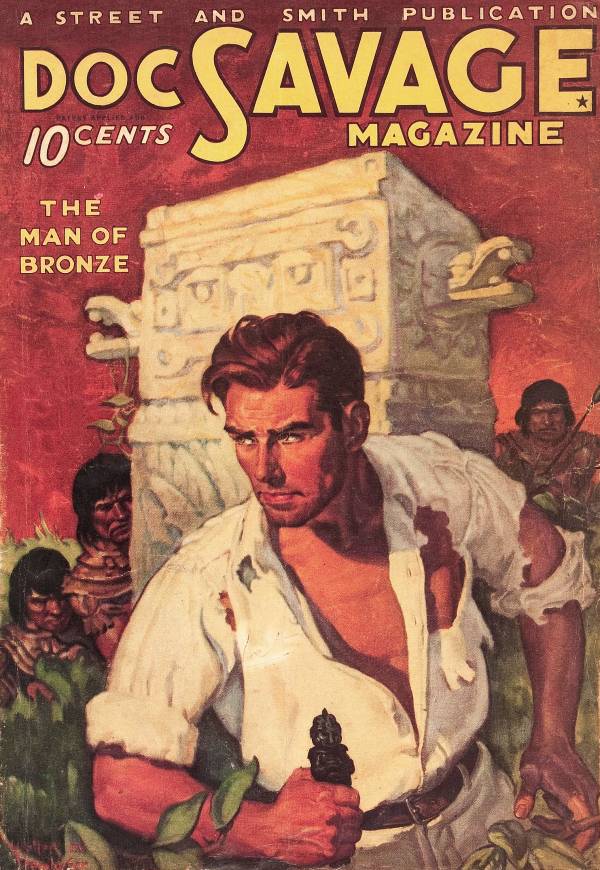
Pulp fiction came into my life when I was eleven years old, and I was never the same again. It happened at the neighborhood Rexall Drug store, and came in a series of paperbacks starring Doc Savage, The Man of Bronze.

The writing spoke to me. It was direct, conversational, and loaded with personality and humor. The author was not only having fun, he was being paid to be a smart-aleck. I wanted to be a professional smart-aleck too.

Doc SavageYears later I learned that Doc Savage was a pulp hero, that most of his adventures were written by Lester Dent, and that the style I so admired was considered hardboiled. My search for more such stuff led to Dashiell Hammett, Raymond Chandler and their less-famous contemporaries. At the time, very little of that stuff was in print, so I went to the source, hunting down the pulps themselves.

The more I read, the more I realized that my favorites were the guys having the most fun. They were the smartest of the smart-alecks, experimenting with the language and injecting plenty of personality and humor into their writing. I found their style infectious, and if my own stories are a little wacked-out, it’s mostly their fault.

The guiltiest parties follow.

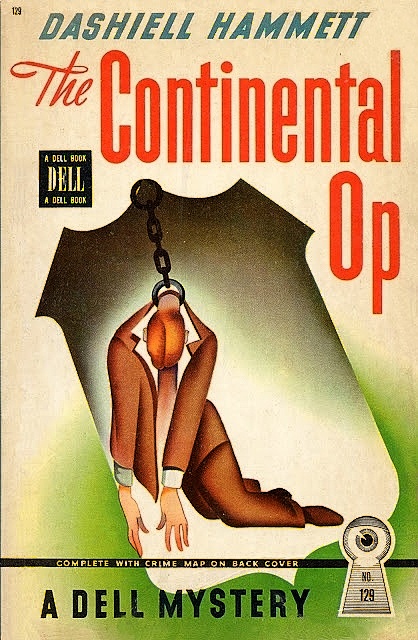
DASHIELL HAMMETT is revered by fans and critics for Dashiell HammettThe Maltese Falcon, and I think it’s a fine novel, but the stories that really grab me feature The Continental Op. The Op began as a nearly invisible narrator and evolved into a supreme smart-aleck, reaching his peak in the novel Red Harvest (originally published as four novelettes in Black Mask). Continue reading

1 Comment

Filed under How'd That Happen

AHMM Congratulates Its Derringer Award finalists

I’m pleased to see that four of our stories from 2013 are on the shortlist for a Derringer Award presented by the Short Mystery Fiction Society.

Kudos to Joseph D’Agnese for his story “Bloody Signorina” (AHMM, September 2013) in the category of Best Long Story, and in the category of Best Novelette, to William Burton McCormick for “The Antiquary’s Wife” (AHMM, March 2013), O’Neil De Noux for his story “For Love’s Sake” (AHMM, July/August 2013), and James L. Ross for “Last Night in Cannes” (AHMM, November 2013).

Leave a comment

Filed under Awards

Anyone Can Write a Mystery

“Anyone can write a mystery,” says a book editor in Helen McCloy’s Two-Thirds of a Ghost (1956), and later a literary agent asserts, “there is no market anywhere now for a story with a plot.” As an author and publisher of mysteries, those most highly plotted of fictions, McCloy is clearly having a little fun.

The opportunity to rediscover McCloy’s work was one of the benefits of a class I taught recently on some women mystery writers of the 1950s. I titled the course “Forgotten Masters” because my four authors—Helen McCloy, Charlotte Armstrong, Margaret Millar, and Dorothy B. Hughes—are largely forgotten and out of print today, while many of their male contemporaries are not (including Ross Macdonald, who was Millar’s husband).

Continue reading

Leave a comment

Filed under Uncategorized