Category Archives: Uncategorized

Zoinks! Scooby Doo and the Story Behind “Shane on the Scene” (by James A. Hearn)

SCOOBY-DOO OR SCOOBY DOO?

Let’s get the question of the hyphen out of the way before I begin.  When Scooby Doo, Where Are You! premiered on CBS in 1969, the titular hero’s name was written without a hyphen between “Scooby” and “Doo.”  The talking Great Dane’s name was Scooby Doo, no hyphens, and it remained that way until some bored Hanna-Barbera executive decided to hyphenate it to Scooby-Doo and have the name retconned for consistency.

As a lifelong Scooby fan, that hyphen just looks wrong to me.  Whenever I watch any of the dozens of incarnations that followed my favorite cartoon, my crotchety old man persona comes out: Back in my day, after those bats flew out from that creepy old mansion, there wasn’t a dang hyphen in the cartoon’s opening sequence!  And we liked it that way!  When the bats flew away, the title flashing spookily on the screen was Scooby Doo Where Are You!  Not Scooby-Doo Where Are You!

Scooby Dooby Doo is his proper name, now and forever.  That said, if I could change anything about the cartoon’s title, the English major in me would trade the exclamation point for a question mark.  That’s proper punctuation, and no fan, however crotchety, can argue the point.  Also, I would’ve added the comma after Doo, as it appears in the brief animated sequence where Scooby and the gang run across the screen, right beneath each episode’s title.  As in:

SCOOBY DOO, WHERE ARE YOU! IN: GO AWAY GHOST SHIP

To sum up, the dog’s name should be Scooby Doo and the cartoon’s official title should be retconned to Scooby Doo, Where Are You?

But I digress.

THE 1970s – CARTOON NIRVANA

To me, the 1970s were the Golden Age of cartoons.  As a child, I spent Saturday mornings in the living room scarfing down Cap’n Crunch cereal in front of the family TV.  I could rattle off dozens of titles, but my favorites were Super Friends; Tarzan, Lord of the Jungle; Star Trek: The Animated Series, Jonny Quest, Star Blazers, Battle of the Planets, Laff-A-Lympics, and The Bugs Bunny/Road Runner Hour.

But the king of cartoons was Scooby Doo, Where Are You!  It was a crazy show, when you think about it.  A Great Dane and four teenagers ride around in a weird van, The Mystery Machine, solving mysteries.  Did these kids live in the van?  Go to school?  Did they have jobs?  Parents?  Responsibilities of any kind?  Apparently not.  All they did was hang out at malt shops and pizza parlors, drive around the country, randomly run into very dumb criminals masquerading as ghosts or monsters, catch said criminals in elaborate traps, and literally unmask them by the episode’s end.  Oh, and their Great Dane talked and usually played an integral part in solving the mysteries.

Crazy.  At the time, I didn’t realize I was enjoying my very first mystery series, though I use the term “mystery” rather loosely.  As a kid, it didn’t matter to me that the clues rarely made sense, or that the traps to catch the crooks defied the laws of physics.  Fred, the gang’s leader, could shoot a “monster” in the butt with a toilet plunger tied to a rope, then capture him by hoisting him up to the ceiling via a pulley.  Shaggy, Scooby’s best friend (I was going to say Scooby’s owner, but that’s a debatable topic), could devour a double triple-decker sardine and marshmallow fudge sandwich in one gulp…unless Scooby stole it.  “Danger-prone” Daphne, Fred’s girlfriend, could fall through a trapdoor and plummet to a dungeon’s stone floor without so much as suffering a hangnail, let alone broken bones.  And don’t get me started on Velma.  She was a walking, talking encyclopedia, a convenient deus ex machina who could pull out any clue or factoid necessary to wrap up the mystery.

The mysteries weren’t so much solved as they were resolved.  The gang gathered clues, sure.  But by the episode’s end, the clues didn’t really matter when all they did was construct an elaborate trap, catch the villain, and pull off his mask to reveal that the seemingly supernatural monster was, after all, a very human criminal.

For all its goofiness and inconsistencies, I was obsessed with this show.  I wanted to drive around in The Mystery Machine, eat Scooby Snacks with my talking dog, hunt for clues, catch crooks, and party at The Malt Shop afterwards.  I think the appeal of Scooby Doo for me—and maybe for everyone—was this: kids were solving crimes that confounded adults.  And that leads me to “Shane on the Scene,” my story in the May/June issue of Alfred Hitchcock’s Mystery Magazine.

“SHANE ON THE SCENE”

This story idea was born from an anthology call for private eye stories exploring 1960s America.  (Since my main character was an amateur sleuth and not a paid professional, turns out he didn’t qualify as a private eye.  Sigh.)  Anyway, the assignment was to take some culturally significant event from that tumultuous decade and use it as the background for a private eye story.  I’m sure there were lots of stories about Woodstock, Vietnam, the sexual revolution, and other monumental historical events.

At first, I had no idea what to write about.  For one thing, I wasn’t alive in the 1960s, so I felt little connection to the decade I was researching.  But, as a child of the seventies, I came to realize I was very much plugged into the pop culture of the sixties through television.  That was my angle.

But what TV show should I write about?  Star TrekThe Twilight Zone?  Those were two of my favorites from the sixties, and they were finding new audience members like me through the power of syndication.  As a kid, I didn’t necessarily understand the decade preceding my birth, but I did take note of the Cold War, Space Age, and apocalyptic storylines running through those shows.  Those lessons applied to my world in the seventies.  In Star Trek’s “A Private Little War,” I realized we were the Federation and the Russians were the Klingons, and our conflict was being played out in other countries instead of other planets.  In The Twilight Zone’s “Time Enough at Last,” I learned we lived under the threat of a nuclear holocaust…and to always carry an extra pair of reading glasses, in case the first pair broke.

But all of that seemed heavy and depressing.  What I remembered from the seventies was a brand of happy curiosity, a feeling of adventure.  I needed to capture a sense of childhood’s . . . mystery.

WOULD YOU WRITE IT FOR A SCOOBY SNACK?

When I hit upon the idea for Scooby Doo, I knew I wanted to model my mystery after the plot of a real episode.  My amateur sleuth, using lessons learned from a show he’d watched on a Saturday morning, would solve an actual crime.  With my premise chosen, I was excited to have my chance, through Shane, to vicariously become the hero I’d dreamed about. 

But which episode?  I started watching Scooby Doo, Where Are You! for inspiration.  Now, I’ve done all kinds of research for stories, everything from reading entire books to mapping out historical constellation patterns.  I’ve even bought a video game console just to learn Texas hold ’em, literally playing thousands of poker hands to master the game and get the details right.  As entertaining as that was, watching old episodes of Scooby Doo was by far the most fun I’ve had doing research.

While I enjoyed episode eleven, “A Gaggle of Galloping Ghosts” (probably my favorite, since there are three monsters), I went with episode fourteen, “Go Away Ghost Ship.”  In my story, Shane watches that episode the Saturday it premiered on CBS, December 13, 1969.  Just as Scooby and the gang snag the Ghost of Redbeard and unravel an insurance fraud scheme involving ship manifests, Shane unmasks the perpetrators of a similar crime.

I hope you enjoy reading my story as much as I did creating it.  If you have a subscription to the streaming service Max, check out Scooby Doo, Where Are You! and the other incarnations of America’s favorite canine sleuth.  The kids in your life—and maybe the kid inside you—will thank you for it.

3 Comments

Filed under Uncategorized

From Reader to Writer (by D. Slayton Avery)

I am thrilled to be in Alfred Hitchcock Mystery Magazine!

This is the magazine that was always around when I was a kid. My mother subscribed, she has always been a fan of Hitchcock; his movies, television show, and the monthly collection of short stories, which was read by the whole family. Though as an adult I don’t write or even read  many mystery stories, I still remember certain stories that I read some fifty years ago in AHMM. Those clever concise stories likely informed my craft as a writer of flash fiction. I have written many flash fiction and short stories, some even dark or mysterious, but “Nuisance Bear” is my first actual murder mystery, though I suppose it’s not really too much of a whodunnit.

“Nuisance Bear” takes place in northern Vermont. If you are not familiar with northern Vermont, watch the Hitchcock movie, The Trouble With Harry, which was filmed around here in 1954. (yes, my mother got autographs, and yes, that lakeside cabin in the movie is still on the very lake that I now live on) If you are not familiar with northern Vermont, you might not notice how Hitchcock had to fudge some of the shots when the weather and foliage that fall did not comply with his wishes. Of course, if you are familiar with northern Vermont you know that’s just how it goes. And you might also notice from the movie how much remains the same and how much has changed around here since that time. Maybe that’s part of what “Nuisance Bear” is about; managing change and preserving place.

At over 3000 words, “Nuisance Bear” is one of the longer stories I’ve written. I usually write flash fiction, which in my book is most often 99 words, though definitions of flash fiction vary. I enjoy the puzzle of fitting a complete story into an exact set amount of words. I have found too that a low word count forces tough decisions which make the finished product more polished through word choice and economy of details. But the flashes don’t have to stay at that word count, don’t have to be terminally “finished.” Often a 99 word story is inherently mysterious; they can leave the reader (and writer) wondering what might happen next. The thing about such short stories is they can be considered scenes, seeds for the writer to grow and expand the story. 

Now would be the time to say that “Nuisance Bear” grew from a flash fiction seed, but that would not be true. It’s too bad, it’d be fun to share that transformation, but this is one of those rare for me stories that I just sat down and wrote until it was finished. But the habits and skills developed through flash fiction writing served me in the writing of the story, and more important, the revising of the scenes. I hope the tale got told with just the right amount of words.

Sometimes my flash fictions produce characters who do not want to be finished at the end of the 99 word story. I become quite fond of some of these characters and so they find there way into ensuing stories and scenes. Nuisance Bear is finished; after all it’s a story of the perfect crime. However, I have lately been hearing whispered suggestions from Barret Ingram. Hmm. Character, check. Setting, check. Hmm.

This was my first mystery story, but maybe not my last.


D. Slayton Avery lives in northern Vermont beside a mountain under some trees overlooking a lake, along with one husband and one cat. Though an award winning poet and published author of flash fiction, “Nuisance Bear” is D.’s first murder mystery. You can sample D.’s prose and poetry  at ShiftnShake

10 Comments

Filed under Uncategorized

David Hagerty on “Fire on the Mountain”

My story, “Fire on the Mountain,” started with a challenge: to write a long short story in the style of Hitchcock’s thrillers.

To begin, I listed all the essential elements of his films: an everyman falsely accused, an absurdist plot, a McGuffin, and of course a mysterious blonde.

I chose North by Northwest as my model because it included wide open spaces, national parks, and a surreal climax.

However, I wanted to update his style to the new century, so I chose a familiar scenario in my home state of California: wildfires.

Since I’m an avid hiker and frequenter of the outdoors, I didn’t have to do much research on the landscape and scenery. I picked Redding, a small mountain town at the base of Mount Shasta, as the setting both for its beauty and its fondness for New Age mysticism.

Next, I drew from my day job at a college. To me, one of the enduring appeals of Hitchcock’s best films is they feature everyday people caught up in heightened scenarios. For my protagonist, I didn’t want some superhero or private eye or courageous cop. I am tired of reading about them. Give me an everyman any day. Instead, I chose a biology professor collecting specimens during a sabbatical.

I also didn’t want a traditional love interest from the 1950s, so I added an independent female forest ranger who is more interested in arson than in a husband. I included a range of suspects, from a family out on a camping trip to a crew of inmate firefighters. And I finished with a climactic chase through the park.

The hardest choice for me was the antagonist. After debating several options, I settled on an arson investigator from the U.S. Forest Service. He knows that the most likely culprit in any fire is the person seen closest to its ignition point, which leads him to suspect the professor. You don’t often read firefighters being cast as bad guys, but it was a fun riff on stereotypes for me.

This is the second piece of mine for AHMM with overt references to a Hitchcock film. In one of the prior stories, I included a Vertigo reference and a few allusions to Rear Window. It’s hard to write a thriller without thinking of Hitch, so I don’t try.


David Hagerty has published four mystery novels and more than 50 short stories, including 8 in Alfred Hitchcock’s Mystery Magazine. If you’d like to read more of his work, much of which is available free online, please visit his website, https://davidhagerty.net, sign up for his newsletter (there as well), or follow him on Facebook: David Hagerty Author.

Leave a comment

Filed under Uncategorized

Never a Dull Moment (by G. Miki Hayden)

My protagonist in “A Deadly Game” in the May/June issue of Alfred Hitchcock’s Mystery Magazine, Oklahoma Senior Police Officer Aaron Clement, is a guy I’m fond of. He derives from my police procedural, Dry Bones, published in May 2024 by Down & Out Books.  (Coming in May 2025 from Down and Out is my Florida suspense thriller Political Alliances headed up by gardening journalist Mara Wayne whose grandmother dies unexpectedly—and even more unexpectedly leaves the family avocado ranch in the South Florida Redlands to a strange religious group, the Children of Jordan.)

But trust me, I’m a short storyist at heart and won a short story Edgar in 2004 for “The Maids” in a Mystery Writers of American anthology. This isn’t my first appearance in AHMM, either, as Ghana-born Harlem resident Miriam Obadah did some crime-stopping in these pages several years ago. I’m published in a few MWA anthologies as well, with a story most recently in Crime Hits Home, edited by S. J. Rozan. You’ll also find other shorts of mine out and about, notably in a few set in the Adirondacks.

I have more of my shorts to mention here, too, in Pacific Empire, lauded by The New York  Times when the alternate history linked short story novel came out, and then the novel appeared on the NYTimes summer reading list.

Where did my knowledge of crime come from? In my stint as a business journalist, I wrote a monthly newsletter about company security and enjoyed listening to talks on a range of corporate security issues and approaches to handling them, from executive protection, to processing incoming mail, to dealing with employee theft—and lots more. I was able to attend top level symposiums in New York, Washington D.C., and Chicago—fun for me.

I like to write about very good people, and to make that stand out I need very bad people to oppose them.  My protagonists are smart, too, but that doesn’t make my antagonists stupid. Morally stupid, perhaps, but they give the good guys a real run for their money.

In the past year or so I had a series out (Rebirth), which I might call something from literary to paranormal to martial arts: Rescued, Re-Live, and Respiration. The cycle starts with the stepmother’s attempt to starve genius child Jay (not to worry) and his rescue and transformation, with Re-Live focusing on Jay’s student Steven, and Respiration showing Jay tangling with the Yakuza at his Japanese mountain retreat (where he attempts to whip his Heavenly clan into shape). Lots of action.

What else I do is teach at Writer’s Digest’s Online Workshops and perform pre-publication edits for people. Look for my instructionals at Amazon: Writing the Mystery: A Start to Finish Guide and The Naked Writer: A Comprehensive Writing Style Guide. I post on Facebook at a personal site and an author’s site. Say hello after you read the AHMM issue.

Leave a comment

Filed under Uncategorized

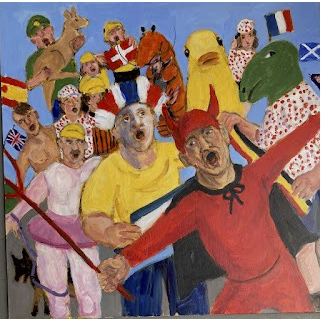
Janice Law on “The Devil at Le Tour”

(Credit: Janice Law)

After more than six decades of living with a sportswriter, I know quite a lot about sports and have written stories and at least one novel (Cross Check) about athletes and sports agents. But until “The Devil at Le Tour,” I have never written about my favorite sport: grand tour and classics bicycle racing.

I first encountered these spectacles during holidays in Scotland, when our rented black and white TV brought in half hour reports on the Tour de France and glimpses of the summer city center criteriums that were the majority of bicycle races in the UK at that time.

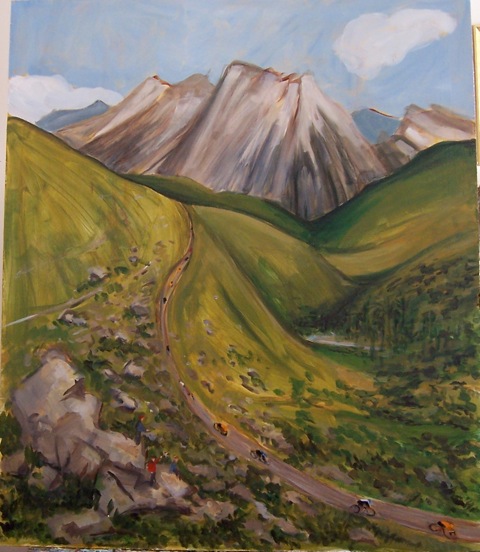
Over the years cycling coverage had grown from functional to spectacular with motos, helicopters, on-board cameras, and drones. The races have become more elaborate, and both the Giro (the Italian grand tour) and the Vuelta (the Spanish tour) have learned from the tourist savvy French organizers to run race segments through the most beautiful countryside possible.

(Credit: Janice Law)

With gorgeous backdrops, colorful racing kits, and even more colorful fans, the grand tours and the one-day classics provide visual feasts. But while I have done over two dozen paintings of the races, cyclists, and fans, my interest in the sport goes beyond interesting visuals.

For one thing, cycling commentators are knowledgeable, humane, and experienced. Many were in the professional peloton. Others were serious amateurs or semi-pros, and they haven’t lost an awareness of the huge difficulties and dangers of the sport, nor an appreciation of individual effort, even when it falls short. There’s none of the yelling and provocation and personal aggrandizement that mars so much of our sports talk and commentary.

Winning races is undeniably important, but it isn’t quite everything in cycling. A long breakaway, a brave rider caught just before the finish line, a rider who finishes in spite of injury or a serious mechanical, the unsung but essential support rider, and the clever lead out rider are all not just acknowledged but celebrated.

Then there are the traditions, some quite romantic, of a sport that has not yet been completely corporatized. In le Tour, it is still traditional for the peloton to wait for a leader who has an accident or a mechanical breakdown, and there are still examples of individual sportsmanship that probably drive result-conscious team managers apoplectic.

There was Roman Bardet stopping when his countryman, Julian Alaphilippe, plunged off the road, ensuring a rival would be quickly rescued; Tour contender Jonas Vinegaard waiting for Tadej Pogacar on a risky descent, and the same Pogacar, undoubtedly the greatest modern grand tour rider, calling his whole team, support people, soigneurs, and mechanics up on the Tour de France podium for a photo.

All this is possibly why I have steered clear of cycling as a setting for murder and mayhem. Still, it has represented both a temptation and a challenge. The riders are useless as either perpetrators or sleuths because they are totally caught up in effort, eating, and recovery. It takes a monstrous amount of calories to ride over alpine passes, negotiate cobble stone streets, and manage mountain descents, not to mention speeding along in packed pelotons at fifty plus kilometers an hour.

Commentators are no more useful, as by and large they are watching monitors at the finish line, catching quotes from the exhausted winners, or setting off for the start of the next stage. It was only when I thought of one of my favorite old riders, the Scottish time trialist and grand tour stage winner, David Millar, now a businessman and an excellent writer and blogger on cycling, that I was able to concoct a character with enough flexibility to serve as investigator.

My Ivor is just starting out as a commentator. His current role is to write blogs on interesting events and colorful characters and to scope out the day’s big climb or the final kilometer that will face the sprinters. He has enough time away from the computer and the monitors to get into trouble.

With everyone else occupied, that trouble can only come from the fans, and who better to stir the pot than the Devil? Why the pitchfork and tail? Why the dinosaur masks, the fuzzy dyed wigs, the inflated kangaroo, the fat suits, the Borat monokinis? You’ll find out in “The Devil at Le Tour.”

Leave a comment

Filed under Uncategorized

When & Where (by R.T. Lawton)

There are two questions I often get from beginning writers. One is when did I start writing? The second is where do my ideas come from?

In answer to the first question, I have always been an avid reader of crime fiction and grand adventures. It was only natural that at some point, I would try to write my own stories. But, the path to publication has not been easy. In college, I took a creative writing course. I soon found out I was not destined for literary writing. Life went on. Then, Uncle Sam pointed his finger at me for the South East Asian Tour. It was off to Ankhe up in the Central Highlands. When I returned to the World, I finished college and joined the old BNDD as a Special Agent.

While working on the bike gangs in Kansas City, I often read Easyriders magazine to get a feel for the biker life style. Upon reading one of their stories, I told myself that I could write a better story than that one. So, I wrote a story and sent it in. The editor bought it. I thought I could write. Then, the editor bounced my second submission. I went back to the drawing board and more carefully studied story structure and other elements of good story writing. The editor bought my next submission.

I had three takeaways from this situation. The first was to write the best story I could. The second was that even reading bad fiction was good if it inspired me to write a better story. And thirdly, I may not be a literary writer, but I was a storyteller. I just needed to put it down on paper in a correct fashion.

Side Note: At that time, special agents were not allowed to have outside employment, to include writing fiction, but the agency had a first-class undercover course where they taught agents how to be someone else. So, the byline on my beginning stories was one of my nicknames from the street and the check came in one of my undercover names. I was merely practicing what the agency taught me. Damn good school.

As for the second question of where did story ideas come from, I was up to my ear lobes in criminal characters, from hard core street dudes to those who had their own armies. Some of these people were very impressive. You wouldn’t want to take them home for supper, but they could make great story characters.

I spent a few years honing my craft on small publishers who paid ten dollars, if you were lucky, or maybe just in contributor copies.  Then, one day I decided to go for the gold ring. On the website for the Alfred Hitchcock Mystery Magazine, then editor Kathleen Jordan mentioned she was looking for stories set in an exotic location. It just so happened that I had in inventory a story set in the Golden Triangle of Burma, Laos and Thailand. I submitted it. She bought it. I was ecstatic. Then panic set in. If I didn’t want to be a one-trick pony, then my next submission would have to be first rate and original. At that point, I had nothing in inventory. But, I knew criminals and criminals steal, so I stole ideas from Issac Azimuth, Nero Wolfe, Dashiell Hammett and the Kansas City Black Mafia. Two members of this latter group had street names of Twin and Twin Brother. Twin and I got to know each other quite well before he went off to join his brother in a stricter environment. Thus was born The Twin Brothers Bail Bond Firm series. Kathleen bought the first three stories in the series before she passed.

Linda Landrigan became the editor and soon sent me an e-mail requesting changes on that third story, which was already bought and paid for. What did I do? I made the requested changes. Linda went on to buy nine more stories in the series. She also bought stories in the Holiday Burglar series, the 1850 Chechnya series, the 1660 Paris Underworld series, the Golden Triangle series, the San Francisco Gold Rush series and the Prohibition Era series. Some of these stories were based on her suggestions made during conversations at various writing conferences.

What did I learn from all of the above? Well, write what you know. If you don’t know it, then research, research, research. Daydreaming helps a lot. Always remember, the editor is the boss. Linda once requested a story from the point of view of the Little Nogai Boy in the 1850 Chechnya series. Prior to that the Mongol boy had no dialogue and not more than three lines of narrative. I buckled down and wrote the story. She published it and it went on to be nominated for a Derringer Award. Find a time period or setting where other authors aren’t writing and see if you can squeeze a series in. Be a breath of fresh air. Keep submitting stories with new plots and solutions, or new takes on old plots and solutions. Don’t overload any one editor’s slush pile. Space your submissions out over time. After all, with all the other potential reasons out there for rejection, you don’t want to compete against yourself. There are other markets.

A couple of thoughts on networking for recognition in the writing community. Volunteer for office in your local organized writing chapter. You’ll meet some good people, generous with writing advice and connections. Attend writing conferences and volunteer as a panelist. If attendees like the way you talk, they will buy your books and stories. Once again, you will meet good people and you never know what new connection will help you sell aa story. Ask me in a writers’ conference bar sometime.


R.T. Lawton is a retired federal law enforcement agent, a 2022 Edgar Award winner for Best Short Story, and has over 170 short stories in various anthologies and other publications, to include 53 sold to Alfred Hitchcock Mystery Magazine. He has nine short story collections in paperback and e-format on Amazon.

1 Comment

Filed under Uncategorized

Training Days (by Kevin Egan)

In the mid-1970s, I was a University of Florida law student hoping to avoid a legal career by becoming a successful fiction writer. To pursue this delusion, I spent my limited free time—usually a three hour chunk on Friday afternoons—writing a novel. 

Early in January of that year, I saw an advertisement in the university newspaper for the annual Florida Writers Conference. The three-day mid-February event featured a guest novelist, a guest short story writer, and a guest poet. There would be lectures, workshops, and mix & mingle gatherings. For an additional fee, conference attendees could submit writing samples (chapters of a novel, a short story, or a few poems) and then meet with the appropriate guest writer for a private critique.

This caught my attention.

The guest novelist that year was John Knowles. And if you were among the many thousands of students of a certain age who read A Separate Peace as part of the standard high school literary canon, I need to add: Yes, that John Knowles. Even though attending the conference required me to cut three days of classes, the opportunity to meet with an author of his stature was too tempting to pass up. I registered for the conference and submitted three chapters of my work-in-progress.

After considerable mental build-up over the intervening weeks—in the most fanciful scenario, John Knowles would pick up the phone to call his publisher about the young writer he’d discovered—my “audience” barely lasted fifteen minutes. Mr. Knowles had read my submission, allowed rather tepidly that I “could write,” and strongly suggested for future reference that when I submit a portion of a novel I should submit consecutive chapters. (I had submitted chapters 1, 5, and 15, thinking that these were the best examples of my writing.)

At that point, most likely because there was nothing else to say, he asked what I did when I wasn’t writing. I told him I was a law student. He groaned, then paused thoughtfully, then predicted that if I became a lawyer and persisted in my quest to become a writer, finding the time to write would be my biggest challenge.

He went on to describe his strategy for writing A Separate Peace. At the time, he was working as an editor for a travel magazine. The job was stressful, and he found that the only time he could totally engage with his fiction writing was during his daily train commute on the New Haven Line between Connecticut and Manhattan. And so, he wrote A Separate Peace on that commuter train, hammering out a steady 500 words per day.

Admittedly, this personal anecdote meant nothing to me at the time. Daily train commutes? Full-time job? I was living a student’s life in North Central Florida. How was any of this relevant to me?

Fast forward approximately three years to a specific date: January 3, 1979. I had moved back to New York and was commuting on that same New Haven Line  to my first day as a tax editor for a legal publishing company. Suddenly, two islands of time on a commuter train bookended my days at the office. How should I use this time? Read the tabloids? Sleep? Stare out the window? I decided I would use the time to write because . . . hey . . . that’s how John Knowles wrote A Separate Peace.

I began by carrying a briefcase loaded with legal pads and pencils. I would find a seat, preferably on the aisle and away from the window, take out a legal pad and pencil, and use the briefcase as a lap desk. And there I would sit. At first, I had nothing to write about. That law school novel was long abandoned, and I had no stories to tell because I knew little and had done nothing interesting in my life. But I carried a collection of quirky characters in my head, along with childhood memories and some crazy summer job experiences. I began to cobble this olio into stories.

Looking back, I now realize that by transforming a commuter train into a rolling office, I had done  more than just use idle time to practical advantage. I had created a psychic space in which to write. Every aspect of the routine became a personal writing prompt: the rhythmic rumble of the wheels on the rails, the weight of the briefcase on my lap, the feel of my fingers curled around the pencil, the friction of the lead scratching across the yellow paper. And surprisingly, or maybe not, rush hour trains were amazingly quiet, filled with commuters who were sleeping, reading the tabloids, and either girding themselves for the day ahead or unwinding on the way home. There were many train rides when I wrote furiously for 45 minutes, many others when I simply stared, unseeing, through the empty page of a legal pad while I worked out plot dilemmas or character sketches in my head.

I sold my first short story in 1979—a bit of beginner’s luck—but it would be a long time and many commuting days before I sold anything else. I rode the rails for 30 years, pounding out eight novels (including a draft ghost-written for another author) and three dozen short stories.

My last train ride as a commuter was on December 1, 2020. I retired three months later. As a retirement gift, my daughter gave me a white noise machine as an aid for my writing. The machine generates 18 different soothing sounds—one of them the sound of a train. I wrote my first “sedentary” story to the sound of that machine. “Negative Pregnant,” which appeared in the Jan.-Feb. 2024 issue of AHMM, proved to me that I could write outside the confines of a commuter train. “Foxx Goes to College” followed and appeared in the May-June 2024 issue. Other stories are on the way, some waiting in the queue to be published, others in the queue to be considered.            

My train excursions into Manhattan are rare now; my latest was to attend Dell’s annual Pre-Edgar Cocktail Party. I always carry a pen and a pocket notebook for these trips. Can’t seem to sit on a train without writing implements in hand.  

Leave a comment

Filed under Uncategorized

It’s All One: Music, Stage, and Words on the Page (by Steve Liskow)

Whatever your background or experience, it influences your writing.

My urge to write is probably genetic. Both my sister and I entered kindergarten reading at the fourth or fifth-grade level because the previous generation included two teachers and two journalists, so people read to us as soon as we could sit upright. We are the youngest of eleven first cousins, six of whom (including me) became teachers. Two cousins besides me also participated in theater, so we got used to hearing stories read with expression and feeling.

I came to publishing late, but I’ve written for most of my life, producing my first stories at ten or eleven, copying the Hardy Boys stories after discovering them on The Mickey Mouse Club (Okay, I’m dating myself). My mother, a stenographer turned housewife, typed them up, and seeing my words in print was a thrill that never went away.

I gave up writing in my teens, but a grad school seminar on American short fiction rekindled my interest in the early 70s and, between 1875 and 1980, I submitted five horrible manuscripts to publishers. I submitted the last one as my sixth-year project at Wesleyan University and told myself that someday, I would go back to it and make it marketable.

My parents were excellent dancers from the Swing era, and either records or the radio filled my world with music, constantly.

One of my uncles used to play my great aunt’s piano on Sunday evenings when we all gathered there for monthly family dinners. I and wanted to play piano, too. Unfortunately, our house was too small to accommodate a piano (this was the 1950’s, before electronic keyboards), so I ended up studying violin for a year. Violin didn’t match the music I heard in my head, so I quit. By then, I was balancing music and my Hardy Boy fixation along with baseball, football, and golf.

When the British Invasion arrived via the Ed Sullivan show, I wanted to play guitar, but didn’t follow up on that dream until I saw the Muddy Waters Blues Band open a concert for Martha and the Vandellas at my community college. Within weeks, I bought a cheap guitar and a Mel-Bay guitar book. When I transferred to Oakland University a few months later, several guys in my dorm were folkies, and I started learning from them, too.

After graduation, I became a high school English teacher. That meant I knew how to write a decent sentence and paragraph, but I didn’t know how to tell a story. I was teaching by the time I wrote those awful novels I mentioned earlier.

My first wife was a classical clarinetist who could sight-read any music you put in front of her. I couldn’t read music very well, but my ear for chords was almost infallible, and, from a brief study of bass guitar (I was in a very short-lived rock band in college), I had a basic understanding of music theory.

We divorced in the early 80s, and I drifted into community theater, where I met my second wife, Barbara. I worked in 100 productions as an actor, director, designer, technician, producer, or—rarely—a musician, often several at once. I haven’t worked in theater in about a decade, but Barb still acts in four or five productions a year throughout eastern Connecticut. She is also an infallible Beta reader.

Music, theater, and writing have overlapped for most of my life. Maybe I’m trying to find something I do well. Still playing guitar adequately, and heavily immersed in theater, I retired from teaching in 2003 and decided to try writing again, but this time I took it more seriously and attended workshops to learn the craft.

Chris Offutt critiqued the first chapters of a novel at the Wesleyan Writer’s Conference, and said he could tell I did theater because I wrote excellent dialogue. But he said I had to rely on it less and use more narration and description. That led me to books on plotting and character. I attended more workshops and got advice from other writers who helped me along until my terrible work improved.

After 350 rejections for about fifteen stories and many revisions of various novels, I sold my first short story, four years after retiring from the classroom. Three years later, I sold my first novel. I still play guitar and am studying piano, about 65 years too late. Last night, I attended a new musical play written by a former theater colleague. He and I acted together and directed each other, and I played guitar in a previous show he wrote.

Theater and music are huge influences on my writing.

Why? you ask.

Because American English is built on RHYTHM and INTONATION. Look at the difference between PASS THE TEA BAG and PASS THE TEA (pause) BAG. Or put a pause after “road” in WHAT’S THAT IN THE ROAD AHEAD?

If you don’t think intonation matters, consider people who end a sentence on a rising note, even when they aren’t asking a question. It blocks your instant comprehension, doesn’t it?

When I’m writing, I hear the pauses and rests as if I’m listening to music. I know some writers who listen to specific music when they write (I’m not one of them), and many of my story and novel titles are also song titles because of a subject or mood. “I Ain’t Got No Home,” in the March/April issue of AHMM, is an old Woody Guthrie song. It’s also the name of an early rock ‘n’ roll song by Clarence “Frogman” Henry.

Twenty-five years of theater, directing everything from Shakespeare to Edward Albee to Lanford Wilson to Christopher Durang, and acting in Wait Until Dark (a crime drama), Noises Off (a British farce), All My Sons (a family drama), Hamlet (Claudius), As You Like It (Jaques), or Book of Days (a murder mystery) amplify that music experience. A scene and play have their own rhythms and tempo changes. If the audience watches a 90-minute-plus production with every scene at the same rhythm and tempo, they’ll all be asleep by the curtain call.

It’s the same in writing. Even a short story has rhythm and tempo shifts to emphasize an event or idea. A novel has hundreds of them. I still remember a woman who stage managed two shows for me and knew my rhythms. She was a Beta reader for one of my novels, and told me, “There’s a huge energy drop in this chapter.” When I looked at it, I realized it was much too long. I cut it in half. Sometimes, the rhythm shift means more or less dialogue, or a longer transition. One of my early novels dragged badly in chronological order, but when I started in the middle and slid the early scenes in as brief flashbacks, everything chugged along so the readers kept turning pages. Listen to the music. And find your light.

Leave a comment

Filed under Uncategorized

Why I Write in the First-Person (by Alexis Stefanovich-Thomson)

One of the initial decisions that every author must make is whether to write in the first-person (I) or the third-person (he/she/they). To the reader this may seem like a technical matter with limited effect on the end product, but in the mystery story, the stakes are amplified; there is a crime to be solved, and having—or not having—access to the inner workings of the mind is of paramount importance to how the solution to the mystery is revealed.

The first-person narrator seems less popular in contemporary crime fiction as writers appear to prefer the freedom to move through time and space, from scene to scene, from character to character, and from mind to mind. But it wasn’t always this way: the Sherlock Holmes stories, the early Agatha Christie, and the Nero Wolfe novels all employ a first-person narrator. And in each case, it’s the plodding sidekick—Doctor Watson, Captain Hastings, and Archie Goodwin—who tells the story from the perspective of “I”. There is good reason for this: the reader needs to be kept a distance from the machinations of the mastermind detective’s inner thoughts. Imagine if the reader is permitted to know all that Holmes, Poirot, or Wolfe are thinking. The mystery would be solved quickly; the story would be over almost before it began. Justice would be served, but the reading experience would be short. How often is Watson forced to admit, “I confess that I was filled with curiosity, but I was aware that Holmes liked to make his disclosures at his own time and in his own way”? The good doctor is the filter between the reader and the detective, denying us access to Holmes’ omniscience.

Most of the earliest authors of the hardboiled school, who, in inventing their own style, wrote in reaction to the intellectual puzzles of the earlier mysteries, continued to write in the first-person: Hammett, with his nameless Continental Op, Chandler with Phillip Marlowe, and later, Ross MacDonald with Lew Archer. The new hardboiled detective wasn’t a genius, he was a man of action, tough and immediate. He wasn’t sitting in his armchair, smoking his pipe, thinking about whodunnit; he was knocking down doors not knocking on doors—and getting knocked down himself, if not knocked out. The detective in these early noir novels parallels the reader: the two locked together, united in purpose, chasing down the killer page by page; the detective’s discoveries are simultaneously made by the reader. There is no space between when the detective has a flash of understanding and the reader learns of it.

And it’s not just the immediacy: writing in the first-person is the most realistic of all narrative techniques. It is how we experience our world everyday: locked inside our heads, looking out at the mystery of life around us, unable to see into the black boxes of others’ psyches. In truth, the novel is the one artistic form that fully allows us into the mind of another, to know—if only on a fictional level—the voice, the thoughts and emotions, the dreams and loathings of another. (Film occasionally tries voice-over to get at this intimacy and fails miserably.) James M. Cain took it a step further and had some of his first-person narrators explain the very act of writing their stories. Frank Chambers in The Postman Always Rings Twice: “So I’m in the death house now, writing the last of this so Father McConnell can look it over and show me the places where maybe it out to be fixed up a little, for punctuation and all that.” Even the copy-editing is made transparent!

And so when I write, I’m reaching for that same feeling—to be immediate and realistic, to show the world as we experience it, to propel the reader through the pages alongside the detective, to have them in his head sharing his discoveries, failures, and doubts in real time as if they were their very own.


Alexis Stefanovich-Thomson is a writer living in Toronto. He is a past winner of the Black Orchid Novella Award, the Crime Writers of Canada Best Novella Award and the Toronto Star Short Story Contest. His first novel, The Road to Heaven, was published by Dundurn Press in 2024. Visit his website at https://www.alexisstefanovichthomson.com/

2 Comments

Filed under Uncategorized

An Accidental Series (by Michael Bracken)

When most readers and writers think of a crime fiction series, they envision following a single protagonist and his or her sidekicks through several stories. Consider, for example, Dashiell Hammett’s Continental Op, Robert B. Parker’s Spenser, Sue Grafton’s Kinsey Millhone, and any of hundreds of other amateur and professional sleuths who come immediately to mind.

Not me. I stumbled backward into writing a series in which the setting—a fictional version of West Texas—is the reoccurring element that ties the stories together. This began with “Quarryville, Texas,” a story I wrote for The Private Eye Writers of America Presents: Fifty Shades of Grey Fedora (Riverdale Avenue Books, 2015). In the story, a private eye from Waco travels to Quarryville to solve a decades-old crime.

The quarry at the heart of Quarryville’s economic existence had closed in the early 1950s, leading to the town’s “long, slow slide into oblivion,” and the “dried-out scab of a town” is barely clinging to life at the beginning of that story. I returned to Quarryville for “Smoked,” written for Noir at the Salad Bar (Level Best Books, 2017), a story later included in The Best American Mystery Stories (2018). In “Smoked,” a former biker in the Witness Protection Program opens Quarryville Smokehouse, a barbecue joint that is soon named one of the state’s best. This unexpected publicity leads to all kinds of trouble.

The notoriety of the Quarryville Smokehouse brings visitors to Quarryville, and that sparks a “rebirth on Main Street” in “Mr. Sugarman Visits the Bookmobile,” written for Shhhh…Murder! (Darkhouse Books, 2018). As the story begins, an antiques shop and an art gallery are scheduled to open within the month.

In “Sonny’s Encore” (Black Cat Mystery Magazine #9, 2021), we visit Quarryville’s past when we experience the 1935 robbery of the quarry’s payroll office.

In subsequent stories, the town plays a minor role. Instead of featuring Quarryville, I developed the region, adding towns such as Chicken Junction and Mertz. Even so, characters visit Quarryville, spend the night in the six-room motel, dine at the Quarryville Smokehouse, or travel through on the way to somewhere else. I even set stories outside of West Texas in which characters from Quarryville play prominent or minor roles.

But I didn’t return to modern-day Quarryville as the central setting until “Barbed Wire Bison” (Alfred Hitchcock’s Mystery Magazine, November/December 2024). The smokehouse is still popular, the antiques shop and the art gallery are now open, and the town is no longer a dried-out scab.

In “Barbed Wire Bison,” a woman moving to Quarryville hires two retired barflies to help her unload her rented moving van. There aren’t many secrets in a small town, and before long they wonder what she’s hiding or who she’s hiding from. When violence comes to town, they learn the reason behind her relocation.

This is far from my last West Texas story. There’s one coming up in a future issue of AHMM about a young woman from Quarryville who travels to Hollywood to seek her fame and fortune, and there are others in the pipeline.

While every West Texas story can be read and enjoyed without reading any of the others, seeing how they all tie together provides readers with a richer experience.

And, as I discovered by accident, a series doesn’t need to feature a reoccurring protagonist. Sometimes the right location can tie everything together.


Michael Bracken (www.CrimeFictionWriter.com) is an Edgar Award and Shamus Award nominee whose crime fiction has appeared in The Best American Mystery Stories, The Best Mystery Stories of the Year, and many other publications. Additionally, Bracken is the editor of Black Cat Mystery Magazine and several anthologies, including the Anthony Award-nominated The Eyes of Texas. In 2024, he was inducted into the Texas Institute of Letters for his contributions to Texas literature. He lives, writes, and edits in Texas.

Leave a comment

Filed under Uncategorized