
In this enlightening post, Catriona McPherson highlights a few recent examples of angry, passionate women in television and literature, and discusses how her latest story fits right in with this motif

My story in the March/April AHMM—“Something that is not Moving”—is about a yoga class full of menopausal women that—ahem—boils over. The central Salem Community Center beginners’ Hatha yoga class has never seen anything like it.
But there’s a lot of it about if you know where to look.
Riot Women on BBC and Britbox has been called the year’s first “must see” telly. (At time of writing, I’ve watched five episodes and am saving the sixth for Friday night and pizza.) Jess, a pub landlady, Beth, an English teacher, Holly, a retiring policewoman, Yvonne, a midwife, and Kitty . . . chaos in leather jeans, are a loosely-connected handful of middle-aged women living in creator Sally Wainright’s Calderdale Valley in Yorkshire. (If you’ve seen last Tango in Halifax, Happy Valley or Scott and Bailey, you’ll know your way around.) They each have good cause to be either despairingly, grindingly, bitterly or righteously angry, but together they’re gloriously angry and the first performance of the punk-inflected rock band they form is a howl of pure hormonal rage. There’s an ice-cold (in every sense) case at the heart of the narrative, as well as sweet family relationships, hilarious dating failures and true warmth running all the way through. If it doesn’t make you punch the air, your air-punching needs some attention.
You’d be looking at a 10th century convent in Norfolk a long time before you thought of a punk band, and yet . . . Mere, the debut supernatural mystery by Danielle Giles, has a community of women just as complex, powerful, flawed and captivating as Wainright’s any day. Abbess Sigeburg is both terrifying and heart-rending as a kind of Lear-like figure scrabbling to hold onto to her place in a system she believes is arranged by God, as a pair of disruptors arrive and begin to chip at the foundations of the institution she has made her life’s work. Meanwhile, Sister Hilda the infirmarian gives us someone to trust. Or does she . . . Oh it’s delicious! Haunting and slippery, like winter’s light on the Fens. Truly unsettling.
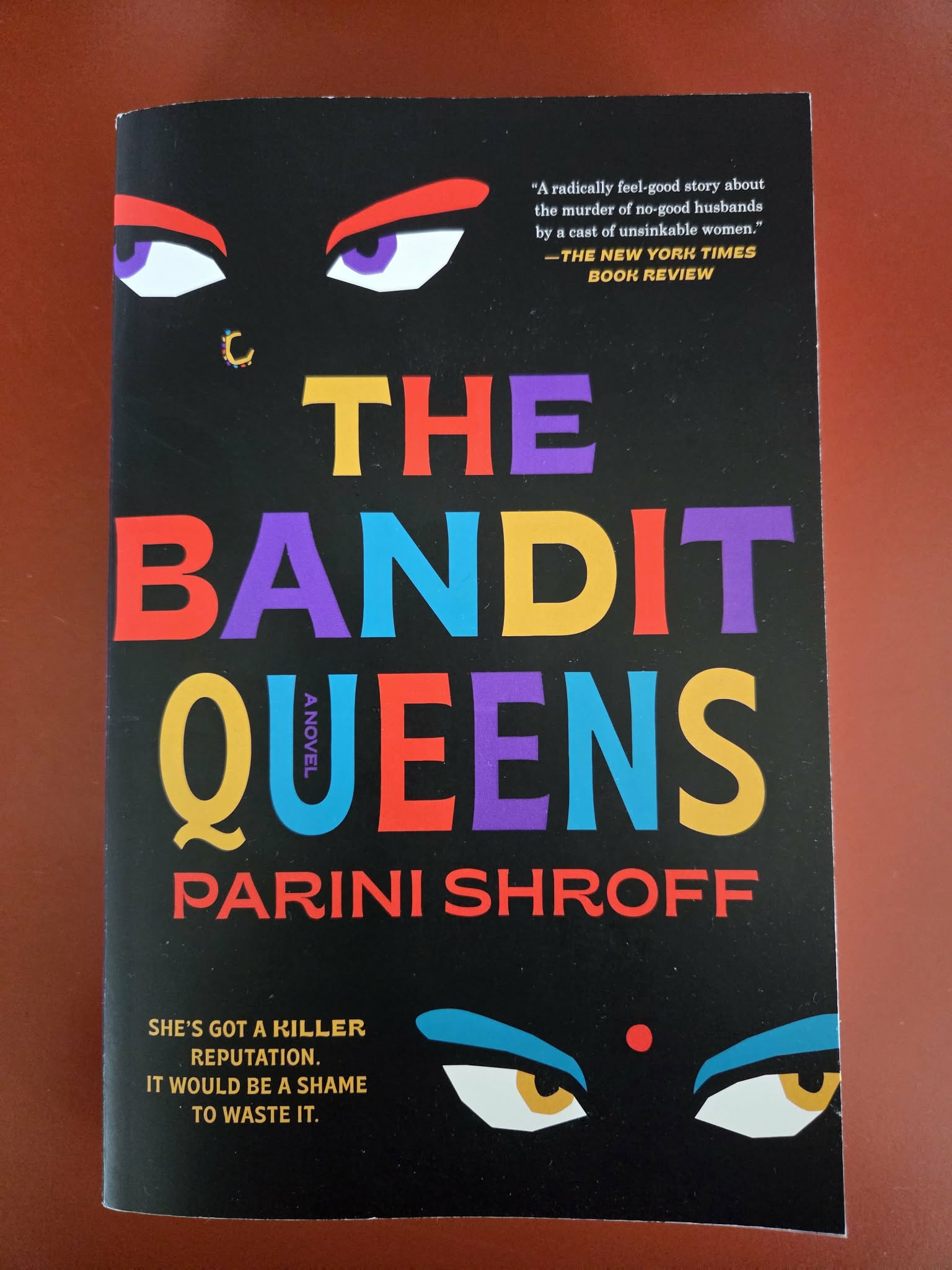
Bandit Queens, by Parini Shroff, is another debut with another bunch of pissed-off women, but the pace is snappy and the laughs and winces both come at you without letting up. The food is better than in the convent too. Newly single Geeta is innocent but the gossip around her rural village in India is that she’s a “self-made widow” (my new favourite phrase) and it occurs to other village women that she might be able to help them with the problem of sub-par husbands. Farah—who makes Abbess Sigeburg look like a Fairy Godmother, Solani—the fixer (sort of), and the irresistible sister-act of Priya and Preity eventually form an unstoppable dust-devil of bad ideas and even worse outcomes on a downhill ride to [no spoilers]. It’s one of those debuts that would be depressing for a fellow author, if we weren’t readers first. Which we are. Yippee!
Finally, I’m once again pitching Dinnerladies, a turn of the millennium British sitcom, long gone but never forgotten. I don’t know anyone who doesn’t love it. It’s so well-written that it takes until one of the final episodes before we realise there’s been a mystery running through it all along. So it belongs here at Trace Evidence on that score and it belongs in this list on account of the women and their . . . you guessed it . . . rage. Jean is angry because her husband left her for a vegetarian dental hygienist, Dolly is angry because of the Blair government (“Put two poems up in a bus shelter and call it a university.”), Brenda is angry because bad things happen to good people (“I’m actually hurting under my bra, I’m so cross.”), and Twinkle? Well, she’s just angry. In one episode she tries to get a job as a stripper. She doesn’t mind having to dance on a table, or having to shove her bits in people’s faces, but when she finds out she has to smile too, she’s raging. Their individual resentments start to chime when their jobs in the factory canteen are threatened by automation and they face unemployment in a struggling economy.
That was twenty-five years ago (hmm), but anger certainly feels like the emotion for this moment too. Kicking over some chairs and going to the bar is a mild response to the state of world right now. If we can find some equally angry people to laugh with along the way, so much the better. Onward! Cx

 Trace Evidence