
Category Archives: How’d That Happen

PULP FICTION: Embracing the Inner Smart-Aleck by Evan Lewis

Evan Lewis’s stories featuring the ghost of Davy Crockett and his descendant David Crockett are distinguished by the lively verbal jousting of the principals, though when the two can simmer down, they make a great pair of sleuths, as demonstrated in “Mr. Crockett and the Longrifle” in our May issue. Here, however, we’re delighted to offer Mr. Lewis’s reflections on a very different kind of mystery writing.

Pulp fiction came into my life when I was eleven years old, and I was never the same again. It happened at the neighborhood Rexall Drug store, and came in a series of paperbacks starring Doc Savage, The Man of Bronze.

The writing spoke to me. It was direct, conversational, and loaded with personality and humor. The author was not only having fun, he was being paid to be a smart-aleck. I wanted to be a professional smart-aleck too.
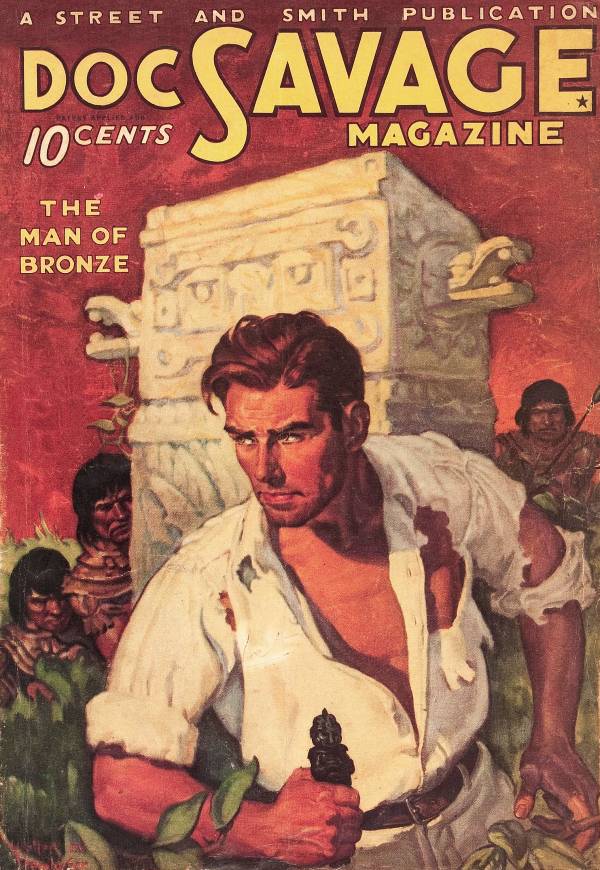
Doc SavageYears later I learned that Doc Savage was a pulp hero, that most of his adventures were written by Lester Dent, and that the style I so admired was considered hardboiled. My search for more such stuff led to Dashiell Hammett, Raymond Chandler and their less-famous contemporaries. At the time, very little of that stuff was in print, so I went to the source, hunting down the pulps themselves.

The more I read, the more I realized that my favorites were the guys having the most fun. They were the smartest of the smart-alecks, experimenting with the language and injecting plenty of personality and humor into their writing. I found their style infectious, and if my own stories are a little wacked-out, it’s mostly their fault.

The guiltiest parties follow.

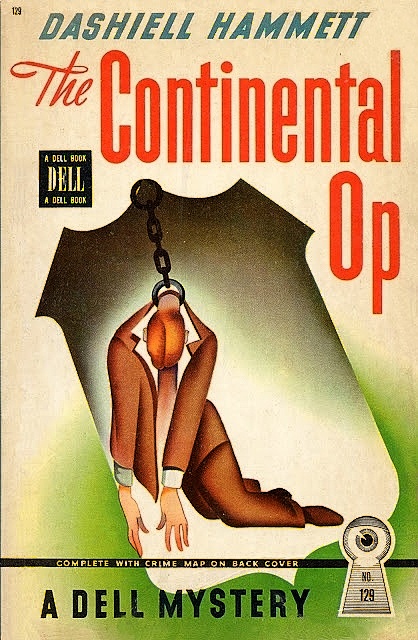
DASHIELL HAMMETT is revered by fans and critics for Dashiell HammettThe Maltese Falcon, and I think it’s a fine novel, but the stories that really grab me feature The Continental Op. The Op began as a nearly invisible narrator and evolved into a supreme smart-aleck, reaching his peak in the novel Red Harvest (originally published as four novelettes in Black Mask). Continue reading
1 Comment

Filed under How'd That Happen

How’d That Happen? Curmudgeons I Have Known, and the Rise of Skig Skorzeny by Jas. R. Petrin

Jas. R. Petrin introduced the tough, but aging Canadian loan shark Skig Skorzeny to the pages of Alfred Hitchcock’s Mystery Magazine in “Juice” the March 2006 issue. I’ve been in love with him every since. Skig appears again in the April 2014 issue in “A Knock on the Door.” Jas. R. Petrin’s AHMM stories have been shortlisted for the Arthur Ellis Award for Best short story presented by the Crime Writers of Canada.

Leo (Skig) Skorzeny. Where did this guy come from? It’s like asking where ideas come from, and the honest answer is—I don’t know. Besides, he seems like something more than an idea.

But the answer (if there is one) might prove interesting, so I’ll just root around in the clutter of my mind for clues. Start a file folder and toss in my findings.

Skig seemed to burst fully formed onto the page, but I believe he spent years stealing up on me. Decades, in fact, starting on the day I met old Nate. (Name changed to protect the curmudgeonly.) Nate was the chief—hell, the only—mechanic at the construction company where I worked as a kid. He was also a curmudgeon of the first order. One incident springs to mind. When I complained to him about the truck I was driving—a coughing beast ready for the crusher, so ancient the starter was a large button poking through the floor—he narrowed his eyes at me. I hurried to explain. Fumes from the rusted muffler, I told him, were filling the cab and making my head swim. “So open the window,” he barked. I pointed out that might be risky because the window glass, cracked in a dozen places, was held together with tape, (one of his previous repair jobs), and might disintegrate completely. With a wrench he knocked the wobbly glass out of the door. “Fixed,” he said. And he was right. No more fumes. But it was February, and thirty below, and as he must have known because he had “fixed” it as well, the heater barely worked. I froze for the next several weeks.

Good old Nate. Into the file folder.

Continue reading

8 Comments

Filed under How'd That Happen

How’d That Happen: Tara Laskowski

The author of the short story collection Modern Manners for Your Inner Demons, Tara Laskowski makes her AHMM debut in the April issue, where she explores the eerie undercurrents of our everyday lives in her story “The Monitor.”

When my husband and I first started using our baby monitor, there was something about the grainy picture and the way our son’s eyes glowed greenly in the infrared light that used to always give me the shivers. “What would you do,” I asked my husband one night, “if you suddenly saw someone in the room with Dash?” That conversation evolved quickly into ridiculousness (What if it was someone crawling in the window? What if it was an old lady or a big cat? What if it was a child? What if Dash started hovering?), but there was something deliciously scary and also weirdly plausible about the whole thing.

Having a new baby around the house turns everything upside down—you’re already on edge, deprived of sleep, emotionally up-and-down. Throw something like a creepy baby monitor into the mix and all bets are off.

Continue reading

2 Comments

Filed under How'd That Happen

Keeping Up with the Tudors: Kathy Lynn Emerson

The cover story of our December 2013 issue is a new Lady Appleton tale by Kathy Lynn Emerson, “A Wondrous Violent Motion.” Kathy Lynn Emerson has appeared frequently in our pages with stories from her Facedown series, featuring 16th century herbalist Lady Appleton and from her Diana Spaulding series, set in the 19th century, built around a young female reporter in a Maine logging town. Ms. Emerson has drawn on her skills as a historical novelist to write How to Write Killer Historical Mysteries (Perseverance Press), and in her guest post below she writes about how she taps old letters for ideas and period color. As Kaitlyn Dunnett, she also writes a series set in present-day Maine. We’re particularly looking forward to next year’s Malice Domestic Conference in Bethesda, Maryland, where Kathy Lynn Emerson will be the Guest of Honor.

I admit it—I’m fascinated by gossip. It’s just that, in my case, the rumors and innuendos are over four hundred years old. Keep up with the Kardashians? No interest. But find some juicy tidbit about the Tudor kings and queens or their subjects? That makes my day . . . and might just become the germ of a story.

There were no supermarket tabloids in sixteenth-century England. No paparazzi lurking or chasing after the celebrity’s car (no car, either!). Not even the equivalent of People or USA Today. And, of course, with no modern media, there was no Entertainment Tonight or Twitter feed or other social media to track. However, there were still plenty of people reporting the latest news from the royal court and writing about the doings of lesser mortals, too.

Continue reading

Leave a comment

Filed under How'd That Happen

Maybe this is what happened: Dan Warthman

Dan Warthman received the Robert L. Fish award for Best First Short Story for “A Dreadful Day” (AHMM, January/February 2009). He introduced Jones and Akin, the characters in this month’s cover story, in “Pansy Place” in our January/February 2011 issue. I was immediately struck by the rapport between these two men and the way they work in unspoken coordination with surprising results.

1) My friend Bill visited me several times when I lived in Beijing. More than once, we went on Saturday evening to the Sanwei Bookstore and Teahouse to listen to live performances of traditional Chinese music. A woman was playing the guzheng, the music was mesmerizing, the place was hushed. And then a mobile phone rang. And the guy, who happened to be another expat, answered it. And talked. And then made another call himself. During the break, Bill said, I’m going to talk to that guy . . .

Continue reading

2 Comments

Filed under How'd That Happen

NAMING THE DETECTIVES: Robert Lopresti

AHMM regular Robert Lopresti is the winner of the 2012 Black Orchid Novella Award, or BONA, for “The Red Envelope,” which appears in our July/August issue. We co-sponsor the BONA contest with The Wolfe Pack, the Nero Wolfe appreciation society, to encourage the ratiocinative detective style exemplified by Wolfe. Here, Rob discusses the important matter of finding the right name for your character.

If you’re a writer creating a character, you need a name. (Oh, there are exceptions: Dashiell Hammett’s Continental Op and Bill Pronzini’s Nameless, for instance, but if you fill an entire book with Anonymous and Mr. X it might get tiresome pretty fast.)

I’m usually pretty casual about names, but when I started writing “The Red Envelope,” my entry for the Black Orchid Novella Award contest, I was hoping that this might be the beginning of a series. That meant that if I were lucky, I might have to live with those characters for a long time.

So I gave a lot of thought to matching the characters to their names. Consider my detective. The story is set in Greenwich Village in 1958 and the hero is a beat poet, a bit of an oddball, and definitely a man who likes to be the center of attention. Surely his name would be unusual. Something that stood out in some way. Hmm . . .

Continue reading

5 Comments

Filed under How'd That Happen

All My Children: John Corrigan

In this post. John R. Corrigan meditates on the personal life experiences that can shape an author’s fiction. His story “Autumn’s Crossing” appears in the July/August issue of AHMM.

I hope you enjoy “Autumn’s Crossing.” Ironically, U.S. Customs and Border Protection Agent and single mom Peyton Cote owes her foray into the short-fiction genre to none other than Alfred Hitchcock Mystery Magazine Editor Linda Landrigan.

I met Linda at Bouchercon in 2003. Her husband, John, was my book editor back then, and I was working on the second of what would be five Jack Austin PGA Tour novels. “Why don’t you write a short story?” Linda asked me at the awards dinner. I was sitting next to S. J. Rozan, whose novels and stories I adore, and I thought about S. J.’s ability to cast her series character in both short-story and book-length genres. So I considered it that evening. But after the conference I fell back into my daily routine of working on my novels in the early morning, teaching, coaching, parenting, sleeping deeply, and getting up and doing it all over again the next day. And so I forgot all about the short-story genre until a decade later, when I sent Linda a story. No longer was I working with her husband, so I sent a brief cover letter that was something along the lines of “I don’t know if you remember me, but you asked for a story. I’m ten years late, but here it is.” She bought that story and another and subsequently “Autumn’s Crossing,” which appears in this issue.

Peyton Cote is a vast departure from Jack Austin, so I was thrilled when Linda wanted the story because the sale validated a risk I’m taking. You see, the short story bears the namesake (or, rather, title-sake) of a novel that my agent and I hope will launch a new series.

All told, I’ve written three series characters, an amateur sleuth, a P.I., and a law-enforcement official, although not of the traditional ilk. Each character is unique from the others, and each has been created for a different reason. Continue reading

Leave a comment

Filed under How'd That Happen

Tom Savage: Venice, Via the V. I.

What is the role of place in a story? Tom Savage’s “Jumbie Tea” offers a strong sense of place, but as he explains in this post, that’s only one ingredient in the creative stew. “Jumbie Tea” appears in our June issue, on newsstands now.

You can also hear Tom read his Barry-nominated “The Method in Her Madness,”  from our June 2005 issue, as part of our podcast series. You can also find the stories on iTunes.

Writers are human sponges; there’s no denying it. From childhood’s earliest hour, we soak up every detail of the world around us and store it somewhere close to our brains. Then, at any given moment, the sponge will squeeze information and images into our conscious minds. The result is a story, and we don’t always know which part of our past experience inspired it. This explains our blank expressions when people ask us that timeworn question, “Where do you get your ideas?”

But sometimes we know. In the case of “Jumbie Tea,” my new story in AHMM, I remember exactly what happened. Three things:

  1. Rereading a favorite story by a favorite author
  2. Memories of my childhood in the Virgin Islands
  3. An invitation from one of my mystery writing organizations (I belong to several) to submit a story for a proposed anthology called MURDER AROUND THE WORLD

Actually, it was #3 above that activated #1 and #2. The assignment was to write a short mystery set in a specific part of the world, using elements of that place in the plot. When the request arrived, I was rereading one of my favorites, “Don’t Look Now,” the creepy 1971 novella by Daphne du Maurier. A British couple, grieving the recent death of their child, take a business trip to Venice, where all sorts of weird, supernatural things begin to happen. It’s a chilling tale with a famous shock ending, but what most impresses the reader is the description of the setting–the sights, sounds, smells, and moods of that ancient city. I’ve been in Venice, and I’ve experienced its strange allure firsthand. Reading her story, you get the distinct impression that these bizarre events could only occur there. This aspect of her work spilled onto the invitation on my desk, and they were both lapped up by the sponge in my head. Continue reading

1 Comment

Filed under How'd That Happen

HIGH FINANCE: John M. Floyd

John M. Floyd is a master of the tight, twisty tale that many people associate with Alfred Hitchcock. In this latest edition of How’d That Happen, John explains how his background and his imagination dovetailed in his  story “The Long Branch,” appearing in our January/February 2013 issue. John’s stories have been collected in Rainbow’s End and Other Stories and Midnight, both published by Dogwood Press.

Back when I was working for a living, I spent a lot of my time in banks.  Matter of fact, I spent almost all of my time in banks.  For most of my thirty years with IBM, I was what was called an “industry specialist,” and my industry was finance.  Specifically, financial software applications, which meant I worked with our clients to develop and install programs for their ATMs, check processing equipment, teller stations, etc.  (Our clients used to be called customers; they morphed into clients at about the same time I morphed from systems engineer into industry specialist—but that’s another story.)

Continue reading

10 Comments

Filed under How'd That Happen

How’d That Happen: Terrie Farley Moran

With our December issue we have the pleasure of introducing our readers to Terrie Farley Moran, who wrote “Jake Says Hello.” In this segment of How’d That Happen, Terrie describes her fascination with the 1940s, the period in which her story takes place.

Long before Tom Brokaw named them The Greatest Generation, even before Studs Terkel wrote his stunning oral histories: Hard Times: An Oral History of the Depression and The Good War: An Oral History of World War 11, the generation just before mine, those born in the 1920s, knew they lived in extraordinary times. And, at least in my family, they were a generation of story tellers.

We grew up surrounded by tales of death, child labor, untended illness, prohibition, bootleg liquor, politicians, gangsters, cops, robbers, home evictions, hunger, religion and orphanages. When conversation turned to the war years, the men were strangely silent but the women talked about “the war effort.” After more than a decade of lean years, the war had brought jobs and money, but there was little in the way of things to buy.

Continue reading

10 Comments

Filed under How'd That Happen